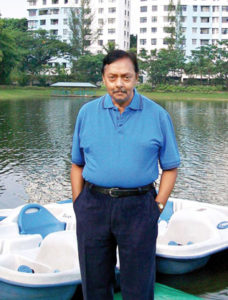
The ferocious Roman king Julius Caesar once said, “Experience is the teacher of all things”. And from the Roman times till date, these words have held their own and can never be obsolete. An experienced business leader like Mr. Siddhartha Bhattacharjee has sailed through his career strongly with stints in a wide range of corporations like Xerox India, The Arvind Mills-Telecom Department, Dale Carnegie Training Institute, Skill Soft, Achieve India, Alps, and, currently with PDI Ninth House. An inspirational leader in the true sense of the word, Mr. Bhattacharjee has been widely acclaimed for his work in all these organisations in which he made a difference. With almost three decades of work, his precision in getting results still separates him from the average. He has had the distinction of working and excelling in multi-dimensional roles including in areas such as TQM, Business Excellence and Business Strategy. Mr. Bhattacharjee is really a living example of how sheer perseverance and hard-work can push somebody to scale the highest peaks of the corporate sector. His peers and people who have had the good fortune of interacting with him regard him as an iconic leader and excellent mentor.
An alumnus from the 1982 Batch of IIPM New Delhi, Mr. Bhattacharjee reminisces his journey to the top of the corporate sector in a one-to-one conversation with CULT…
Q. Give us a brief about your illustrious career that has lasted almost three decades.
A. I started of as a management trainee with Intercraft ( FU’s Jeans) but left the company in 2 months, and then joined HCL in their Reprographics division to sell Microfilm Equipment . Thus my sales career began with Solution Selling. In 1985 Modi’s and Xerox entered into a 50:50 JV, the first of it’s kind by Xerox outside of USA. I joined them as a Territory Manager with a stated aspiration of becoming a line manager on meeting of performance standards and expectation. The company met that requirement after I cleared the performance requirement and Assessment center. Starting up operation for Eastern UP came with the role. The next 6 years I scaled up to a Profit Center Management role managing operations of Rajasthan. This marked the introduction of marketing channel’s and therefore an exciting phase of setting up channel operations, and new product launches commensurate for channels began for me. I branched out into TQM and Business Process Re-Engineering for next 3 years working in projects that had a serious business consequence. By the mid nineties Telecom became a sunrise industry and opportunity came through with Lalbhai Group ( Arvind Mills) to head their Telecom equipment division. This role involved executing wireless infrastructure equipment projects to the licensed service providers for city wide trunked radio operators ( for voice and data application). Subsequently, as a part of my role expansion I managed the PBX division manufacturing EPABX and PBX equipment under the brand name Syntel. From 2005 onwards I chose people development over technology and hence branched into Training and Leadership Development. I have served as President of Dale Carnegie, India, then Regional Business Manager – Asia for Skillsoft and CEO South Asia for Achieve Global. Preesently I work as Director Client Solutions for PDI Ninth House . These roles have provided me with insights into learning and development, performance support and leadership development.
 Q. Your first stint in IT was back in 1982. Looking at 2011-12, how do you describe the evolution of IT and its inference in business on a global scale?
A. More than IT, at that time , people were concerned about reducing cycle time of information flow, to top management. The organisations were conventional and multi-layered, with no major business pressure in managing demand and supply imbalance. Many early initiators adopted technology and automation for image enhancement. The garment exporters fell into this category. Only towards late 80’s ,with global companies re-entering India, was there a realisation of productivity improvement. From early 90’s with the advent of Liberalisation, came the need to become competitive and hence managing productivity, reducing errors and improving quality became key. In the late 90’s the services sector opened up and with it came a spurt in transaction volumes and hence IT became critical – this was coupled with improvement in GUI , enabling wider deployment. From early 2000, IT entered homes and convergence of technology between telecom and IT made the backbone seamless. This opened boundaries and removed barriers and hence businesses became global, forcing governments worldwide to open frontiers. I am glad, that I have been able to witness this great disruption from it’s nascent stage in India.
“CONSULTING BUSINESS IS ABOUT COLLABORATION AND CO-CRATION, GENERATING MUTUAL VALUE” sid
Q. Tell us more about PDI Ninth House and shed some light on your role at PDI Ninth House.
A. PDI Ninth House is a premier global leadership solutions company headquartered in Minnesota, USA. For over 43 years the company has been working on making outcome based leadership development. This is based on scientific research and actual working experience covering over a 1.5 million leaders across the globe. Clients usually engage PDI to overcome challenges traceable to LEADERSHIP.
Q. What are the challenges that come with experience when you take roles of CEOs or Directors?
A. While there could be many challenges – some of the key ones are around people. One requires high level of people intelligence to steer around and getting things done. Understanding people, understanding of capability and execution of plans are usually very significant.
Q. What are the ways to overcome them and how have you personally eliminated those obstacles?
A. While there are no miracle formulas – it is important to build trust among stakeholders, employees, clients. Communication with more of listening is the key. Since all business is to do with customers, it is important to deliver products and services that deliver value (easily identifiable by the customer)
Q. According to you, what are the dynamics of the business of management consulting? What do you suggest to leverage the reach of consultancies and also client retention?
A. Consulting is about collaboration and co-creation. Business consulting must therefore generate mutual value. All deep mining engagements with client consulting is about credibility at work – can get built based on flexibility to co-create and walk the journey as a partner.
Q. What steps can HR take according to you to lower the attrition rates? Where does the parity between talent acquisition and talent retention lie?
A. In a developing economy, which is fast growing and has limited supply of skilled talent requirement, – attrition can and will take place. No single element can help mitigate voluntary attrition. Some of the key steps of retention may include fast track career – multiple exciting role opportunities, and career development. Options may offer stickiness , subject to industry standard pay and compensation and benefits.
Q. What are the quintessential characters that a business leader must possess? What is your style of leading people?
A. Qualities of effective leaders must include sincere concern for welfare of all. Helping people to succeed by aligning personal goals to organisational goals. Lot has been written about MBWA ( Managing by wandering around). I seriously believe that. My personal style revolves around coaching and mentoring a lot.
Q. Getting back to the early 80s, how do you cherish your days at IIPM? Any incidences or moments that you would like to share with us ?
A. There are many, however , to recollect one – In a cold November night , a dozen of us walked up to the Dhaba on the Jaipur highway. Someone proposed “lets hitch a ride” and we actually did stop a truck loaded with sugar cane jaggery. Next morning we found ourselves in Jaipur jumping from the truck as aliens. The ride back to campus was equally adventurous, with a truck driver paying for our dinner. If part of our course was to educate us as future managers, this incident did teach us humor in adversity. My favourite Professor ( too many – we had great faculty) – NR Chatterjee made HR sessions extremely exciting.
Q. For the new generation, what will be your advice to them in order to reach the top of the corporate ladder, and stay there?
A. Be prepared to develop social intelligence – information, technology and processes will become extremely accessible, so the only distinction you can bring as a leader is to make sure you can connect and motivate people. Learn to take risks and ACT. No harm if you fail a couple of times as you will end up learning something new. Overcome the fear of failure.
Cult would like to convey the best of regards to such a person who we feel is a role model of perseverance.