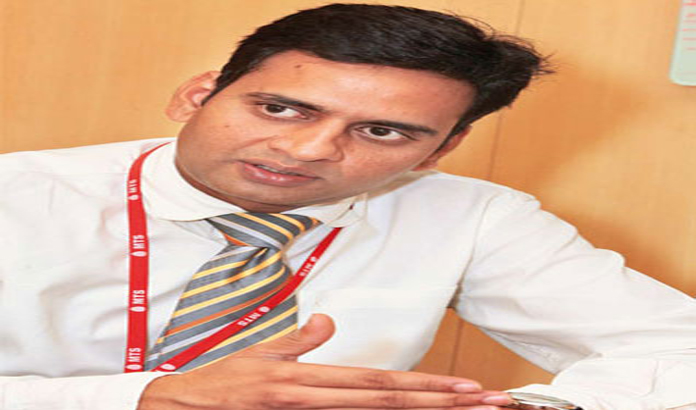
Mr. Sharique Sheerazi has had over a decade of experience in handling, planning, and executing many CRM Green Field projects for massive brands like Airtel, Hewlett Packard, Etisalat and MTS India. He is someone who is very courteous in his approach and has an eye for detail. His concepts in CRM are aptly structured from the core. His colleagues rate him as a highly proactive and process centric professional who is always willing to go out of his way to help others. He truly is a living proof of the words of the French legend Victor Marie Hugo – “Inspiration and Genius – one and the same”.
Mr. Sheerazi completed his BBA course in 1998 from Mysore University and then decided to pursue his Masters from IIPM. He commenced his career in the year 2000 with a CRM foundation. He adds that back then, people presumed that CRM is nothing but a Call Center, and after some contemplation about it, he opted to go with it. “For one year I was involved in a lot of research work around CRM and worked with prestigious clients like Reliance, ICICI, Hindustan Petroleum, Tata Tele, Airtel, BPCL, and others”, he says. During that time, he feels that there was a lot of confusion that prevailed about loyalty marketing, loyalty programmes, call centers, and services. Mr. Sheerazi was actively involved in communication exercises, seminars, collaborated with CRM experts, created content, and also conducted workshops on CRM with IIM Lucknow, iCRM Atlanta and MDI Gurgaon. After a two year stint he decided to make a move and got an offer from Bharti Airtel.
He reminds us that in that era, CSD was known as Call Centers, and his job at Bharti was to set up their CRM function. After that he got involved with business transition, and went on to be part of many different projects. This resulted in the transformation for Airtel with a unified CRM for all lines of business operation. Back then Bharti Airtel had businesses of fixed line, enterprise, and mobile services. Mr. Sheerazi adds, “I was looking after the fixed line and enterprise services”. Post this he became part of HP wherein he had the experience of showcasing his expertise on business transformation, change management, ground level planning, and working with top management. “I was their country manager for the CRM”, he adds. Mr. Sheerazi’s role over there was to transform the current CRM of HP to a global CRM. On the operational front his team worked closely with the Marketing teams revolving around many aspects like how to capture responses, direct mailing campaigns, pitching campaigns, RoIs, evolution and growth of the company.
Mr. Sheerazi explains that at that point of time, the telecom industry was undergoing many changes and he became part of Etisalat in Mumbai to set up their CRM and CSD function. “Though we did not launch on a mass scale, there were other areas like team formation, technology, and the call center set up ready for full scale launch”, he adds. After a spell of two years at Etisalat, he joined MTS India. His core job at MTS India is once again the migration of their homegrown CRM to FORIS CRM that includes risk management and activities surrounding the transformation with constant interactions with both ground level as well as the top management.
 According to Mr. Sheerazi, there is a misconception about CRM that has been there since 12 years. He feels that people think that a customer calls and you attend it, and through the ticketing system a complaint is logged, service is provided to close this ticket, and that CRM does. “This notion is totally wrong. It is not CRM because only 3-5 per cent (that’s the percentage of people who actually complain) of customers are covered through this and the perception about a company is based on this 3-5 per cent only”, he explains. But in the actual business context, Mr. Sheerazi thinks that CRM is all about being able to know your customers and providing them with a preference center. In all businesses, customer is the most important thing and you do not have to wait for customers to complaint but you need to involve them. Mr. Sheerazi provides the example of products like Ambassador (Hindustan Motors), Fiat Premier Padmini, Maruti 800 etc. on how they survived in the Indian market. “These cars were purchased on the basis of the nearest service station available as they were designed to fail”, he clarifies. He thinks that earlier products were not reliable but today the product failure is out of question.
Mr. Sheerazi draws an analogy between PLC (Product Life Cycle) and CLC (Customer Life Cycle). CLC management begins when the customer enters and starts using a product. He thinks that one can apply the theory of hierarchy by Maslow which means that products will always go down and customer needs will go up. He says, “A college boy wants a bike, then while you are working, you want a car”. The idea is that the company should pitch different products to the customer depending upon CLC. “That is the best way forward to grow along with the customer”, sums up Mr. Sheerazi. Speaking on the variance between B2B and B2C, Mr. Sheerazi opines that in B2B there is retail, SME, medium, and then large organizations – one should plot the growth rate of customer and try up-selling by tracking the growth of the customer and being there with him when he wants to grow and thereby move the customer in the upper strata product/service in line with his growth needs. “This is basically the B2B model”, adds Mr. Sheerazi. On the B2C model he further explains through an example which states that once you sell a Tato Nano to a customer within that capacity, you should continuously engage the customer for the next 3-5 years as it is obvious that in that period the purchasing power would increase. “You can then pitch him with an Indica, then a Manza, and then a Safari or Aria – so he or she will always have a Tata car through out”, he adds. Similarly in the telecom industry, segmentation is according to the consumption levels like bill, age factor, income, location and demographics. But that is probably a little old school model as customers today can be very dynamic. Mr. Sheerazi then speaks about a Hybrid Model with Gold, Platinum, and Diamond customers which few operators have started to deploy. “This evolution in segmentation is very crucial as data has evolved over voice in the telecom industry which is why most ads now try and show what one can do with data rather than only voice”, feels Mr. Sheerazi. Marketing communication has to be focused and segmented and then can be directly targeted reducing the marketing cost per customer and higher ROI for the campaign.
Mr. Sheerazi then emphasizes the need to study the customer in depth by knowing who the customer is, what does he do, where does he spend, what are his peer groups or peer pressure. “In certain industries, you are now able to know the preferences of the customer like mobiles, credit cards etc. and so depending upon their usage of the same, you can offer them products”, affirms Mr. Sheerazi.
He also warns that CRM surely demands proper planning and analysis without which one cannot know the customer potential thereby they are unable to harvest the money spent. For CRM to be a success, one has to take the aspiration value of the customer and be ahead by touching the customer ego and aspiration. “Companies need to build data and do the required follow ups regularly”, he says. This he thinks is the essence of CRM.
For CRM to be beneficial in driving business excellence, the data and the relevant strategy must be set out right from the word go. “If you do not know whom to target, you will fail in CRM”, adds Mr. Sheerazi feeling that this is the element of risk taking that revolves around CRM. The next hindrance is the communication barrier which creates an uncertainty regarding responses.
“Like in telecom, when you send 100 SMS, only 3-4 per cent reply, and due to spamming, that comes down to 1 per cent”, he remarks. Thus the general feeling in the customers is that the company is only selling their product and not thinking about them. Mr. Sheerazi adds with substance, “The innovation in terms of communication can only change that notion”.
For streamlining CRM, dealing with customers needs to be in the right dimension. Switching of brands Mr. Sheerazi feels is based on how much ownership an employee takes of the company. “Empowerment of employees is easy to say but tough to deliver. Technology has to be right and the front end needs to be enabled with all required information, so that they take the correct decisions”, he opines. BPO teams are the most difficult to manage due to the negative responses which sometimes effects the emotional quotient at work. “People with short temper should not be part of your front end teams”, he says firmly. Often customers shout at the callers and thus breaks are also an important part of BPO teams. He adds, “They learn as they mature but they should be given their own space”. In this outsourcing era the partners will always put pressure on the frontline to take more calls and thereby more productivity and more savings for the outsourcer. Organizations’ who out source need to relook at the parameters of engagement, which now needs to be more qualitative than quantitative. One dissatisfied caller will give another three calls, but one slightly longer call will eliminate the balance three calls.
He believes in delegating responsibility to his team members which helps them know where they are and where they want to be. “I let them decide the path and I only intervene when a problem is about to occur”, he adds. For the youngsters, he iterates the importance of learning over mugging up. “One should always question the reason which in turn helps to learn and develop strategy”, confirms Mr. Sheerazi. In addition to that, analyzing things is vital along with finding answers to reasons which makes remembering things easier. Reflecting on the IIPM days of his, Mr. Sheerazi feels that the advantage at IIPM is the world class exposure. The learning was not limited to bookish concepts but clarifies that an institute is only an engine to learn, “You have to be smart and ask the right questions. Do not recite but be analytical always, always ask the questions why and how”.
On a personal note, Mr. Sheerazi is a complete technology freak as he is a qualified IT professional. “I also love to read, play adventure sports, and try new restaurants”, he adds. His wife, Ms. Shadma Sheerazi, used to be a part of Airtel Corporate Relations, but is now a homemaker. Mr. Sheerazi also loves to answer the cute questions of his son Raiyaan, and enjoys spending time with him.
This was an intruguing session on the domain of CRM, and through a spirited feel, Cult conveys the most sincere regards to him and hopes that like Maslow’s hierarchy, his career will keep growing.