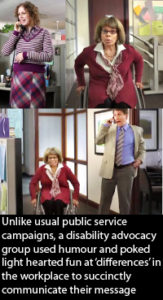
 In February 2010, even as President Barack Obama was pledging to the American people that he could and would tackle double-digit unemployment levels and bring some respite to the recession-hit economy, a little known disability advocacy group was hatching a little plan of its own to convince employers to hire people with disability and bring more diversity to their respective workplaces. Unlike Obama, their mood was hardly sombre.
The advocacy group ‘Think beyond the label’ discarded the traditional solemn approach to a public service announcements. Their prominent TV spots – for the first time – dared to present the message in a light-hearted manner. It challenged conventional wisdom by poking fun at ‘differently abled’ workers already employed by companies. The TV spot had a wheelchair-bound employee of the company (the HR manager, no less) pointing out which of her colleagues could be termed as disabled. There is an awfully dressed female worker who is termed as ‘fashion deficient’; a screaming man termed as ‘volume control deficient’; a clumsy, confused guy by the copier who is ‘copy disabled’ and so on. The punch line: “Labels get in the way, but disabilities rarely do!”
The prominent $4 million TV, print and online campaign, financed largely by agencies in 30 states of the United States that provide employment services to their disabled citizens, used humour to drive home their point. The light-hearted commercial aired on national TV in the United States when the chips were really down for the economy and people were either too depressed at losing their jobs, homes and life savings or else too angry with the greed, recklessness and illegal behaviour on Wall Street that caused the recession.
But the disability ad which made them smile through their misery and anger worked. Ad effectiveness data revealed that as many as nine out of ten employers polled found the ad humorous. More heartening was the fact that eight out of ten said that the communication would spur them to positive action.
As markets across the globe face tough economic realities – with consumers remaining either depressed or angry due to high inflation, rising employment and corruption – humour seems to have acquired a new halo for advertisers to revive consumer sentiment. India is no exception. All through 2012 – as the nation grappled with economic slowdown, price rise and one-too-many scams coming to the fore – marketers were seen taking a trip down the humour road in a bid to bring in much-needed comic relief and appeal to their target segments.
The humour overdrive has not been without scientific data to back up the trend. According to an in-depth research conducted by Nielsen to study advertising effectiveness of more than 4,000 ads during 2006 and 2011 (before, during and after the global economic meltdown), it was found that humorous ads have ‘consistently resonated’ with viewers irrespective of the state of the economy (See chart on pg. 37). Funny ads were 47% more appealing to consumers in the pre-recession stage than sentimental ads or ads harping on pricing and promotions. Funny ads continued their supremacy even during the recession with 33% more appeal than other ad categories.
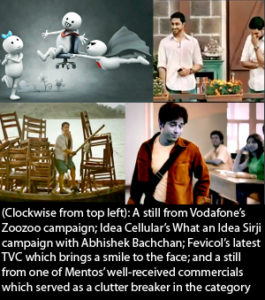 learly, advertisers in India have followed the same lead in devising communications during the economic slowdown. From media to telecom, consumer goods to financial services, a smile has been the advertisers’ best friend in these worst times. Particular mention needs to be made of the insurance sector in India, which went gung-ho on levity this year to reach and resonate with an ever more diverse and demanding audience.
If Edelweiss Tokio Life Insurance hilariously made use of the ubiquitous IT admin guy in offices treating employees with disdain on their computer illiteracy (Kyonki insurance se badh kar hai aap ki zaroorat); IDBI Federal Life Insurance poked fun at the missed ambitions of various people with ‘Plan Jo Fail Na ho’; and Iffco Tokio General Insurance said ‘Ek Bima Hona Chhahiye’ with light hearted banter. Even the continuing Max Life Insurance ads that showcase a greedy ghost in various avtars hovering over the sales guy (Aapke sacche advisor?) created quite an impact. Notably, while insurance ads got rid of their ‘depressing’ overtone a few years ago, 2012 was when more and more insurance marketers took the rib-tickling route to consumer consiousness.
In telecom, the lead – at least in ads that trigger a fond smile – seems to have been consistently taken by Idea Cellular after the creatively comical Zoo Zoo series unleashed by Vodafone a few years ago. Film star Abhishek Bachchan occupied mindspace in the What an Idea Sirjee campaign. Particularly compelling was a group of warring and rioting folks who decided to drop using their caste names and replace them with their Idea phone numbers or even the one when Bachchan junior wows ‘heavenly deities’ with his ‘ideas’. Even Idea’s latest campaign with the very hummable jingle ‘Honey Bunny’ is hitting bulls eye.
Humour can be effective even it is overdone. At least it helps brand recall! Take the one about a father, his wife and then daughter being literally electrocuted (with faces turning blue and hair standing on at its end) till the disdainful son switches off the power mains. Quite over the top. But the brand Havell’s seems to have generated great brand recall, just as some of the over-the-top ads for men’s underwear using film stars.
Someone once said that a picture is worth a thousand words. But in the world of advertising and brand building, a smile can be worth a million words! Enjoy our analysis of 12 of the top 20 humorous ads India saw in 2012.