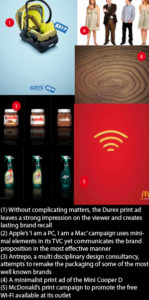
 Minimalism! The ideology literally means stripping down any entity – a product, a logo, an art form, an architecture, a positioning message, the ideology itself – to its bare essentials. The philosophy behind the concept is that in a lettered and literate society, you really need not take the effort to pass on the whole message to the intended audience; all you need to do is goad the individuals with a hint and they’d do the rest – that is, undertake further research and follow the action hoped for.
The minimalist movement more or less started in America somewhere in the middle of the previous century – while a majority of advertising during those years was full of deliberate clutter, garish colours, over-the-top messages, the so-called advertising revolution during those mid-century years promoted the moving thought of white/blank space. While gentry advertising was expected to be in-the-face, creative advertising was supposed to be minimalistic; less of the message, more of white space. There were classic success stories in both quarters over the decades. While Ogilvy stuck to the write-more-sell-more tenet, George Lois’ blank backgrounds and Volkswagen’s amazing success with plain layouts started turning the tables for minimalism. The movement gained ground when Paul Rand convinced International Business Machines that they should reduce their corporate logo to the block initials IBM – as he was confident that a minimalistic acronym could consolidate the complete positioning message of the institution – and with that, minimalism formally entered Madison Avenue.
But somewhere ahead in this century, the global consumption boom over the last few decades, which fuelled a rapid rise in consumerism, brought back maximalism. The advertising discipline had its golden run during these times with a surplus set of consumers where the more ads one’d show, the more products one’d sell. Convincing consumers to shell out more money for products and services that weren’t ‘necessary’ became an essential qualifier for any marketing manager – Naomi Klein be damned. The proliferation of ads and content within them just would not stop. Creative heads, at the behest of clients, started bombarding consumers with heavy duty advertising left, right & centre. Almost anything tangible was converted into an advertising medium. According to statistics from one research, an average viewer in US watched (and watches) 153 hours of TV a month, out of which 55 hours was direct advertising. And this is just TV. If one factors in other mediums, we might land up at around 20-22 hours of advertising exposure per week.
However, the economic slowdown rocked the marketing boat – and the advertising oar – worse than one expected. While consumers low on surplus and high on EMIs were already fed up of advertising, the resulting global economic meltdown led them to develop a further defence mechanism (what Gary Vaynerchuk – author of The Thank You Economy – calls the bullshit/BS radar). Consumers started blocking or dismissing any communication that mentioned more information than they were expecting, that put more efforts in attempts to convince them, that enticed them to borrow more in order to spend beyond their means; in essence, consumers started hating aggressive marketers and distrusting any message that assumed that they wouldn’t do their own research. “Tell us which cars there are and we’ll check out the guzzlers ourselves,” became the ground rule. The Western advertising world became a large Supermall that stopped convincing consumers to buy particular brands; and rather allowed them to walk freely through the pathways lined up with various brands; and left it to the free choice of the consumer to enter a shop to know more, or simply walk on.
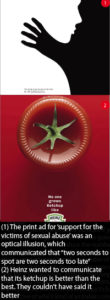 Walmart with its large spaces and free choice became the world’s largest corporation in sales. Google with its white space, zero homepage ads and free choice became the world’s leading search engine.
Apple even started applying minimalistic principles across divisions. Right from the beginning, its products were compact and clean. The first iPod came with just one user interface. Even the first iPad came sans the camera and USB port, but sold like hot cakes. None of their products have ever been shipped with a user manual – they’re expectably intuitive to use and simple to operate. Operationally, Apple has just four product lines and at any given point; there is only one variant of each line in the market. Even the advertisements are low on clutter; yet they are entertaining. Most of the times, the background is pearly white with adjectives like ‘extraordinary’, ‘brilliant’, ‘iconic’, et al. “If you don’t have an iPhone, you don’t have an iPhone.” Make what you may of it! Dr.Peter Golder, Faculty of Marketing at the Tuck School of Business, explains to 4Ps B&M, “On the inside, the iPhone may be extremely complicated, but in terms of solving people’s problem, it’s minimalist. It consolidates so much into one single device.” With 60,400 employees, Apple has accumulated an m-cap of $534 billion compared to Microsoft’s $242.72 billion (90,000 employees) and HP’s $42.37 billion (349,600 employees) and their respective maximalist product lines and complicated features.
And so, without even having tried, the minimalist camp was back in business in the Western world; and the most significant user of this concept became social media. Essentially minimalistic in nature, social media strips down all possible forms of complicated and time consuming channels between a brand and its patrons to the bare minimum; so much so that people can just express themselves whenever they want. Research undertaken by Theodoros Bozios, Georgios Lekakos, Victoria Skoularidou and Kostas Chorianopoulos of the Athens University of Economics and Business titled Advanced Techniques for Personalized Advertising in a Digital TV Environment: The iMEDIA System, finds that, “In order to implement interactive and personalized advertising, the Information System comprising the backbone of a platform, should be supported in terms of functionality from a ‘minimalist’ interface provided to viewers.” Social media gives brands an excuse to stop shouting at their customers and straightaway start inviting them in for tea! All they have to do is build a space for their audience to converse in and open their doors and listen.
But can minimalism work in India?
Minimalism has found its way into Indian advertising to a certain extent. The commercials are not as lengthy as they were a few decades back. Print ads are not as heavy on text as they used to be. We have toned down. As Indian media reaches the clutter levels of the West, advertisers in India apparently are turning the corner to keep it simple and straight rather than bombard consumers with complicated messages. Arvind Sharma, Chairman & CEO, Leo Burnett-India subcontinent puts it thus, “Good advice in marketing and advertising for decades has been ‘less is more’… Be it a smartphone or a car, if your communication is confusing, the consumer will shy away from it.” And marketers are even paying attention to social media, albeit less than desired. The IBM CMO Study 2011 found Indian CMOs listing social media right up there among the top five challenges they have to understand and manage going forward.
 But then again, that doesn’t answer the question whether minimalism would work in India in general. There are two philosophies, not necessarily contrasting, that have to be considered while addressing this issue of minimalism in India.
The first philosophy propagates that when it comes to the consuming classes in India, they are looking for more as they move up the income as well as consumer experience ladder (and to crown it all, are spoilt for choice). Therefore, minimalism can’t be the way to go. Bombard them with material and they’ll be ready for more. Maruti Suzuki is an apt example, as it moved from the simple, no frills Maruti 800 to the huge variety of models and variants available today. The fact that Maruti tries to put in features of its C class cars (like automatic gear systems, in-build stereos, steering mounted controls, et al) into its top end hatchbacks is a tribute to all that minimalism doesn’t stand for! The fact of the matter is that with rising incomes, Indian consumption patterns are bound to move towards more aspirational values rather than the traditional values we know India by; in line with other countries that have passed this stage of development. The oft cited McKinsey report on the Indian market titled “Bird of Gold” asserts the same. It highlights, how, on the food and clothing parameter, South Korean spending on necessities went down from 57% in 1970 to 22% in 2007. Similarly, US went down from 25% to 14% in the same period and Japan went down from 35% to 22% between 1980 and 2007. According to McKinsey, discretionary spending in India grew from 35% of average household income in 1985 to 52% in 2005. In other words, maximalism is what should rule the roost and not minimalism. The second philosophy starts where the first one ends. It propagates that what transpired till the mid 2000s doesn’t hold true anymore for Indian consumers. The high incomes that we presumed were coming, never did. The so called hyped large consumer class never existed. Worse, the economic slowdown pulled down Indian consumer surpluses to such an extent that even they went the BS radar way. Large advertisements, repeated advertisements and those with excessive content only evoked criticism and cynicism. Conveniently, even Indian companies – suffering from cost pressures – fell into the minimalistic line by necessity than by choice. With less ad money up their sleeve, ads became smaller, messages were stripped down to the bare essentials, and a large number of consumers started coming in from minimalistic one-line punchlines on the Internet – ala, “Click here to know more.”
In other words, if maximalism was the rule from 2000 till, say, 2008, minimalism is the growing thought since 2009 till date.
Kingfisher Airlines is a classic example that rode the wrong wave in both these economic cycles, and ended up – as HBS’ Dr. Michael Porter describes the term – “stuck in the middle”, not clear about what positioning to take. The Vijay Mallya-owned airlines started operations as an economy class carrier. Food and entertainment were the standard in-flight benefits offered. After an year, they shifted their focus to luxury; incorporating more business class seats. In April 2008, Kingfisher acquired Air Deccan and rebranded it as Kingfisher Red. And towards the end of 2011, the airline announced that it would be shutting down Kingfisher Red because it no longer believed in the low cost model! Today, it’s India’s largest loss making corporation, if not the world’s largest loss making airline.
 IndiGo, on the other hand, was always clear about the value it would be delivering to customers. It was a low cost airline and they maintained it. Starting with just one aircraft, they added one aircraft every six weeks. From the beginning, they had a single configuration fleet with no in-flight entertainment. Meals and drinks are sold and not provided free of cost. As a result of this and many other highly structured cost efficient processes, IndiGo is presumably India’s most profitable airlines. Minimalism also reflects in their communication. The promise of being on-time is about all that Indigo communicates in its positioning statements.
But there’s a balance one needs to strike!
In the Indian context, minimalism could be seen in two contexts – one is minimalism in number of advertisement exposures; and the other is minimalism in information being packaged within each advertising exposure.
The exposure minimalism context: If you are convinced that because India in general seems to be going the minimalistic way, therefore it is alright to reduce the number of advertisements of your products, you’re already in a deep hole and you need to stop digging immediately. To reduce number of advertisements believing that past momentum would keep you going forever, will work only for a few quarters. Human memory, loyalty and purchase intent are as vicarious as a mistress’ whims. The less your advertising exposures, the worse your product’s future chances become, irrespective of which kind of an Indian consumer you’re targeting. One can understand that you might be out of your advertising budgets and simply don’t have the wherewithal to advertise as regularly as you used to. The solution here is to reduce the ‘size’ of each advertisement exposure than to reduce the ‘number’ of advertisement exposures. In other words, give the same number of ads in the same media vehicles – but reduce their size to compensate your ad budget. This would automatically lead you to the information minimalism context.
The information minimalism context: The moment you’re forced to reduce your ad size because of reduced budgets, there’s no way you’ll be able to give the same amount of information in the reduced space. In other words, you’re forced to choose the most important and essential tents of your positioning message and place that in the limited space available – and that’s the exact definition of minimalism; and that’s what’s going to be the rule for a few years in India.
When to be a maximalist in India? If one were to assume that you’re one of the few Indian corporations that doesn’t have a constraint on marketing budgets, then what’s the way to go? Here comes one of the most important lessons for Indian marketers. If the product is a high investment product, which in itself is maximalistic (that is, contains many features), then there is no way that you can succeed with minimalistic advertising, whether on exposure or on information. From cars to houses, from educational programmes to even travel tours, you need to embrace the maximalism concept. But if your product is a low investment one – carbonated drinks, soaps, even lower cell phone categories – one should embrace minimalism in the information context, yet continue with maximalism on the exposure context. That is, continue giving the same or higher ‘number’ of ads, while keeping the material within the ads stripped to the bare minimum. Really, you don’t need to describe all the raw materials that went into preparing that lemon soda and how no animals were harmed in the preparation.
As trends indicate, if marketers have to adopt minimalism in their products successfully in India, they have to adopt careful targeting of customers looking for utilitarian value propositions rather than aspirational appeals. If marketers can scale back on their innovation engines to give low income customers the value they exactly want at a price that is just right, they have really taken the first steps on the road to success. However, they need to also consider the McKinsey report, which projects that the seekers class in India (household income of Rs.2,00,000-500,000 a year) will swell to 37% of the population in 2025 from 17% in 2005; while strivers (Rs.5,00,000 to 10,00,000 a year) will swell even more spectacularly to 33% in 2025 from just 8% in 2005. So in all, this robust consuming class will then be 70% of our population and a vibrant market; and that’s when today’s question will reverberate more in India!