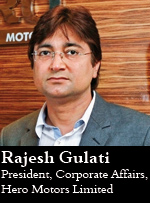
Rajesh Gulati, President, Corporate Affairs, Hero Motors Limited, which includes Hero Cycles, shares his response on how Hero Cycles is rolling up its sleeves to meet the emerging demand for high-end bicycles in India. Gulati’s association with the Hero Group runs long and deep. He has also served as the Chief Financial Officer at Hero Honda Motors Ltd. In an interview with 4Ps B&M, he fields questions on how the world’s largest bicycle maker is gearing up to launch new premium models and the market opportunities that the segment provides.
What is the size of the Indian bicycle industry and what is Hero Cycles’ share in it?
The industry is worth $1.2 billion and the annual production stands at 12 million units currently. The cycle market in India is dominated by four key players – Hero Cycles, TI Cycles, Avon Cycles and Atlas Cycles. They account for 90% of the country’s total bicycle sales. Around two million units are exported and the Middle East, Africa, US and Latin America are the main export destinations. With an annual bicycle production of 19,500 cycles per day, Hero Cycles holds a 45% share of the Indian market. This strangth catapulted Hero into the ‘Guinness Books of World Records’ in 1986 and ever since we have had an edge over global players.
How is the cycle market evolving and what is Hero Cycles doing to maintain its leadership position in the market?
In the mass market segment, Hero Cycles has been the market leader throughout. With the changing dynamics in the social-economic scenario in India, the future clearly lies in the premium & luxury segments. With the launch of Urban Trail, Hero Cycles wants to achieve the leadership position in these segments. Currently, the market size of these premium bicycles in India is estimated at two lakh units per annum, which is approximately 1.5%–2% of the total market. But it is growing at a rapid pace. There is a great scope in this segment and Hero Cycles is trying to tap this market by coming up with various models to cater to the requirements of the various sub-categories in the premium segment. Bikes with high features like front & rear disc brakes, high end gear systems, vibrant colors and graphics, etc would be launched by Hero Cycles very soon.
How has been the response to your launch of the Urban Trail’ series of cycles? With their cost ranging between Rs.10,000 and Rs.43,000, has it found enough takers in the premium and luxury segments?
We forayed into high-end bicycles with the launch of the brand “Urban Trail” early last year. “Red Dot”, the first product of the series has been unveiled till date. Red Dot is made of carbon fiber and is the most affordable carbon bike available in India, apart from 16 of our other models made from the same material.
Urban Trail offers cycles for all cycling enthusiasts across all age groups. Demand for high-end cycles is surging in India and we have received encouraging response during our pilot launch in some markets. We see the emergence of a completely new market segment in India and are excited to see the changing trend take root.
What was your revenue last year and what are your targets for future?
Hero Cycles is part of the Rs. 2,300 crore Munjal Holdings, which also owns auto component firm Hero Motors. In 2010 –11, Hero Cycles’ net was at Rs.162 crore. The total income was up 10% at Rs.2,046 crore, according to the data filed with the registrar of companies. The target is to reach 10 million unit sales by 2017, from 6 million units per day.
What kind of BTL activities have Hero Cycles been doing and how do you propose to take these forward?
Hero Cycles has been associated with a lot of cycling events like the Yamuna cyclothon and the Chandigarh cyclothon, which aim to encourage budding cyclists to pursue cycling as a serious sport and not just limit it to a hobby.
With the participation of over 5,000 cycling enthusiasts, the Chandigarh cyclothon received tremendous response. India also witnessed the final leg of the biggest cycling event – the Tour de India 2012, presented by Hero Cycles in Delhi in December. It was the largest and most glamorous cycling event in India. The event saw 80 international CFI approved riders from 54 nationalities taking part in the 128-km race in Delhi.
F1 in Schools is another concept where our effort is to introduce the F1 phenomena right during the formative years of an individual: in school. F1 in Schools is an international competition for school children (aged 9–19), in which groups of 3-6 students have to design and manufacture a miniature “car” out of balsa wood using CAD/CAM design tools. The challenge will put their academic knowledge to use and polish their soft skills. The program is designed to provide an exciting yet challenging educational experience through the magnetic appeal of Formula 1. This is a tried and tested method in the West. However, in India, it has been conceptualised and implemented for the first time.
Our interest in conducting these activities stem from the fact that we have always supported health and fitness in all the forms. In the future as well, we shall continue to broaden our target audience by visiting residential spaces, malls, etc and making people aware of our existing and upcoming product launches.
The bicycle industry has clocked a negative growth of 8% in the current financial year. The industry is overtaxed. What steps do you think the government should take to push the industry’s growth?
Bicycle is not only the common man’s choice but also the choice of the environmentally concerned. The industry is certainly overtaxed and overburdened. In order to build the industry to the size of $5billion (from $1.2bn), the following steps are needed:
l 2% reduction in the excise duty which was levied in the last budget. While this will be a small sacrifice for the exchequer, it will be a big relief for the common Indian.
1 The Chinese bicycle industry is $8 billion compared to India’s $1.2 billion. This is because they have a favorable export policy and much better infrastructure. The export of Indian bicycle will reach new highs if the government makes the necessary changes in policy. Reimbursement of inland freight up to port, which is stalling the growth prospects of the export segment, should be allowed.
2 To be at par with China, Goverment of India needs to consider higher duty drawback from 12.3% to 15% of FOB price. Alternatively, it could consider offering bonus incentive of 2% of FOB price as applicable to select industries currently.
3 Government of India needs to negotiate with the EU for getting the status of the most preferred nation for export of bicycles to Europe.
4 Government needs to promote cycling by focusing on infrastructure development in cities.
5 Small subsidies could be offered to companies which encourage a corporate culture of cyclist employees.
6 Government should provide bicycles to people below the poverty line, which would not only improve their mobility but also help them get education and employment.