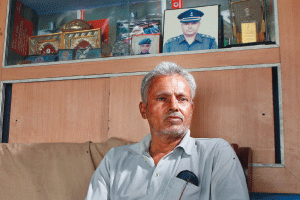
More than six years six years ago, I travelled about 60 kilometers from Delhi towards western UP to a village called Saidpur. The lush greenery that I saw then is still visible. With a population of about 20,000, Saidpur is a village of serving and ex-army personnel. My visit six years ago was to meet two friends ,Captain Udayvir Singh Sirohi and Prem Singh Sirohi. Both were born in Saidpur and spent a fun filled childhood. Both had passed out from the same school called Military Heroes Memorial Intermediate College. While Udayvir joined the Indian Army, Prem Singh went to the Uttar Pradesh police. That choice determined the future course of their lives. Both have retired and settled down in their native village. Both nurse memories. But while the retired army-man recollects his career with fond nostalgia, the retired cop cannot but help express bitterness at his fate.
Six years ago, Udayvir Singh Sirohi was proud of his employer. He and his family still have access to canteen facilities, the best medical facilities and a lot of respect and dignity. Six years ago, Prem Singh Sirohi was not proud of his employer. His contention at that time was that a police job was dehumanising and degrading. Not much has changed since then. Both are now in the sunset of their lives. The army man recently went for medical treatment of his eye. The Indian Army stood the entire expense of Rs four lakhs spent in treatment. His childhood friend Prem, the retired cop, too had injured his leg. In contrast to the former `fauji’, the retired cop had to bear all the expenses himself. This has increased his rancour even more. Recalling his young days, retired cop Prem says, “I was excellent in high jump and could comfortably clear six feet. If I had had the fortune of joining the army, I am sure they would have nurtured my skill and I could have achieved a lot”. Fellow villagers agree that Prem, who retired as a sub inspector and won many medals, was really good at sports and athletics.
The contrast is stark. The retired army captain has a much bigger house than that of the retired cop. Both his children now serve in the army. The retired cop Prem Singh had a son who had joined the police. For reasons unexplained, he quit his police job and is now a businessman based in Meerut. After the Sixth Pay Commission, the difference between the families of Udayvir Singh and Prem Singh have further widened – as has the ‘respect’ quotient. Recalls Udayvir, “When I was once posted in Moradabad, I and some police friends wanted a lift from a truck to reach our village. The truck driver gave me a lift and cursed the policemen as tormentors and parasites. That day, I felt happy at the respect I got and very sad at the way he talked about my police friends”. According to the retired army captain, there is a fundamental difference between armed forces personnel and policemen when it comes to work. “We are trained very well and are taught to revere our unit and the motherland. In contrast, the policemen are under constant pressure from politicians. This makes it very difficult for honest policemen to work effectively”.
Well known sociologist Satyamitra Dubey echoes similar sentiments. According to him, the Indian Penal Code of 1960 was devised by the British to use the police to oppress the average citizen and keep the country subjugated. “Nothing much has changed since Independence since politicians from all parties have replaced the British as the new rulers and masters who use the police to subjugate people”, says Dubey. In a related story, my colleague Parimal Peeyush has pointed out how the political class has ensured that desperately needed police reforms remain a chimera despite specific orders from the Supreme Court.
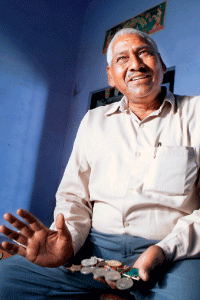 Saidpur has always been known as a village of war heroes. In the Second World War, about 129 villagers fought for the British and 29 were martyred. Since then, it has been a tradition to send the young to the army. About 70 percent of the population of the village are retired or serving army personnel, including Lt General Rajendra Singh Sirohi (retd). But unfortunately, there has been a dip in army recruitments and more and more youngsters, despite their reservations, are trying for police jobs. In 1965, Captain Sukhbir Singh Sirohi was martyred at Khem Kharan in Punjab during the war with Pakistan. In October 1965, former Prime Minister Indira Gandhi had visited the village with the mortal remains of the martyr. At that time, a nephew of the martyr Swaroop Singh was a child and still fondly recalls Gandhi’s visit to their house. A retired army man himself now, Swaroop proudly points out the place where Indira Gandhi sat wile offering her condolences. Like everyone else in the village, he too is worried about the police system in the country. But he has an innovative solution. “A lot of us retire before we are 40 years old. It would make a very big difference if we are recruited by the police and if half the personnel in each thana are retired army personnel”, says Swaroop. Food for thought.
As we head back towards Delhi after bidding farewell to both Udayvir and Prem Singh, we again wonder how dramatically different an army man is from a policeman. And we also realise that this gulf has not been bridged. In fact, it has widened. Prem Singh admits that cops demand money even for registration of cases and often arrest innocent people just to extort money. Psychiatrist Manish Kandpal says, “The mindset of the average cop is so distorted by poor working conditions and constant political interference that he routinely vents his frustration on poor people”. Clearly, if politicians so want, an average cop can become a proud army man. But it doesn’t look like they are in any mood to allow that.