
You may think that you’re the piece that holds everything together for your business. But this is far from the truth. In reality, the key to making your business a success – the key to ensuring growth – is to have a leadership pipeline. That is, you want to create a robust strategy to develop new leaders who are capable of seeing new horizons and methodically moving agendas to achieve those horizons.
Leadership is the key. However, let’s get leadership in perspective. The biggest mistake you can make is to assume that leadership belongs in the realm of the few or to think that leadership is a question of charisma and stage presence. If you hold on to an elitist notion of leadership – that leadership is only for the select few – you will never realise the potential of those around you.
You need to break apart the mythology around leadership and discover that leadership is about the skills of execution. Execution means mobilising teams around ideas and sustaining those ideas to fruition. Execution is about having the practical, learnable behavioural skills of negotiation, coaching, and team building. These are all skills that can be methodically taught and these are the type of skills that are essential to your organisation’s success. If you believe that leadership is key to the future success of your organisation, you must take control of leadership development and put in place a program that will give your high potentials the skills they need to move your organisation ahead. With these skills in hand, your high potentials can become true change leaders.
Your first challenge is to identify the high potentials you want to have in your pipeline.
Not everyone in your organisation is going to be a high-potential employee. Not because you work with a group of poor performers who embrace mediocrity – but simply because some people have different life goals and aspirations and are perfectly content with their current role.
There are also employees who feel that they have great potential and don’t mind talking about it. They spend time polishing their resumes without the requisite performance. When their work is closely examined, however, their claims fall short.
At the Bacharach Leadership Group (BLG) we found that truly high-potential employees share a group of specific traits across all industries.
High-potential employees must first exhibit a deep knowledge of the business. The knowledge can be technical or simply a wealth of expertise that comes with many years on the job.
Moreover, high potentials must know how their expertise can help further the wider organisational agenda.
High potentials should also have an outstanding organisational reputation. They should have the ability to earn the professional respect of others and be able to train new employees with ease.
Of course knowledge and reputation aren’t the only traits a high-potential employee need exhibit. They should also have a keen sense of ambition and display a thirst for climbing the organisational ladder. High potentials should jump at the chance to take on new responsibilities, learn more, and achieve more recognition.
 But high potentials shouldn’t be simply focused on racing to the top. They need to have the ability to partner with others for pragmatic, tactical reasons. They must have the ability to work with others to achieve goals and finish projects. Loners may be creative and hard-working, but they may not be ideal to tap for larger leadership responsibilities.
Lastly, high potentials need to be able to make tough decisions. They have to be comfortable with a degree of risk because in today’s uncertain climate information is limited. High potentials have to know that decisions are inevitable and will need the resolve to make them.
By selecting a group of high potentials you are setting the leadership theme for your organisation. You want them to be knowledgeable so they can remain competitive and current. You want them to have a firm reputation so they are respected for their work, not just their position. You want them to be ambitious and forward moving while a team player who doesn’t mind partnering with others to achieve goals. Lastly, you want someone who can stand firm and make a decision even in uncertain winds. How do you put a high-potential leadership program in place? How to you train your high potentials to ensure for results?
For years BLG has been tackling this challenge and have found a number of factors that need to be considered in putting in place a high-potential leadership program that assures that the program delivers the appropriate training. Let me share three that are of particular importance.
When putting in place a high-potential leadership program, be sure to:
1. Get buy-in from the top Leadership training isn’t always welcomed with enthusiasm. People have work to do and view training as a distraction – especially if there isn’t wide organisational support for the training program.
That’s why is imperative that you ensure the program is legitimised from the top-down right away. Make sure the gatekeepers in your organisation state publically that the program is relevant and of consequence.
The gatekeepers in your organisation are those who have elevated, decision-making positions and control the direction of the business. Make sure you have their buy-in before implementing a training program and interview them about their needs. Tailor your leadership training to their specific wishes, goals, and agendas and give them a sense of partnership in the training program.
With a firm endorsement from your organisation’s gatekeepers your program will be legitimised internally and ensure participates are engaged early.
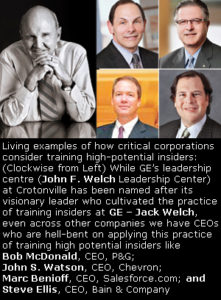 2. Use multiple training modalities Some trainers view training as interaction and others rely too much on lecturing. Balancing the modality of delivery is essential. I’ve taught for thirty years and I know the key to successful learning revolves around student engagement. That’s why it’s important to use different learning modalities to keep things fresh, interesting, and active. The best leadership training isn’t a dry seminar. It’s an analytical exercise that relies on illustrative stories, interactive cases, captivating games, anecdotes, online participation, and support.
Ideally, thoughtful, engaging lectures will actively support cases, games, and online discussions to create a broad, interactive learning experience. Of course, face-to-face interaction is best and supports group cohesion that can benefit the organisation over time. But you should also develop programs utilising social media to encourage long-distance learning, communication, and collaboration.
3. Follow-up Ownership of the material will only take place if there is follow-up and continuous learning. Participants won’t remember everything you teach. That’s why they need something they can bring back to their desk and study routinely. Offer a list of principles and a guide for implementing change and overcoming leadership challenges. Providing take-away material for participants to reference later keeps the training program current, fresh, and memorable.
At BLG we create a lively alumni groups where we host chats, networking hours, and video-conferencing sessions to help keep everyone in touch. It’s a great way of keeping the material relevant and it drives people to routinely think about their leadership challenges, difficulties, and hurdles in a pragmatic, proactive light.
You can always recruit leaders from the outside. Is this what you really want? I think not. In this day, in an age where everyone seems to be worried about their career, organisational commitment is a rare commodity. A leadership development program in not simply a way of enhancing your leadership pipeline, but also a way of showing your key employees that you’re willing to invest in them, that you value them, and that you see that they are part of the organisation’s future. Even more than that, a leadership development program that brings together high potentials will enhance the interaction among the group, creating a network and sense of team that will only foster and enhance the collective culture that is so critical to your success.
The author of this piece is Samuel B Bacharach, who is the McKelvey-Grant Professor in the Department of Organizational Behavior at Cornell University and co-founder of the Bacharach Leadership Group (BLG), a boutique leadership development training company specializing in high-potential leadership programs. Among his books are ‘Get Them on Your Side’ (2004), ‘Keep Them on Your Side’, and the soon to be published ‘Pragmatic Leadership’. He also blogs at: www.bacharachblog.com.
Coordinated by : Steven Philip Warner, Editor, Business & Economy