“Amusing” Product placement in Iron Man 3
The product placement in the China version of Marvel Studios’ latest flick Iron Man 3 has evoked amusing response from fans and film critics. Some have criticised the film for the inclusion of overt product placement and for additional footage added to the film which is superfluous to the plot. The China-only cut of the movie opens to a question appearing on screen: “What does Iron Man rely on to revitalize his energy?” The answer then arrives ‘Gu Li Duo’, a brand of milk drink available across China. A character only in the Chinese version called Dr Wu, played by Wang Xueqi, also appears in the film explicitly drinking a carton of the drink. There are also lengthy shots of products made by electronics firms Wang and TCL, as well as footage of Tony Stark seen on a TV news report being cheered by Chinese schoolchildren while appearing at landmarks in the capital. The kind of blatant product placement in Iron Man 3 raises questions about how effective a marketing strategy it is for brands to go for product placement in films and whether it impacts consumer preferences and spending habits?
 Microsoft contemplates buying barnes and noble’s nook media
Microsoft is considering a purchase of Nook Media for $1 billion which will give the software maker access to e-readers, tablets and e-books. According to a report by technology web site TechCrunch, Microsoft’s plan would build on its $300 million investment in Nook in 2012 and take current co-owner Barnes & Noble out of the equation. TechCrunch also reports that B&N had planned to phase out production of its Android-based tablets in 2014 and instead let others — including possibly Microsoft — produce Nook tablets. Microsoft has already committed an additional $180 million investment in Nook to develop content for Windows 8-based tablets. Microsoft currently owns 16.8% of Nook, a separate entity that B&N spun off last October. A deal for Nook would appear to suit both parties. B&N is reportedly interested in getting out of the hardware business while Microsoft is looking to give consumers more reasons to migrate to its so-far tepidly received Windows 8 OS and give the company a greater foothold in the online publishing business.
 Intel anoints new ceo, president
Intel Corp’s Chief Operating Officer Brian Krzanich has succeeded Paul Otellini as chief executive. The semi-conductor giant has simultaneously elevated its software head Renée James as President—the highest ranking job ever held by a woman at Intel. The selection of Krzanich, who is 52 and joined Intel in 1982, suggests that Intel will continue to try to use its manufacturing muscle to play a broader role in mobile chips. Intel, whose chips serve as calculating engines for most personal computers and server systems, has seen its stock price shrink as consumers shift spending to smaller mobile devices that use different chip designs. James, 48, at one time served as a technical assistant to Andy Grove, the former Intel CEO. In recent years, she has helped to spearhead some of Intel’s biggest acquisitions, including McAfee and Wind River Systems.
 Coca-cola’s new pledge
Seeking to counter growing criticism that it is contributing to global obesity problems, Coca-Cola has announced four pledges, which it will apply to the UK and more than 200 other countries where it operates. These are: to offer low or no-calorie beverage options in every market; to provide transparent nutrition information, featuring calories on the front of all of its packages; support physical activity programs in every country where Coca-Cola does business; to market responsibly, including no advertising to children under 12 anywhere in the world. Coke chief executive Muhtar Kent made the announcement as part of a move to combat criticism that the company is contributing to a perceived obesity epidemic across Western countries. However, according to reports, the pledge not to advertise to under-12s relates to an existing US policy, where Coke will only advertise to audiences where “no more than 35% of viewers are children”.
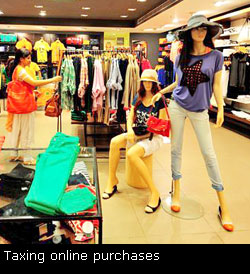 Pay tax on online buying
The U.S. Senate has voted to allow states to collect sales tax from online retailers, making it more difficult to buy tax-free products online. The Senate’s vote of 69-27 for the Marketplace Fairness Act sends the bill to the House of Representatives, where it may face opposition from many antitax Republicans. The Marketplace Fairness Act, which has cross-party supporter and the backing of powerful retailers, would give states the power to require retailers with sales over $1 million to collect state and local sales taxes for online purchases. U.S. President Barack Obama has voiced support for the bill, meaning he would sign it into law if the House passed it. The bill would allow states to collect sales tax on large Internet sellers that have no presence within their borders, curtailing the ability of Internet shoppers to avoid sales tax.
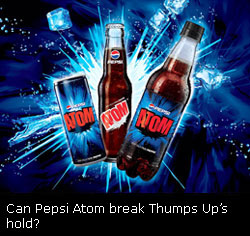 Pepsi atom to take on thums up
In a renewed effort to catch up with market leader Coca-Cola, PepsiCo India has come out with second mainstream cola – Pepsi Atom – which is supposed to be ‘stronger and fizzier’ than the original Pepsi. The company called it PepsiCo’s ‘biggest beverage innovation’, created especially for the Indian market by its global innovation team. Atom will try to dislodge homegrown Thums Up, which is the largest-selling carbonated beverage in the country by volume. The new cola, the latest addition to the fast growing branded beverage market in India, is available across the country. It comes in a bold black and blue packaging including a 250 ml My Can at an introductory price of Rs 15 and a 500 ml PET bottle at Rs 25. 200 ml returnable glass bottles (RGB) are also available in select markets at Rs. 10. Introductory prices, however, may vary slightly in different markets. The company has also roped in actor Sushant Singh Rajput, who took Bollywood by storm this year with his debut film Kai Po Chi, as Pepsi Atom’s brand ambassador.
 VIDEO CONTENT FOR ADVERTISERS
To cash in on the digital medium, which has become an integral part of brand campaigns and activations, GroupM and O4 Digital Media from Optimystix Entertainment, a TV production company, have come together to launch MashUp, a digital video-based brand solutions company. Internet video consumption has witnessed a growth, with 80% more video views in 2012 than its previous year. The current market size in India is more than 43 million monthly unique viewers; more than 3.3 billion monthly total video streams; and approximately 19 billion minutes spent watching videos online every month, as per comScore India’s report. MashUp will concentrate on providing ‘video led sustained engagement’ for its clients and will help create engagement strategies on digital and social media through customised and quality content in the form of rich video packages. It will also offer additional services including evaluation of the brand and its competition in social media, social media management and marketing, online media planning and buying and analytics and measurement of brand progress. Currently, MashUp is working with brands like Airtel, Ford, Mercedes Benz, Shoppers Stop, Streax, Citi Bank, Skoda and Gillette, among others.
 HIGH DEMAND FOR RETAIL SPACE
Many global retailers are setting up stores in India despite slowing sales, drawn by the country’s large young population and rising incomes, says real estate consultancy CBRE. Last year, 13 global retailers set up stores in New Delhi, compared with 51 in Hong Kong and 27 in Singapore, CBRE’s Retail Hotspots in Asia Pacific report shows. According to a CBRE report, luxury and business retailers accounted for the highest portion (26%) of new store openings in the Asia-Pacific region in 2012, followed by mid-range fashion (18%), specialist clothing (13%), coffee and restaurant chains (13%), and value and denim stores (11%). Retailers from the US set up 70 stores last year across the Asia-Pacific region. The region is expected to account for just under half of the world’s total retail sales by 2016, CBRE said. India in September allowed up to 51% foreign investment in supermarkets and other multi-brand retail stores, subject to the approval of the state governments where the stores are to come up. New Delhi is among the 10 states that have so far allowed foreign retailers to set up stores, many of whom are looking at India to expand their business.