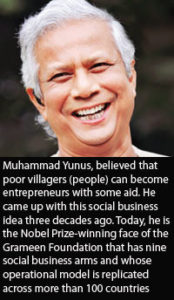
 B&E: You are a celebrated social entrepreneur, having been awarded the Nobel Peace Prize for your work in the past three decades. What prime qualities do you think an entrepreneur should possess?
Prof. Muhammad Yunus (MY): An entrepreneur should have the urge and firm belief to be able to take his business enterprise forward with positive thoughts and imagination. He should possess the quality of being a fighter till the end, no matter how many difficulties he may have to face and tackle in the path of achieving his set business targets for the benefit of the society. If an entrepreneur does not give up, and with goodwill continues to work endlessly and tackle difficulties with maturity and peace of mind, then that entrepreneur will be able to go the distance to achieve his long-term objectives. In the process, it becomes imperative for an entrepreneur to believe in team work and pass on his goodwill qualities to his colleagues and subordinates so that collectively the enterprise can grow.
B&E: How do you describe Mohammad Yunus – the entrepreneur and leader?
MY: Stubborn. As an entrepreneur and as a leader, I have always believed in starting small business enterprises, create a strong foothold and growing gradually to meet the evolving needs of people living in rural areas. Of course, this also depends on requirements in particular rural areas. At the same time, I believe in ensuring that there is no wastage of food or any other material being supplied to those rural areas keeping in mind that funds are scarce. I do not believe in starting big business enterprises and reaching a stage where I am not able to manage even one efficiently the way I want to.
B&E: What lessons have failures taught you as an entrepreneur? For instance, you did once find yourself in a situation where you were teaching in a university that was in a country affected from severe famine. People were dying of hunger and you felt very helpless because there was very little you could do to eradicate poverty.
MY: Every entrepreneur learns lessons from failures and I am no different. When my company faced difficult situations in terms of project failures, I worked and reworked on the programmes and understood the value of doing so by setting and resetting up small business enterprises to cater to the rural audience, and not worrying about profits. I believe that the moment you start thinking about setting up big enterprises, you start losing focus on your core audience and serving ability to the needy society, and only worry about profits which should not be the case.
B&E: And how about Indian villages? Tell us about your plans to create new social business enterprises for the purpose of serving people in Indian villages?
MY: For the Indian market, I intend to form a JV with a domestic or multinational company in India to supply sanitary napkins in bulk for Indian village women in near future. Besides, I also plan to form a JV with a waste water management company in India to enable Indian villages to avail clean water for domestic consumption and farming. I am starting dialogues with companies to initiate these projects at the soonest possible date.
B&E: Till date, you have set up three international joint ventures (JVs) and eight social businesses. How many new international JVs and social businesses do you plan to start?
MY: I am thinking of a JV in Columbia for initiating a business enterprise to supply red pepper in rural areas. It will also in the process generate employment in those rural areas. This is because, Columbia was earlier a country renowned for the coffee bean business, but has lost out on that uniqueness over time. The coffee bean production in Columbia has gone down alarmingly. As a result, rural people became jobless. Hence, I feel that this idea of supplying red pepper in rural areas in Columbia will not only cater to the great demand of the product in Columbia and its neighbouring countries, especially US, but will also provide for a source of livelihood for the locals there. In future, I may even look at making Columbia an export hub for red peppers. Then comes Bangladesh. After launching a social business in partnership with Danone to sell fortified butter to rural areas in Bangladesh, we are currently working with the company to sell about one lakh cups of fresh yoghurt everyday to people, including small children, who reside in rural areas in Bangladesh. We are also in the process of gathering funds that will be infused in Haiti to start two poultry farms, a bakery and a plantation of jatropha plants that can be utilised for biodiesel. Again, these will not only offer an alternative energy source, it will also create jobs for 200-odd farmers in that country. The Germany-based Yunus Social Business Fund, formerly the Grameen Creative Lab, has opened an office in Haiti after the earthquake in 2010, from which the country is still recovering.
B&E: And how about your plan with a Japanese company to provide high-yielding variety of seeds in Bangladesh?
MY: Yes, that is in collaboration with the Yukiguni Maitake Company, which is Japan’s leading agro company. The Grameen Krishi Foundation (GKF) has signed a JV with the Japanese giant for establishing a new social business in the field of agriculture, and producing high quality mung beans in Bangladesh for both domestic consumption and exports. Of the produce, sixty to seventy percent will be exported to the Japanese market, while the remaining thirty to forty percent will sold in the local market.
B&E: You’ve been quoted as saying that, “There is the expression of selfishness and there is the expression of selflessness – but economists or theoreticians never touched that part. They said: ‘Go and become a philanthropist.’ I said, ‘No, I can do that in the business world, create a different kind of business – a business based on selflessness.” So, how important and difficult is it for a an entrepreneur not to be selfish?
MY: It is not at all difficult. An entrepreneur has to avoid being selfish, be very strong-willed, and work towards his vision while keep his soul pure. Once these values are put in place, he will find it easy as a social entrepreneur to religiously serve society.
B&E: Do you think the idea of micro-credit will help eradicate poverty from the world to a great extent if applied with fairness?
MY: Yes. The idea of micro-credit will effectively help eradicate poverty from the world if the poor and needy are given the power to help themselves through jobs and increased incomes, loans. Lives around the world can be changed this way!