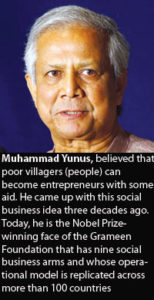
 It was fifteen years ago when we met Muhammad Yunus for the first time in New Delhi. During our conversation, the blue kurta pajama-clad gentleman didn’t come across to me as a made-for-profit-making businessman. He was just another nice individual, pleasant to talk to. Yet, he wasn’t conservative either in his approach. Everything he spoke to us to explain his entrepreneurial work and motive of travel kept resonating with two words – poverty and unemployment. Clearly, at that time, we had quite a shallow understanding of what Yunus’ model for mitigating poverty and unemployment could do globally. And then again, Yunus wasn’t a celebrity star. Then, his fifteen year-old Grameen Bank-tagged microcredit facility had spread to 21 nations including India, China and others across Asia and Africa. The Grameen Bank he had founded employed 12,628 people. It had disbursed loans amounting to $2.22 billion to 2.3 million borrowers. And the number of branches had already crossed the 1,100 mark. But, the world still didn’t know him well.
Much had changed when we connected again ten years later in the fall of 2008. By then, Prof. Muhammad Yunus had become a Nobel laureate, and replicas of the Grameen Bank model had started operating in more than 100 countries. His Grameen Bank had grown into a time-tested model, with 2,500 branches spread around the world (including US, where the first Grameen Bank branch opened in New York), having disbursed loans amounting to $7.6 billion to 7.7 million individuals! And to talk of his limitless vision as a social entrepreneur, by 2008, his brainchild had grown from being a tool for those in need of personal financial credit to a not-for-profit family of enterprises that included entities like Grameen Trust, Grameen Fund, Grameen Communications, Grameen Energy (Shakti), Grameen Education (Shikkha), Grameen Telecom, Grameen Knitwear and Grameen Cybernet. Not hard to imagine, if the forprofit business tycoon Li Ka-shing Li had found a match in Asia, it was Muhammad Yunus. What the Hutchison Whampoa Group was to Hong Kong, the Grameen Group had become to Bangladesh. [To quote two examples: Grameen Cybernet is Bangladesh’s #1 Internet Service Provider and Grameen Telecom has over 100 million subscribers in Bangladesh, reaching out to over 66% of the country’s population!] But by January 2013, when we connected again, he was no longer the operational head of Grameen Bank. The legal battle that led to the ousting of Yunus isn’t important. What is important is what makes Yunus a Cult entrepreneur, which he will always be.
He may not be a common name in the corporate rumour mill. He does not command a strong identity amongst stock traders. And he may not have raked in millions of dollars as most entrepreneurs deservedly have. But you could take his name in the same breath as of those entrepreneurs who have changed the lives of millions. And it all began on a humid summer morning of 1976 when Yunus started visiting villages near the Chittagong University (in Bangladesh) to understand more about poverty, and how he could actually use economics to help the underprivileged. During one of his visits, he came by Sufia Khatun, a poor widow. She sold baskets that she weaved during the day. To buy raw materials for the bamboo baskets, she had to borrow money at interest rates that were as high as 45% a month! And what was her daily average earnings after selling all her produce? 5 taka, equal to 2 cents ($0.02). Yunus lent her $4, enough for her to pay back the moneylenders and buy some material for a day’s produce. Her daily earnings immediately rose to $2, and her manufacturing business became selfsustainable. Yunus identified 41 other such villagers in Jobra and lent them $27. All of their earnings increased many times over. Even better – all borrowers returned the sums they owed to Yunus. This surprised the man. It encouraged him too. He continued lending more money to other needy villagers – mostly women – and yet, after months of having begun the practice, got back every penny that he had lent out to the poor. Confident of his pilot tests, Yunus appealed to the local banks to make similar loans to the poor. The suggestion was rejected time and again, because for those bank managers – whose jaws would drop each time Yunus advocated his social plan – those with no collateral were not in their list of creditworthy customers. Finally, a branch manager of Janata Bank lent Yunus to be distributed to the poor on personal guarantee.
The loans were distributed and the poor maintained their zero default record. Yunus went back to the banks with the proof, and they put forward a challenge before him. They claimed that his zero bad loan record in Jabra village was due to the fact that he was a lecturer at the nearby Chittagong University and therefore was influential. They asked him to show them that his model of microcredit would work in the Tangali district (north of Dhaka) where he was a stranger. He replicated his Grameen Project in Tangali, worked in that district for a couple of years and returned to the bankers with success on record. The bankers were not moved. So wasn’t Yunus. He started the Grameen Project in five other, different districts with great success. The banks still had their excuses. While on the verge of giving up, an idea struck him: he decided to start his own bank in 1982 – the Grameen Bank.
Setting up of new Grameen Bank centres, procuring hardware and developing training centres, deciding on borrower groups, procuring capital for faster growth from agencies like the International Fund for Agricultural Development and others, keeping a check on repayment rates (that has remained at around 97% at Grameen Bank, as per a Stanford Graduate School of Business paper), were only some of the challenges Yunus faced. But what made him successful was his strategy of being shockingly transparent about his operations, effective handling of conflicts within the organisation, and most critically, of doing things different as compared to the large banks, despite popular disbelief and many-a-failure in the initial stages of his entrepreneurial career.
Be it his idea of setting up moneychasing entities or the Five Star targets given to each center or even his belief in the community of women being better borrowers, each served the entrepreneur well. From setting up the first centre (set up at Jabra village) to over 2600 today, from lending out the first taka to over 684.13 billion taka ($11.35 billion; source: Grameen Bank) as of December 31, 2012, Yunus has come through as a true champion of social causes.
Today, the Grameen group of enterprises has nine businesses – all of which are not-for-profit, and whose working models are replicated across 100 nations. So trusted has his model of social entrepreneurship become that he has succeeded to attract even private capital to fund his social dreams.
Out as the operational head of Grameen Bank’s lending and savings business, Yunus is still in there, enjoying his fourth decade as a social entrepreneur. And there are many new projects on his platter. The Grameen-Danone Food Company is a new 50-50 partnership with France’s Group Danone that sells low-priced baby food, fortified butter and fresh yoghurt in rural areas across Bangladesh. In Columbia, work is on to initiate a business enterprise that can supply red pepper in rural areas (and export to US) at low prices while providing for employment to rural dwellers. In Haiti, work is on to put in place two poultry farms, a bakery and a plantation of jatropha plants that can be utilised for bio-diesel, and in the process provide livelihood to 200 farmers. In another effort, a tie-up of Grameen Krishi Foundation and Yukiguni Maitake of Japan is being worked on to establish a new social business in the field of agriculture, that would produce and supply high quality moong beans in Bangladesh. There is another upcoming healthcare project on his list (for which he is still on the lookout for a partner) that includes setting up of lowcost eye care units and rural hospitals with video-conferencing facilities in rural areas around Dhaka. India too is on his map.
People credit Yunus for being the father of microfinance. Actually he deserves more credit for being the father of ‘impossible economics’ – one who proved how demand is possible with zero propensity to consume! [Isn’t that the reason why traditional banking outfits refused to fund Yunus’ plan initially?] We leave you with a thought from the man who has defined what social entrepreneurship is, and according to us is a true Cult entrepreneur. “An entrepreneur should have an urge inside him and a firm belief in terms of taking his business enterprise forward with positive thoughts and imagination. He should possess the quality of being a fighter till the end, no matter how many difficulties he may have to face in the path of achieving his set targets.”
May the world see many more such kurta-clad Cult entrepreneurs for whom poverty and unemployment, rather than profits and turnovers, are the key issues to address.