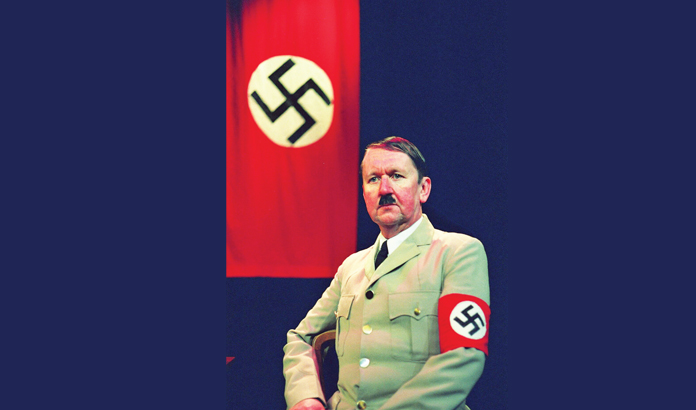
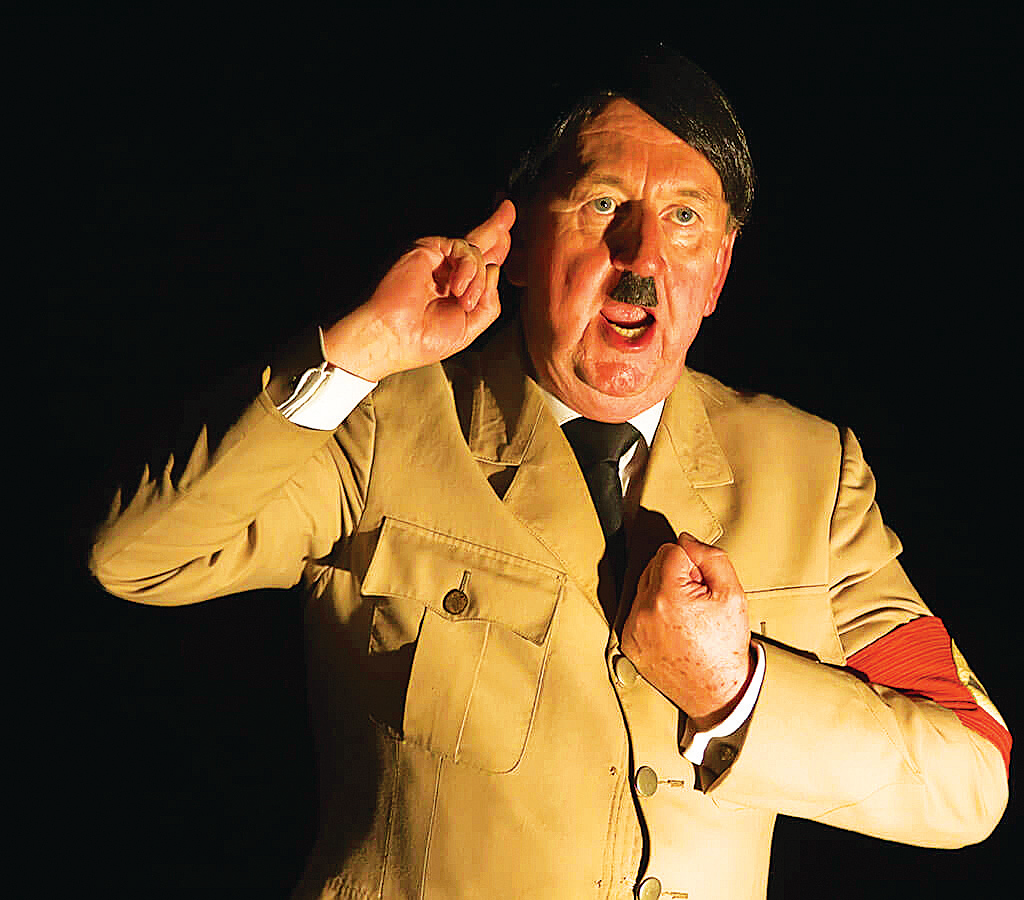
 The rise of Neo-Nazism is no more an academic debate. It is a reality that is staring right into our eyes. In ways more than one, this Neo-Nazism is omnipresent. Gone are the days when Neo-Nazis used to mark their presence through photos and grainy videos shot in the dungeons, often after they completed their day job. Not anymore. To many, across the Europe, it is now a full time job. And that’s eerie. There has been a persistent rise of Neo- Nazi parties in Europe. Some in the nations that suffered the most under Nazi occupation. The irony died a thousand death when a Neo-Nazi group was busted in Israel, of all the places on earth. What does that signify? British Actor Pip Utton has tried to find them with his remarkable solo-act play, Adolf. Pip Utton might not be a huge name in the theatre circle in Britain, but with his splendid work and commitment to present something fresh, he has carved his name among the theatre enthusiasts. Pip Utton comes from a working class family, many of whom were devastated by the policies of Margaret Thatcher, especially the coal miners. The agony and humiliation of the Margaret Thatcher era helped shape Utton’s world view. When he decided to enter into the world of theatre, the going got tougher. “Because I had no training, bio or CV, nobody was going to offer me a part. Nobody would even offer me an audition. It is difficult because you want people with a background, so the only way forward was to write something for myself,” he admitted in one of the interviews. However, persistence paid dividends and he started to get noticed. Since then, he has performed globally to packed audiences and has won several awards for his productions such as Playing Maggie (2015), Churchill (2000), Bacon (2005) and Dickens (2010). However, none of them achieved the kind of popularity Adolf did. Even before the play starts, the environment is created befitting the content. A quiet man with cold stare separates the incoming audiences into two groups with a wave of his hand. He does not speak a word neither betrays any emotion. He simply segregates. The stage is eerily lit and the props are minimal. There’s a huge Swastika banner in the background, a table and a chair. Nothing else. The play starts as nay soloact play does. Utton enters in Hitler attire and gives an impression that he is inside the Fuehrer-bunker waiting for the Soviet troops to arrive. The war has been lost but Hitler is not ready to relent. In the back of his mind he has prepared for the end, but this does not stop him from going to a long diatribe against Communists, scholars, intellectuals and Jews. In between, an impression is created that he wants his loyal staff to escape and leave him to his fate. When he is ostensibly talking to them, a much mellower side of Hitler is presented. On the other hand, when he breaks into his diatribe blaming everyone for the debacle but himself, the tone is sharp and the magic created by the spotlight leaves you shaken to the core.
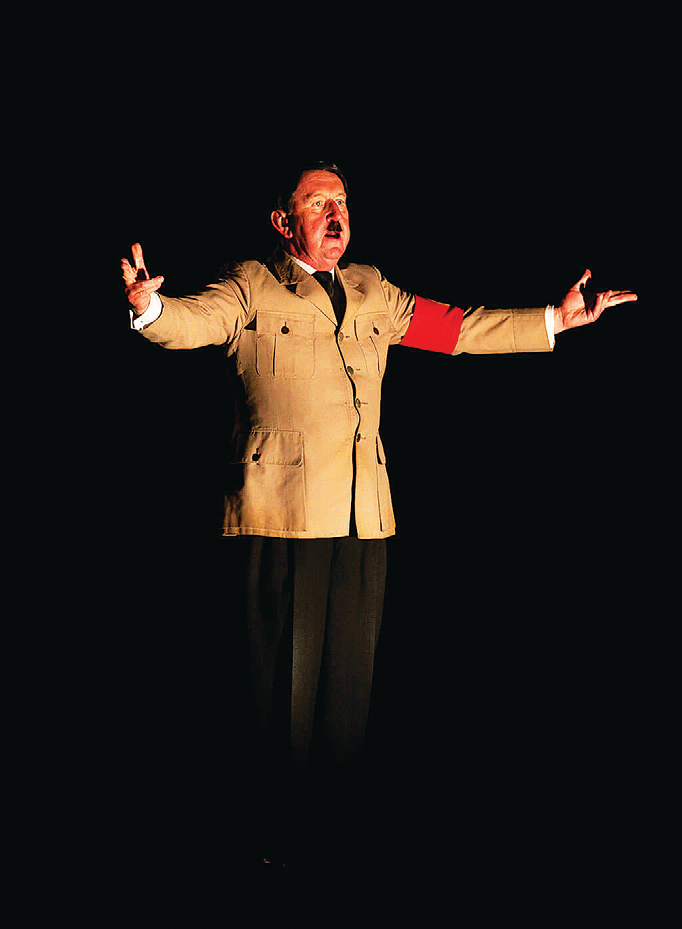 Utton copies Hitler’s mannerism without overdoing any of the gesture and at times you feel that if he would have been speaking German instead of English, the effect could have been even better. Most of the dialogues used are taken from Mein Kampf and other writings by Hitler. Naturally, they are revolting. But there’s a catch there. And that catch forms the second act of the play. After the diatribe is over, Utton comes out of character and throws away the wig and the coat, and starts as if he is interacting with the audience. He starts with sundry comments and then slowly moves to racial jokes and mild bigotry, if at all there can be a phrase like this. In the beginning, the racial jokes are of the garden variety. The ones that tabloids in the West spew regularly. The audience plays along. The jokes turn harsher and comments more xenophobic. The audience is now hooked, oblivious to the fact that they are being taken for a ride. As the comments turn even further bigoted and xenophobic, the laughter from the audience increases in decibel. It culminates to the point where Pip Utton, not in the character of Hitler, gives a Hail Hitler salute, and the vast majority of the audience sitting inside the theatre follows. Only then does he pick up the get up of Hitler again and says a line with which he had started the play, “I stand at the door and any man who opens the door, I will step in.” It is only then that the audience realises how they were swept away in a diatribe of racial bigotry when it was slyly presented to them by a smiling, harmless looking man. Deceptively chatty, he allowed the audience to lower their guard. It is a way of conveying that as Germany allowed itself to be taken for a ride by a skilful orator decades ago, the same can be repeated again if we are not sufficiently cautious. The reaction of the audience in the second act has varied internationally. In more sophisticated and educated societies, especially in Europe, many audience members managed to see through the ruse. At other places, they could not believe that it was deliberate on the part of Utton to show them a mirror; and they reacted violently. Utton was even hit by a viewer in Scotland; at several other places, audience left in the between. In the US and India, the majority of spectators remained oblivious and played along. In two of the shows that this correspondent saw, he was horrified to see almost the absolute majority of audience giving back the Hail Hitler salute. By deliberately playing a bigot in a more jovial setting, Utton basically forces us to lower our guards and thus brings out the worst in ourselves. It is akin to what Sasha Baron Cohen does through his character Borat. By trying to portray himself as an anti-Semite, he forces people to lower their guard and brings their anti-Semitism to the fore. Only, Utton does it with live audience. “I can find no redeeming factors in Hitler and the more I research him, the harder I find it to understand how a human being could have inspired such evil. I can find no redemption, no justification and no moral reasons for his vile actions. I portray him as a man without doubts, a man who could charm, bully and manipulate with his warped logic,” he says. Adolf, in ways more than one, is a pinnacle of experimental theatre. Such out of the box ideas are essential not only to keep the interest in theatre alive but to occasionally also remind those involved in the craft that this is what theatre is meant to do.