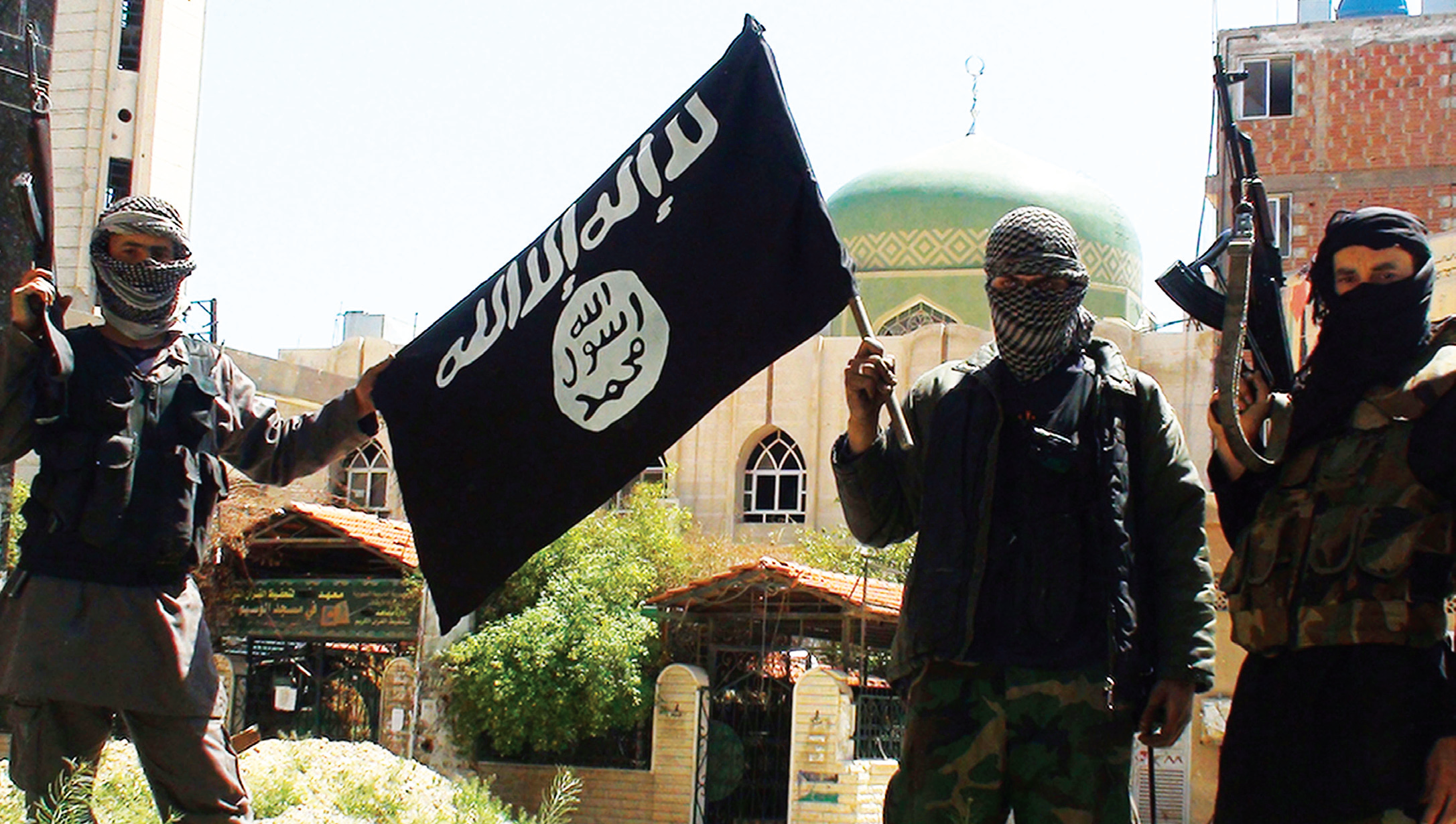
Islamic State will endure as long as the factors and circumstances that have fueled its rise remain in place in Iraq and Syria and beyond. This article is excerpted from ISIS: A History, the forthcoming book by Fawaz A. Gerges (right)
 Although the spectacular surge of ISIS must be contextualized within the social and political circumstances that exist in Iraq and Syria and beyond, the group’s world-view and ideology should be taken equally seriously. Ideology is, after all, the superglue that binds Salafi-jihadists – known as revolutionary religious activists or global jihadists of the ISIS variety – to each other. The Salafi-jihadist movement emerged from an alliance between ultraconservative Saudi Salafism (or Wahhabism) and revolutionary Egyptian Islamism which was inspired by the Egyptian master theorist, Sayyid Qutb. The Afghan war against Soviet occupation from 1980s onwards baptized Salafi-jihadists by blood and fire and lay the operational foundation of what subsequently came to be known as Al Qaeda. Ever since, a vibrant ideology has allowed the Salafi-jihadist movement to renew and revitalize itself after suffering crushing blows. A travelling and expanding ideology, Salafi-jihadism has evolved into a powerful social movement with a repertoire of ideas, iconic leaders, worldwide supporters, networks of recruiters and enablers, theorists, preachers who provide members with ideological and theological sustenance. It has taken hold of the imagination of small Sunni communities worldwide. Regardless of what happens to ISIS – which is an extension of the global Salafijihadist movement which includes a litany of groups, like Al Qaeda – this messianic ideology is here to stay and will likely gain more followers in the politically and socially polarized Arab and Muslim societies. Despite a costly civil war unfolding between ISIS and Al Qaeda Central, particularly in Syria, Salafi-jihadists continue to expand their influence and attract new recruits. A fringe social movement during the second half of the 20th century, Salafi-jihadism now vies for public influence and offers an alternative for both mainstream and radical Islamists. It is a popular, enduring brand. A sense of triumphalism permeates the discourse and public pronouncements by Salafi-jihadist ideologues and propagandists who openly proselytize. They boast that the tide of history has shifted their way and that they are on the cusp of a historical breakthrough. Researchers have tended to underestimate the power of the Salafi-jihadist ideology at their own peril. The challenge is to shine light on this growing ideology and make sense of it. Although the Islamic State is an extension of the global Salafi-jihadist movement, Abu Bakr al-Baghdadi, the leader of ISIS who anointed himself caliph in the summer of 2014, and his cohorts represent another wave, a post-Al Qaeda generation of Salafi-jihadists. At present, ISIS – its ideology, as well as its state and security status – has successfully tapped into a fierce clash of identities between Sunni Muslims and Shia Muslims in the Middle East and beyond. The US-led invasion and occupation of Iraq in 2003 caused a rupture in an already fractured Iraqi society. America’s destruction of Iraqi institutions, particularly its dismantling of the army and the Baathist ruling party, unleashed a fierce power struggle, mainly along sectarian lines, creating fissures in society. These growing ruptures provided the room necessary for non-state actors and armed insurgent militias, including Al Qaeda (AQI), to infiltrate the fragile body politic in post- 2003 Iraq. In contrast to Al Qaeda Central whose key concern is the far enemy – that is, the US and its close European allies – AQI and its successor ISIS are a hyper- Sunni identity driven by an intrinsic and even genocidal anti-Shia ideology. ISIS’s lineage of Salafi-jihadism forms part of the ideological impetus; the other part of its ideological nature is an identity frame of politics. Despite the group’s insistence that it operates within a different value system from that promulgated by Western liberalism and the nation state system, its ideological rhetoric is anchored not in novelty but in identity politics whose main articulating pole is religious. Religion can act as a potent framework for social identity, especially in war environments where insecurity runs high and cultivates group loyalty by projecting itself as the truth and the right path to follow. By providing a clear structure through strict sets of rules and beliefs and a worldview that encompasses life on earth and in the afterlife, Islamic State presents individuals with the promise of an eternal group membership, which can prove particularly attractive for people prone to existential anxiety. Moreover, scholars point out that several factors feed into the (Abrahamic Religion’s) fundamentalist ideology, including dualism (absolute evaluations of good versus evil), authority (of a sacred book or leader), selectivity (choosing certain beliefs or practices over others), and millennialism (confidence in eschatology as God’s will). Of all factors, however, one facet is thought to be vital: “reactivity”, which takes the form of a hostility toward secular modernity that is directed not only toward people outside of the fundamentalists’ religious in-group but also toward members of their own religious group who are not viewed as “true believers.” In this light, ISIS’s development of a pure and absolutist ideology can be seen as part of a strategy to feed its members’ fundamentalism by emphasizing their exclusivity while projecting a universalist vision. For example, the widespread use of suicide bombers by Salafi-jihadist groups such as ISIS constitutes a recent modus operandi in Islam rather than a return to the roots. Few Muslim communities appear to be currently entangled in a war of subjectivities that stems from a series of ruptures that started with the Enlightenment and that takes the form of an Islamic-Islamic civil war over the Muslim identity itself. Meanwhile, many Arabs are also involved in an interpretative dispute about their being-inthe- world in which both the Arab world and the world at large are questioned and contested. According to an Arab philosopher, Fathi al Makdisi, the current rise of Salafi-jihadism and terrorism represented by ISIS is the result of not only creeping sectarianism or a crisis of the modern state, but also a growing nihilism that signals the collapse of progressive values and tolerance in its conception of humanity. Nevertheless, far from being sui generis, genealogically and ideologically ISIS belongs to the Salafi-jihadist family, although it marks another stage in the evolution or, rather, mutation of the ideological gene pool. Over the past half century, the Salafijihadist movement has developed a repertoire of ideas, a frame of reference, theorists, thousands of followers, and “martyrs” who provide inspiration for new volunteers and who ensure the durability of the brand. ISIS has been able to draw from this repertoire, re-articulating old concepts and presenting them as new or revolutionary. Its rhetoric makes use of religious ideology to articulate identity politics. Indeed, religion has for some time been the glue that maintains the coherence, if not the unity, of various factions and divisions, and the rationale for vicious and flamboyant violence. Salafi-jihadists from various orientations, including ISIS, always cite verses from Qur’anic scripture to portray their offensive jihad as blessed. The world according to ISIS is frozen in time and space, incorporating the rules and laws of seventh-century Arabia into the twenty-first century. Its leader, Abu Bakr al Baghdadi and his associates depict themselves as battling the “anti-Christ” and paving the way for the ultimate triumph of the “Mahdi” and Islam (in Arabic, the Mahdi means “the Guided One,” the central crowning element of all Islamic end-time narratives, or an expected spiritual and temporal ruler destined to establish a reign of righteousness throughout the world). This millenarian thinking is at the heart of ISIS’s caliphate ideology and the global jihadist movement in general.