What are your most powerful leadership techniques?
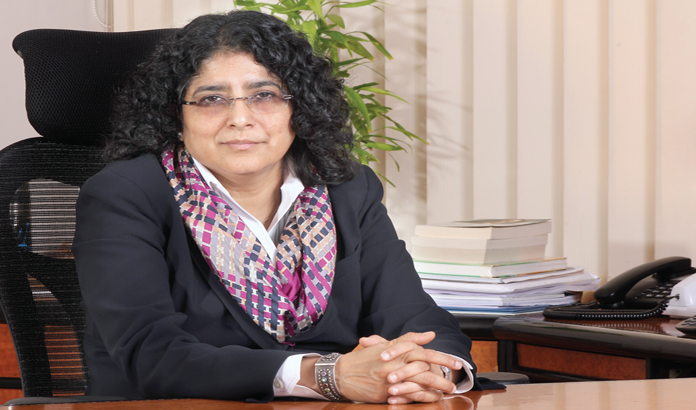
Sushma Rajagopalan (SR): Leadership is about effecting change that is needed and enabling decisions in various situations. The roles leaders play change and vary depending on the situation. There are times the leader has to play coach and mentor; at other times has to be involved deeply with the team and yet at other times needs to step back and let others take the lead. Knowing when to wear what hat is essential for effective leadership. Such adaptability is rooted in knowing your business very well and your people even better. For instance, when one is changing or transforming an organization you have to play the coach and team member more often. An effective leader is one who is constantly building the roof by nurturing the next generation of leaders.
Do you have any tricks or techniques that help you stay ahead and keep you abreast with the latest changes in today’s exceptionally fast changing world?
(SR): In today’s fast changing world, it is extremely important to constantly keep track of the market, the customer, the employee and feed back to the organization the changing perceptions. Else organizations will become very inward focused. This is one of the best practices that I follow diligently. In addition to the above, I resort to the 4 Cs of leadership: ‘Clarity’ of thought: A leader needs to have complete clarity of thought and vision, which is the starting point of any action or initiative. In-depth knowledge is often the foundation to clarity of thought. ‘Courage’ to act: The courage to act comes from extreme conviction. One should not lose the courage to do what is right even if 20 people are saying something different. In a fast changing world, where speed is of essence the ability to act, fail fast and rebound are critical. ‘Charisma’ to influence: A leader should have the charisma to influence people and convince them to follow him. It is a myth to think that knowledge and clarity will automatically create followers. One has to influence others using multiple techniques. ‘Character’: A leader should always remain true to oneself.
What, according to you, is the one most important quality of a leader?
(SR): While integrity is an important quality of being a leader, the most important quality of a leader is effective communication across multiple channels – both formal and informal. I have increased the use of short videos and short twitter-like messages in addition to regularly meeting 20-30 employees at least twice a week over a program called “Coffee & Conversation”. You can have the best ideas in your head but to make those ideas see the light of the day, you need to be a compelling communicator. Communication is the way by which one influences another.
Can we teach people to become better leaders, or is it a skill you are born with?
(SR): Most certainly one can be taught to be a better leader; provided you have some of the essential qualities. Qualities such as the four Cs; integrity, passion, effective communication skills, ability to inspire others are some of the essential qualities. Learning from experience and improvising is key to improving one’s leadership skills. A healthy amount of introspection is vital to overcoming blind spots. Having a couple of people with whom you can discuss your introspections and who can give constructive suggestions is important. Finding such people is not easy. I am lucky to have two such people.
What is the secret to building a strong and efficient team?
(SR): Team work and collaboration is the only way to achieve success. The secret to building an efficient team is having a deep understanding of individual strengths and knowing how to harness them effectively. Especially in the times to come, where one will be required to have multiple skills and competencies and deliver results with unprecedented speed, reliance on team work will be much higher. The much clichéd expression “there is no I in a team” is very true. There is no magic bullet to building teams. It has to be deeply embedded in the culture of the organization. Policies and incentives should be built in a manner where team success is lauded more than individual heroism.
What is your secret of effective time management?
(SR): It all comes down to “Energy & Enjoyment” –mental energy that is displayed through clarity of thought and physical energy to apply oneself to a diverse range of issues with equal passion. I don’t try to solve the problems, I usually establish principles by which we should solve them. This helps you get more done and empower others. Often people comment on my high energy levels. The ability to work 15- 16 hours a day for years on end yet having the time to chat with friends on Whatsapp or play other roles such as a daughter or a daughterin- law or a wife, stems from enjoying what you do. Enjoying what you do also energizes you. Involving all the stakeholders from the beginning, speed of communication and complete communication are key. My response time to most emails is less than an hour and I either try to seek clarifications through questions or provide a decision with an explanation.
How do you inspire and sustain motivation?
(SR): I believe in sharing the vision of what we aspire to be with my extended team. Vision cannot belong to one single individual, rather it needs to be a collective vision of what we wish to be. Each employee wants to be of value to the organization. My leadership mantra is to enable the dreams of my employees and provide them the resources required to innovate. Ideas are necessary but an idea brought to life is way more significant in the growth of the employee as well as the organization.
What is the secret to handling failure effectively?
(SR): A leader should always be committed to learning and the wisdom gained through learning from failure is undeniable. The secret to handling failure effectively is open acceptance and early acceptance. Over time you will perfect the art of detecting failure earlier.
How do you prioritize between work and life?
(SR): To me, work is an integral part of life. The strain and issues of balance come up only when you treat “work’ as something different from one’s life. As long as you enjoy what you are doing and achieving results you can carry your family along with you.
Which leaders do you admire?
(SR): I admire different leaders for different things. I do not believe in role models. I’m a firm believer in the fact that one can learn from everyone. I like Steve Jobs’ die hard conviction in his own ideas even when others did not see it his way and eventually proving it to the world; I like the way Bill Gates became the chief architect of Microsoft and let others lead the company to greater heights. I admire how President Obama used technology to initially rally a country; I like the bold actions of Prime Minister Modi and the courage to take up issues that have been neglected such as Swachcha Bharat; I admire Indira Nooyi for being a true global leader; how she is driving innovation in the company and for shattering all the stereotypes about women. For every one of the notable figures I have mentioned there are countless people who are admirable in the way they are creating impact for society at large.
Your views on the leadership skills of the next generation of leaders?
(SR): In the VUCA world speed and agility have to be demonstrated in every facet of leadership along with the ability to fail fast. As the Chair of Nasscom’s IT services council, our charter is to help drive the future readiness of the industry. One of the initiatives we are working on with IIM-B is define these traits. We held 6 discovery workshops across the country and have come up with four must have skills. One skill is the ability to cope with ambiguity. We are further refining this and developing a way to measure these skills.
Best advice you can give to the future leaders
(SR): My advice to future leaders would be that leadership is never about the technology, products or the organization, and you. it is always about other people. A true leader should embrace her/his people and grow with them. One should always keep the elements of empathy, collaboration, team-building, encouraging work-place culture in place.