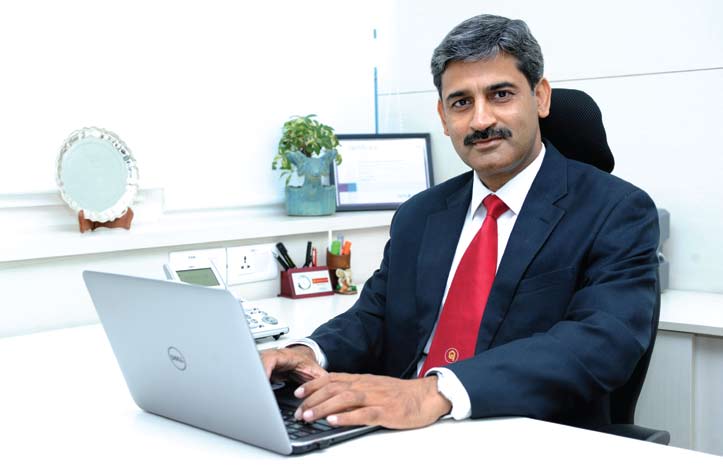
Q. How and where did you start your career, specifically in HR?
A. Well!! As I go down memory lane by about 28 years I vividly remember myself as a squeaky young officer in intense combat situations grappling with incessantly emerging volatile, uncertain, complex and ambiguous (VUCA) tactical situations. VUCA was a common acronym originally used by the defense forces to describe the scenario envisaged in battlefield. Today its more often used in the context of the prevailing business environment.
My formative learning lessons in the art of leadership and developing an understanding of diverse human behaviors under intense and stressful situations were carved during my professional journey with the armed forces. Early in my career, I got umpteen opportunities to intensely practice varied forms of leadership styles as per the demand of the situation and I soon learnt to motivate and drive each member and the team to accomplish every compelling mission. At a later stage my career in the armed forces steered towards a different direction and helped me become an accomplished assessor of human behavior and personality. I had been trained and certified by the Defence Institute of Psychological Research as a Group Behaviour Analyst . It is here that I got an opportunity to assess the personality of more than 3000 candidates aspiring to become officers in the Armed Forces. As a Group Behaviour Analyst, you conduct assessment centres with a bouquet of group exercises to illicit behavioural manifestations of the candidates against a predefined competency framework. It was this exposure, which ultimately led me to my true calling – Human Resources. My smooth transition to the corporate world was facilitated with my educational sojourn at IIM Calcutta. I formally started my corporate career as a Human Resource professional as Head of HR for ARMS- the retail division of Asset Reconstruction Company of India (ARCIL).
Q. You have steered an exemplary organisational change and HR transformational journey? What were your learnings on effectively managing change at PNB Housing Finance Ltd?
A. It was in 2010, PNB Housing Finance Ltd then a fully owned subsidiary of a leading public sector bank, embarked on a major organisational transformational and business process re-engineering journey under the Public Private Partnership (PPP) model. With the entry of a private equity partner, the Board decided to use this maiden endeavour to bring about a structural and cultural transformation in the company. I really saw this as a challenge and a compelling learning opportunity. I am sure very few HR professionals actually get this kind of an exposure and have a hands on experience to steer and effectively manage change and transformation of this complexity and magnitude. We the leadership team at PNB Housing literally changed the tyres of a moving car.
The learnings were numerous.
I am convinced that managing change and cultural transformation is among the top challenges facing the HR professionals— and is one area in which HR is most likely to efficiently partner with business. I also learnt that change management is no longer focused on operational improvements or process reengineering. The complexities of perpetual change are an interwoven part of every successful organization’s DNA. An astute HR professional should aptly articulate a change strategy by understanding the nature of change, and identifying the type, scale and magnitude of the change the organization is likely to experience. Any transformational changes like acquisitions and mergers require a special approach beyond the “one size fits all” change management approaches based on the prevailing organisational climate and business dynamics.
I learnt that the important factors needed to bring about effective change were -articulating a compelling vision, communicating the strategic rationale, building credibility and trust, project management, monitoring, measuring change outcomes, and a structured follow-up to ensure sustainability of the change initiative.
One must not forget that human elements are at the heart of any successful change and are often the most challenging to manage. HR can help employees successfully navigate the turbulent change process by recognizing that employee motivation increases, when individuals are confident they can meet the change expectations. Hence skill upgradation becomes extremely important. Employee resistance to change is more often related to performance anxiety than negative attitudes. Effective communication is the key to manage employee anxiety and make employees buy in.
Cultural integration is another critical success factor is any transformational change effort. HR should facilitate cultural integration and encourage the imbibing of new culture through enabling mechanisms like organisational value framework, learning and development initiatives and performance management systems etc.
Lastly, I strongly feel the need for HR to embrace the role of a change agent and accordingly develop strong change and influencing competencies, which will help to anticipate and manage risks associated with the dynamic change process.
Q. What are the challenges HR faces in the new era of the ‘digital age’?
A. **Nowadays digital initiatives are impacting all industries and organizations and have become a driving force of change across industries. The transformation is accelerating day by day . So HR needs to be more pre-emptive with regard to digital transformation as it plays an important role in shaping the organization’s digital identity. A new wave of digital tools and cloud computing can help companies to focus not only on talent acquisition but also help them to efficiently manage the employee life cycle. With the availability of new-age analytics capabilities, the HR function can now move from a rear-view mirror (lag data) mode to a forward-looking (predictive and forecasting analytics) mode. Employee data that exists in silos can now be combined very easily and quickly so that the HR teams get an integrated view of the human capital which in turn enables them to take data backed “business” decisions. This in turn means that all HR personnel need to develop contextual data analysis competencies and inferences.
**The millennial who are also termed as “Digital talent” today constitute the biggest demographic in an organization’s workforce. They are constantly looking for purpose, fun, agility, and something challenging and rewarding. This would involve gamification in processes such as performance management, refreshers on policies and benefits and learning. So it challenges HR, to create a contemporary culture within the organization and a strong employer brand.
**Job portals are now seen as supplements to the traditional paper résumé. Today, the world of recruiting has gone digital. From short listing of resumes to calling the candidate for interview, everything runs on a digital model. In fact candidates prefer the job opportunities that are digital in nature and hence less time consuming so that they can quickly jump on to other similar job openings. There are platforms available which carry reviews of an organization’s culture and are an important source of information for job aspirants while making the decision. To maintain the reputation of the organization on such platforms, HR needs to constantly engage and effectively communicate compelling employer value proposition (EVP) according to the individual employee life cycle stage.
In the end I feel the biggest challenge in the digital era for HR professionals will be the ability to strike the right balance between technology and human touch. While the new era compels us to embrace technology and big data we need to be careful not to lose empathy and the human touch with the employees.
PM Modi’s biggest reform – ‘Digital India’, is aimed at making the economy digital and the sectors like BFSI which touch almost every person are also gearing towards this reform. HR needs to strengthen its role and rapidly adapt itself to the changing trends to enable an effective digital transformation.
Q. Any advice you would like to give on how to manage people/teams as the workforce becomes more diverse?
A. As globalization increases so does the need for more and more interaction among people from diverse backgrounds. People no longer live and work in an insular environment; they are now part of a world economy competing within a global framework. Companies need to learn to embrace diversity and look for ways to become inclusive organizations because diversity has the potential to yield greater work productivity and competitive advantages.
Employee initiative and empowerment are inevitably rising. The rigidities of the current hierarchical system are likely to become obsolete soon, and new types of professional relationships will be put in practice. By the end of this decade four or five generation’s will co-exist in the organisations. The new generation will seek a fresh managerial relationship based on direct interaction and trust. As managing diversity is a significant organizational challenge, supervisors and managers need to recognize the ways in which the workplace is changing and evolving and learn to adapt and accommodate a multicultural and multi-generational work environment. HR must become flexible and agile to meet the needs like compensation structures, benefits, rewards and engagement programs etc. for different employee segments in a customised fashion.
Q. How effective and how important are rewards and recognitions in strengthening employee engagement and retention?
A. Human beings by nature are gregarious. We all have social needs such as acceptance, appreciation, belonging and companionship. This basic principle holds good at our work places also. Employee recognition and appreciation programs can create a unique company culture and strengthen organization- employee relationships and nurture healthy engagement levels. By ingraining a sense of gratitude like saying “thank you” – into the company’s culture, employees will be more willing to spread positivity, bring about collaborative spirit and steer towards customer centric behaviour. This calls upon HR to conceptualise, design and execute R&R programs which firstly make employees feel valued, secondly are strategically aligned to the company’s values and overall objectives and thirdly, propel the employees towards superior performance and nurtures their self-esteem. Apart from meticulous execution, it’s important to regularly assess the program’s effectiveness and determine whether rewards and recognition are distributed in a fair and equitable manner.
It is also important to determine, if employees really value it as a form of genuine recognition for their contributions. This can be done by launching well designed employee surveys at regular intervals and making mid-course corrections. In my experience the most effective programs have been where “empowerment“ has been used to acknowledge and recognise each individual’s contribution. As far as rewards are concerned, HR professionals are required to build clear productivity driven transparent rewards culture in the organisation. Moreover, from a total rewards perspective, HR should integrate the total rewards system and create a good blend of monetary and non-monetary rewards/benefits offered to the employees. The seapart from generating valuable business results, will also enhance individual and organizational performance, job satisfaction, employee loyalty, and workforce morale.
Q. How can a company attract the best people?
A. The new generation of potential employees are today influenced by numerous factors like their own social and professional networks. Add to this the fact that companies are proactively using social media to reposition their brands and woo the right talent. Companies are also proactively updating and revamping their end to end talent acquisition programs. This is so because all sectors are facing a scarcity of key skills and rapidly evolving talent demands.
However the underlying question remains, what is it that a perspective candidate looks out for before making a career decision? An informed and savvy candidate primarily looks for a progressive and inclusive organisation, where he can be himself, where he feels empowered, where development opportunities exist, where he is respected and recognised for his contribution and where he gets a balanced work life and sees a growth opportunity. He also seeks for himself the right “culture fit”.
It’s the company culture that sets it apart from the rest. Creating an enabling culture not only attracts top talent but also leads to higher levels of engagement. The engaged employees become the brand ambassadors and can get more similarly talented people to apply to and join the company. Social media and professional networking sites in particular (such as Facebook, YouTube and Linkedin) are a great way to promote an employer’s brand and offer realistic previews of work life, of the employees and the prevailing culture in the organization. Going forward, to emerge as the most preferred employer brand, the HR team has to use a multi pronged strategy to correctly package and market the employer value proposition (EVP) to the perspective talent pool.