At a time when people have half-baked and ill-conceived opinions on a range of subjects, understanding economics, that pervades every aspect of our lives and the world, can be a little tricky.
Often, economists dealing with the subject assume that everyone understands them, and hence, use jargons. In any society, formulation of economic policies requires public participation. Most often common citizens fail to comprehend economic discussions. Yet, economics has a greater impact on our daily lives than any academic discipline.
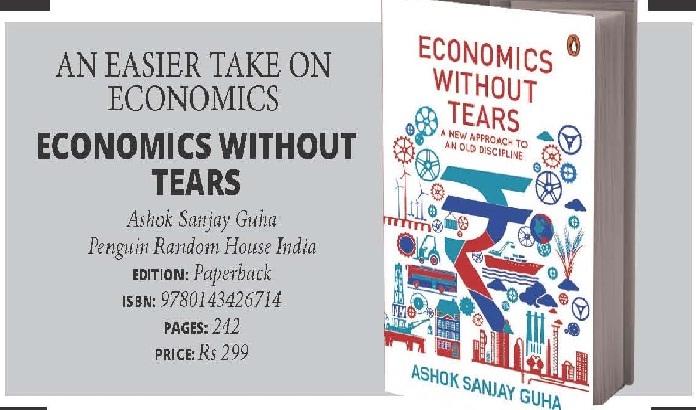
Unlike most economic text books, Economics without Tears: A New Approach to an Old Discipline, authored by Ashok Sanjay Guha, has tried to free the subject from jargon and mathematics. Guha, who is currently Professor Emeritus at the School of International Studies, JNU, introduces the readers to the concepts of economic theory. As you read the book and begin to relate to the policy pronouncements, the exercise can actually be an intellectual adventure too. To stimulate and improve the economic skills of readers, the author poses economic problems at the end of each of the ten chapters. At the end of the book, the readers will realise that despite its serious implications, economics can be fun too.
A trained economist in prestigious universities, such as Yale, Guha has made economics entertaining by posing questions and narrating stories without enmeshing them in mathematical methods. But how did he embark on such an initiative of simplifying ecospeak for the uninitiated? Guha faced many challenges while introducing the subject to the students pursuing their masters in International Relations at JNU. These were students who had not familiarity with economics and suffered from math phobia!
Economists try to understand how billions of disparate and dispersed activities by millions of people knit together to produce order. Prof Guha too begins with the fundamental problem of economics— that of coordination. He goes on to discuss how this coordination can be achieved and points out to the different types of coordination viz, ‘command’, ‘by market intervention’ and ‘police state’. Also, he explains private properties in terms of private and public goods. The example of the Maghrebi Jewish coalition which traded across the Mediterranean from the 11th to the 13th centuries outside government control, using a system of ostracism to keep the network patent and to prevent infiltrations by third parties is cited extensively in the book. Similar examples are cited within the 242 pages. Other topics covered in the book include the central role played by information and misinformation; the consumer; monopoly and international trade theory.
On the issue of economics of monopoly, Guha brings to us the significant role played by patents and how they restrict entry and impede the dissemination of new technology on the one hand, and create and protect intellectual property rights on the other. Without the latter, the incentive to invest in research technological progress cannot the sustained. “Can we design a patent system that optimally balances these two conflicting considerations?” This question, according to Guha, remains an open one at present.
Guha, a gifted writer who presents economics to a wider audience, argues that the per capita income growth does not necessarily enhance welfare. To prove his point, he cites the example of Kerala that emerges as the clear winner with the highest life expectancy, the lowest infant mortality, the best public health facilities, the highest literacy rates, the best gender ratio, the best record in female education, health and empowerment, and the lowest total fertility.
With such a record performance crucial to the quality of life, do Keralites enjoy the most satisfying lives among all Indians, he asks. He answers that question for all of us engaged in tracking the annual budgetary allocation to various social sectors. “Kerala”, he points out “also has the highest rate of suicide among all states, no less than three times the national average. It has the highest rate of alcoholism and possibly the highest rate of drug addiction.”
However, Kerala is not an accidental aberration, Guha explains by citing how its suicide rate was highest after the Danish Government began developing Greenland into a welfare state during the 60s.
Despite being a public intellectual, who writes on several burning issues in the mainstream media at regular intervals, Prof Guha restricted himself to the narrower field of pure economics. But Guha could have won a larger fan following if he had cared to quote examples from the Indian political economy rather than relying on global cases and economic models. For instance, his view on Prime Minister Narendra Modi’s decision to demonetise and ban high-currency notes, in terms of co-ordination and the role of information and misinformation in the Indian economy!
Yet, the book is in a sense a crash course in the significant theories and ideas of economics. It has been blurbed splendidly by economists Jagdish Bhagwati and Pranab Bardhan.
Still the book could have avoided curves and graphics. No doubt books such as these do enhance understanding for those who have little to do with economics or policymaking. Such efforts help push the political process to make more informed and choices.
S Sathya