Historians — including the biased, Soviet Union – hating variety — unanimously agree that it was Soviet red Army that defeated the Nazi War machine in the World War II. However, since it is singularly impossible for the western historians to write in an unbiased fashion when it comes to the feat of Soviet Union, they use various tools to try and belittle this achievement. This is a dangerous game. Partly because of the lack of relevant Soviet scholarship in English and partly because of the fact-free propaganda onslaught by Hollywood, the majority of Europeans these days believe that it is not Soviet Union but United States of America that liberated them from Nazi occupation.
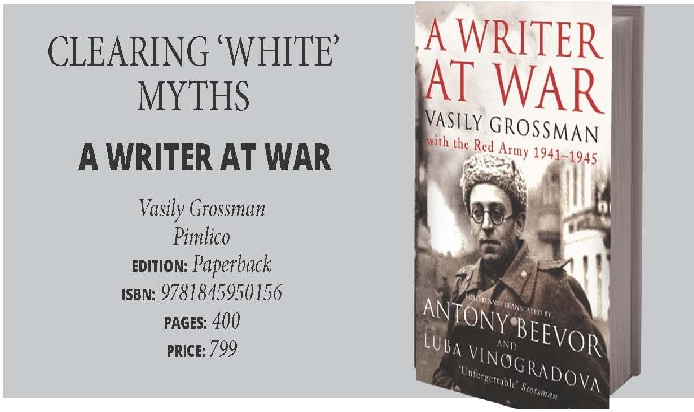
Under the circumstances, Vasily Grossman’s A Writer At War comes as a desperately wanted break. When the Nazis invaded Russia in 1941, Vasily Grossman volunteered as a soldier, but was rejected on physical grounds. Desperate to be in the thick of action, he became a special correspondent for the Red Star, the Soviet Army’s newspaper, and started reporting from the front lines of the war.
What makes Grossman’s account particularly interesting is the fact that unlike other correspondents of the Soviet papers who were well trained in propaganda spin,
Grossman was a greenhorn and went out of his way to stick to the truth. While this is problematic for Stalinist narrative, it is a bigger problem for Western authors who don’t know how to refute his claims without personally demonising him; something they can’t dare do because of Grossman’s later “disillusionment” from Soviet Union. This is a catch-22 situation for the Western writers in general and Antony Beevor in particular who has translated Grossman’s work from Russian to English. Grossman used to keep war diary and jotted down every small detail meticulously. Because of his prior unfamiliarity with the military jargon, he seems to have a special fascination for the same and has spent considerable time writing and explaining these jargons. In fact, most of his jottings were too meticulous for his own good. Such jottings were always at the risk of being abused by NKVD. What makes his writing particularly riveting is the way he sees the war through the eyes of the common soldiers and commoners.
Winning confidence came easy to him and it did him lots of good. His chronicling of commoners’ lives so seamlessly intermingled with military adventure that no one who has read his writing can remain unimpressed. His writing reflected his unhinged attitude. Take for example this paragraph where he talks about his first impressions at the Eastern Front.
“…they (Ukrainians) look at us with a challenge in their eyes: ‘It’s Easter.’ The implication behind this strange remark in autumn was the hint that they were celebrating the arrival of the most joyful moment of the year. Some historians have suggested that the Germans, with black crosses on their vehicles, were seen as bringing Christian liberation to a population oppressed by Soviet atheism. Many Ukrainians did welcome the Germans with bread and salt, and many Ukrainian girls consorted cheerfully with German soldiers…”
Writing about such collusions could have proven fatal for anyone else. However Grossman remained unscathed. He also possessed the talent to make even the most mundane of events readable. One such section is where he and his cameraman hitch a ride on a train Gomel.
“We jump to our feet in the middle of the night. There is a hospital train going to Gomel. We take hold of the handrails when the train is already moving. We hang on the steps, knock at the door, pleading with them to let us at least on to the platform of the freight car. Suddenly a woman looks out and shouts: `Jump off this second! It is forbidden to travel on hospital trains!’ The woman is a doctor whose calling is to relieve people’s suffering. `Excuse us, but the train is moving at full speed, how are we to jump off?’ There are five of us holding on to the handrails, we are all officers and all we are asking for is to be allowed to stand on the covered platform. She starts kicking us with her great boot, silently and with extraordinary force. She punches us on the hands with her fist, trying to make us let go of the handrails. Things are looking bad: if one lets go, that would be the end. Fortunately, it dawns on us that we aren’t on a Moscow tram, and switch from the defensive to the attack. A few seconds later, the covered platform is ours, and the bitch with the rank of doctor is screaming in a frightened way and disappears very quickly. This is our first taste of fighting.”
Grossman’s best pieces are the ones that he wrote during the Battle of Stalingrad. His description of street to street fight, pain, desperation and ultimate victory is probably the best writing available on this historic triumph.
However, Grossman being Grossman betters even that. His description of the extermination camp of Treblinka is regarded as one of the most valuable source on the Holocaust. The text of his essay was used as evidence at Nuremberg Trials and helped put the entire event in perspective.
A Writer At War is by some margin best insider account of how Red Army stopped the Nazi Beast in its track. Missing it would be missing one of the most important pieces of human history.
Saurabh Kumar Shahi