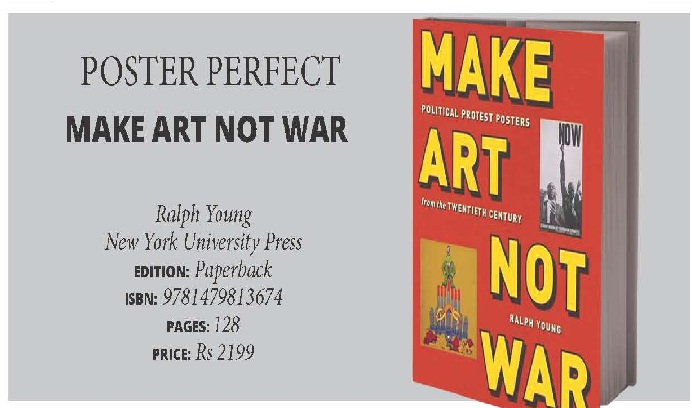
Political posters have intrigued and delighted me, both as an activist and as a teacher, for most of my adult life. My deep affection for this powerful artistic medium began in France in May 1968, when I happened to be in Paris following my university days. I took a small part in the massive demonstrations there, where posters were an integral part of the historic agitation. Images of brutal gendarmes, caricatures of Charles de Gaulle, attacks on bureaucracy, demands for free expression and many more radical themes all reflected brilliant design and powerful political criticism. Created daily by students and striking workers, these posters were central to the French rebellion and to 20th century art history.
Historian Ralph Young has presented a valuable collection of 20th century American political posters from the Tamiment Library and Robert F. Wagner Labor Archives Poster and Broadside Collection of NYU. This collection contains over 2,900 posters from 1904 to the present, and addresses the rich tradition of social protest throughout that period. Professor Young’s selection is a useful historical and thematic cross section.
Young is a longtime scholar of political dissent at Temple University. In the present work, he provides an essay contextualizing political posters in the broader tradition of American political dissent. His essay shows how this vital visual art form has been an indispensible feature of the various struggles in America to build a society that provides dignified lives to its workers; its women; its racial, ethnic, and sexual minorities; and its citizens opposing several immoral and illegal wars from Vietnam to the present.
Make Art Not War is a pictorial volume, and Young’s essay is not intended to be comprehensive. It serves its limited purpose effectively, however, allowing readers to understand American political posters in the broad historical framework that gives rise to all cultural expression that supports movements for social change and transformation.
General audiences can enjoy the diverse visual examples in this volume, especially those people who have participated in mass movements and who have affectionate regard for socially conscious art. Educators, especially in high schools and colleges and universities, can take special advantage of many of the posters. Some of the book’s early entries lend themselves especially well to imaginative pedagogical strategies.
A 1949 election poster from New York’s American Labor Party, for example, proclaims “Make Marcantonio Mayor.” That provides a powerful opportunity to explain that for more than 20 years, a viable leftist political party existed and had some significant political successes. Among its key figures was Vito Marcantonio, one of the few genuine radicals to serve for an extended period as an elected official in the United States. The presence of this poster in the volume modestly counters the unfortunate reputational censorship that Marcantonio has suffered in the wake of Cold War anti-communism.
Likewise, the book features a 1955 poster entitled “Vote and Unite” that the Communist Party disseminated in Pittsburgh announcing a speech by Elizabeth Gurley Flynn. In almost a half century of university teaching, I cannot recall any student who recognized her name, even though I have mentioned her and her contributions in various classes.
The crown jewel of this volume is Ben Shahn’s “This is Nazi Brutality.” Shahn was one of the finest political artists in American and world art history. This remarkable poster was a protest against one of the most horrific Nazi atrocities during World War II.
This book also contains several posters advancing the African- American liberation struggle. Iconic figures including Martin Luther King, Malcolm X, Angela Davis and others join historic slogans like “One Man, One Vote” and “Power to the People” in reminding viewers of recent struggles for racial justice and dignity. Young has also included some posters highlighting the struggles of Native Americans. One eerily relevant poster from the ’70s is entitled “Our Land is more valuable than your money.”
Many of the posters included in the volume address international issues, especially opposition to the Vietnam and Gulf wars. These are vibrant examples of a theme that has pervaded poster art since Käthe Kollwitz drew her masterpiece “Never Again War” in 1924. Demonstrations against the war in Vietnam, the Gulf War, and the Iraq War regularly featured colorful posters that helped create solidarity among antiwar resisters. American military adventurism continues, requiring new antiwar posters regularly to reflect political sentiments and reinforce the collective will to resist.
Artists who create political posters can contribute enormously to the organizational efforts and street demonstrations that will inevitably increase in both number and intensity.
These artists should look to the past for inspiration, including to this and other collections of valuable and effective political posters. Their efforts can add to the burgeoning body of political art that has served as the conscience of humanity for many centuries. But more important, their work must, above all, be equally judged by the successes of the causes themselves to which they have lent their creative energies.
Paul Von Blum