Internet has really proved to be a double-edged sword. While it has, expectedly, brought science and scientific writing out of the ambit of the drawing-rooms and laboratories of snooty scientists; it has also provided a weapon to those who dwell in the dark underbellies of pseudoscience. In fact, the latter have been more successful in using internet and other modern means of communication to their benefit. A case in point is pseudoscience dabbling self-proclaimed “Food Babe” Vani Hari. A decade or so ago, a person as untrained in science as her, would have ended up opening a psychic centre or something.
However, with internet in hand, she and her millions of followers today possess the power to make or break a brand. She and her ilk forced Pepsi to stop the use of Aspartame as artificial sweetener in spite of countless scientific papers attesting to the fact that Aspartame does not do any harm to human beings.
More recently, Robert F Kennedy Junior and Robert De Niro—both big names in their own right—took a headfirst jump into the rumour mongering cesspool by giving credence to the conspiracy theory that vaccines lead to autism in kids. While this theory has no scientific basis, it has been popularized by pseudo scientists, one of who recently came up with a “documentary” called Vaxxed. The documentary got a huge promoter in the form of Robert de Niro, whose son suffers from Autism; a fact that has rendered him unable to approach the subject without emotion. Other similar topics include opposition to Genetically Modified Crops, and promotion of Homeopathy, traditional healing and other sundry pseudoscience.
The question arises, why are these pseudoscience theories and their charlatan proponents getting so much traction? What is it that attracts readers?
The answer is not so simple. There’s a profound lack of scientific temperament among the casual readers. It is especially high in Eastern societies. In the West, the USA is an exception. The lack of education among average Americans in comparison to their transatlantic cousins means that they are more prone to cock-and-bull than the Europeans.
However, recently, the scientific community has started to fight back. Make no mistake, when it comes to strength in numbers, the pro-science group is till puny in comparison to the Golden Horde that the pseudoscience quacks command; but at least there’s a beginning.
One of the guys fighting this war is author and scientist John Brockman. Brockman runs an online “Science Salon” Edge.org, and has penned critically acclaimed books such as This idea Must Die, This Explains Everything and This Will Make You Smarter.
Last year, during one of his several interactions with scientists at Edge, science-writer John Brockman raised the question “What do you consider the most interesting recent scientific news? What makes it important?”
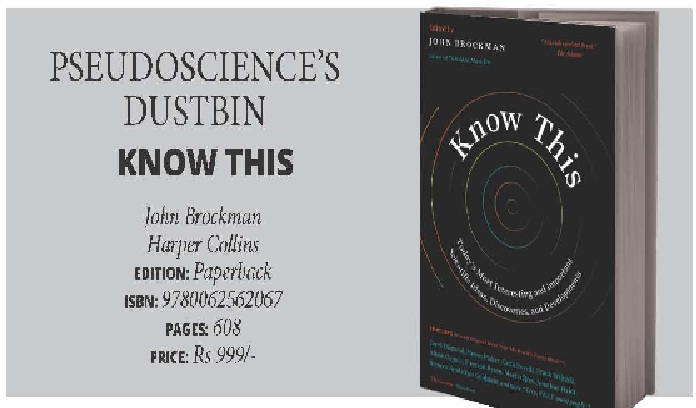
Several dozen scientists and science-writers responded through short essays. The result is this positively mind-numbing book Know This. It will help clear mind off all pseudoscience apart from keeping you abreast of the interesting things happening in the Scientific world.
The star cast includes names such as Martin Rees, Jared Diamond, Carl Page and this correspondent’s favourite Steven Pinker. In total as many as 198 of the finest minds in the world have contributed in this project. The result is this bombshell of a book.
What is fascinating is the choice that the readers get here. If you like the free-flowing style of writing less laden with scientific jargons, you can enjoy Jared Diamond. If you are more anthropologically inclined, Steven Pinker will come to your rescue. Freeman Dyson can satiate the urge of those who dwell in the world of physics. It is one spread where you’ll probably want to taste every dish.
As far as topics are concerned, it is varied. Jared Diamond holds forth on the topic of what is the best way to understand complex problems. Carlo Rovelli, author of the brilliant book Seven Brief Lessons on Physics, discusses the latest progress in understanding the mystery of black holes. Steven Pinker, Harvard psychologist who has done pioneer work on linguistics as well discusses whether one can quantify the progress human race has made in all these years. Harvard Cosmologist Lisa Randall meanwhile discusses the true measure of breakthrough discoveries.
Those interested in Particle Physics, Nobel Prize winning physicist Frank Wilczek’s essay on why the twenty-first century will be shaped by our mastery of the laws of matter, will answer many questions. However there’s not just hard sciences all along. There’s healthy dose of philosophy as well.
A case in point is an essay by philosopher Rebecca Newberger Goldstein that deals with the issue of the underestimation of female genius. Goldstein’s free flowing essay takes long-held conventions and bigotry head on and leaves them to smithereens. Similarly music legend Peter Gabriel’s essay on tearing down the barriers between imagination and reality tries to take readers into a hitherto unchartered territory.
Know This is not only a fascinating book, it is a timely one too. If there’s one book you have to read this year, let it be this one here. How much will this be able to blunt the charge of pseudoscience is anybody’s guess; but what is beyond doubt that a stand has been taken. And what a stand it is.
Saurabh Kumar Shahi