“ALL THE PARTIES SHED CROCODILE TEARS FOR FARMERS BUT SIDE WITH THE ANTI-FARMER LOBBIES WHEN THEY COME TO POWER”
A lot happened in these years. PM Modi brought you to the NDA fold, but apparently failed to deliver on his promises, leading to your departure from the fold. However, it seems like no one noticed your absence…
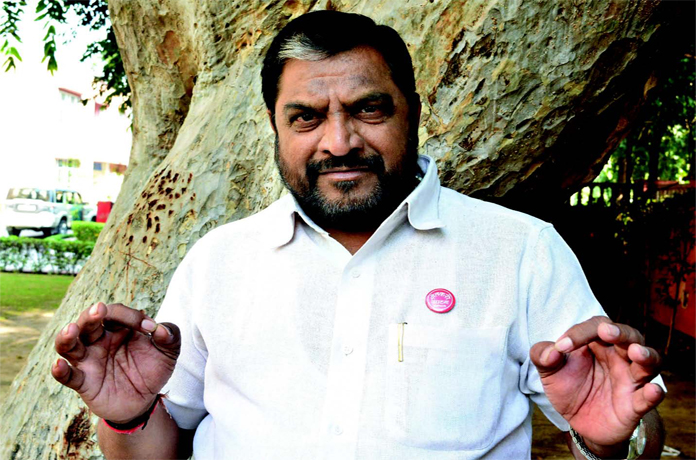
While I have been fighting for agrarian cause since 1998, it was only in 2014 that I won on the ticket of Swabhimani Paksha. Modiji knew about our strength, and he wanted to win the elections in Maharashtra at any cost. Gopinath Munde was sent to bring me to meet Narendra Modi in Ahmedabad. He said he wanted me to be part of the NDA, and that change was the demand of the time. I put forward my demands. I insisted that the BJP includes them in its manifesto, and work on them post victory. These included demands like taking farmers out of the vicious cycle of debt, providing them with a stable income, and provide them the MSP that is above 50 per cent of their input cost, as per the recommendations of the Swaminathan Committee. We also demanded that a national commission should be set up to look into causes and effects of drought from Bundelkhand to Tamil Nadu. He liked the demands but conveniently forgot to include them in the manifesto. We delivered our part of the deal, and won the state for the coalition. Farmers trusted Modi. I felt bad when their trust was betrayed. When a debate on the issue was initiated in the Lok Sabha, only 58 MPs turned up. The government sent a MoS to defend. They failed to make any announcement. This forced me to leave the NDA’s fold. However, my struggle shall continue.
Modi slighted farmers or a leader?
When he called me and made promises, he was the CM of Gujarat. His claim to fame was that he had promoted farmers and farming in Gujarat. At the very minimum it meant that he was at least aware of the agrarian crisis. I knew that he won’t be able to keep all the promises. The question arises, why did he make these promises then? There can be one of two reasons. That is, either he is unaware of the crisis or he – and his party – deliberately took farmers for a ride.
Every party plays politics with farmers…
Of course the Congress is also playing politics. The difference is the BJP is doing so by being in power. All the parties shed crocodile tears for farmers but side with the anti-farmer lobbies when they come to power. The influence of non-agrarian consumer lobby is much more than any farmer lobby, in spite of farmers being the biggest consumers. This imbalance of power leaves farmers to the dock. Consequently farming has been reduced to be an unprofitable business. The commission made by the government is a conspiracy to hoodwink farmers. The Commission for Agricultural Costs and Prices has no constitutional status, therefore whatever MSP it sets is at the government’s whims. I have attended several meetings of this commission. It’s nothing but a show. What actually happens is that the commission already sets a price before the meeting making the meeting just a show. They also set the price of all the inputs, and they just add it up to reach on a figure about the input cost. This is fraud. This commission is a conspiracy against the farmers.
What are the realistic options to give this commission a constitutional status? Several attempts have been made to award it autonomous or constitutional status. This was one of my demands in my meeting with Modi before the elections. This also forms the important part of the demand that agitating farmers in Delhi have given to the government. I have given a notice to the Lok Sabha in order to file a private member’s bill to push for this recognition. This bill might come for discussion in the next session. It would be interesting to see if this bill is passed or sent to the back burner. It is difficult to get a private member’s bill passed. I also want to see how much support this bill attracts from the Congress and other opposition parties. My bitter experience is that Parliament is generally apathetic to the concerns of farmers.
The Commission for AgriCulTurAl CosTs And PriCes hAs no ConsTiTuTionAl sTATus, Therefore whATever msP iT seTs is AT The governmenT’s whims
Rahul Gandhi came into limelight after Bhatta Parsaul. Is he not serious? It was just an act. The issue at Bhatta Parsaul was of land acquisition, the law for which was made by the UPA. Singur happened during Congress’s rule. They raise farmers’ issues when in opposition, and conveniently forget when in power.
What’s the underlying reason for this? My personal assessment is that even if a particular MP wants to raise concerns of farmers, he is generally impotent in front of the party machinery. The primary reason is that Indian polity is controlled by consumer lobbies. It is in sync with the consumption-based economy that we have become. That is why the moment a party comes to power, it becomes afraid of the influence and pushbacks by the consumer lobby. For example, the rising price of onion cost the BJP elections in Delhi way back in the late 1990s. It has further aggravated. Protest marches are taken out against the rising prices of gas, oil, flour, pulses, onion and what not. The prices are brought down through artificial mechanism. No one cares about marches for lowering the cost of diesel and fertiliser. You can see which lobby wields power in Delhi. Farmers need to create a vote bank; a vote bank that can take on the consumer lobbies head on.
Do you believe that farmers will be able to form a meaningful pressure group? This is not possible overnight. This will take time. We are working among the farmers trying to convince them to vote above the concerns of caste and religion. We are asking them to vote for those who raise the issues that are of the concern of the farmers. This will make it possible to raise the issue of the MSP of sugarcane or wheat in the Parliament. When we reach at a point where a government can collapse under the pressure from an agrarian pressure group, we will start to see our concerns being taken seriously.
Can such a pressure group be formed before the next Lok Sabha?
We need to do a lot of work to make farmers aware. This will take a lot of time. Next Lok Sabha deadline is not realistic.
The government can outsmart such a move by not letting such a pressure group take shape at all.
That’s quite possible. But only when it writes off all the debt, when it provides them with stable income, when it admits all their demands. This will render any pressure group useless. The question is, is the government ready to do so? Can it go for complete loan waiver? Can it implement Swaminathan Commission’s recommendation with regard to the MSP? This does not look possible, as the government is not serious.
Do you advocate awarding industry status to agriculture?
We don’t have either a liberal or controlled economy. Whatever government has come to power till now has regulated the economy depending on the prevailing situation and requirements. If it is a liberal economy, then why do we see dumping in the market? If it is a controlled economy then why doesn’t the government step in to give fair MSP when the prices fall? They think of price control when the productivity increases. Whatever is the economic system in play, the government is not concerned about farmers.
Do you think loan waiver can improve the prevailing crisis?
A lot needs to be done to improve the situation of farmers. The government can start by assuring a fixed income for them. This is part of the recommendations made by the Swaminathan Commission. The recommendations have not been implemented by the government. The pre- and post-harvest costs in agriculture are the highest in the world. This leads to huge input cost. The government needs to provide better infrastructure and assure cutting-edge technology for the agriculture sector as well. No government works in this direction. The next big problem is lack of storage facilities. This is the primary reason why farmers have to sell their products to the middlemen at unprofitable prices. In areas where there are storage facilities, they are too costly. At this point the government is not able to provide even 10 per cent of the storage space demanded by the farmers. However, there is dearth of bombastic claims. Both the Sangh and Left insist on organic farming, completely ignoring the fact that such farming will not be able to cope with the demands of the country. No one is asking farmers what they want.
What do you think farmers should get? Your question is loaded. It seems that you also think on the lines of the government that farmers are getting everything, and yet whine incessantly. This is far from the truth. We have some advises for the government. One of which is that the marginal farmers should be paid under MNREGA for working in their own fields. This is a major input component, and if this is paid the input cost will go down substantially. Farmers should get access to the best quality of seeds and fertilisers at the minimum cost. Then there’s the issue of harvesting and storage. There should be proper arrangement for these apart from processing, packaging and marketing. Direct cash transfer is also required. On top of it, people demonise farmers on the issue of fertiliser. We need data to correctly assess how much and when the fertiliser is required. At the fraction of the cost of PM’s foreign tour, a satellite can be launched that will tell the farmers how much sowing or harvesting of a particular crop has been done. This will give them ample time and information to shift to other crop if there has already been over-sowing of a particular crop, or vice versa. This data needs to be integrated to weather prediction satellites that can pin-point how much rain or sun is expected in a season. Such information is readily available to the farmers outside India. I have witnessed this personally. During one of my trips to a foreign country, a farmer told me there will be heavy rain in five minutes. I asked how he knew such a thing. He said that the government releases advisory based on satellite data. And it did rain in five minutes. I demand that Modiji scrap one of his tours and launch such a satellite instead.
Why’s there no enthusiasm from farmers over ethanol as an alternative fuel?
We have ample sugarcane. Ethanol is one of its by-products. We have been fighting for it for a very long time, but there are lobbies and vested interests stopping us from making any progress. If we start ethanol as an alternative fuel, the oil bill of the country will go down drastically. The saved money can then be used in increasing agricultural productivity. This will further strengthen our economy.
What’s your take on the increased use of technology in agriculture leading to the dip in animal husbandry?
Animal husbandry has not seen any meaningful research lately. Lots need to be done from breeding new breeds of cows and buffaloes to increasing the yield. While milk production has increased, we need to do more to bring in the next White Revolution. There are states that fulfil the fishery needs of the country. What’s worrying is the politics over the so-called “Go-Vansh”. It is the farmers who are suffering. I also believe that animal husbandry and fishery have more return for the investment, and that is why many farmers have shifted towards these. There’s still scope of improvement here, however.
 The Prime Minister has insisted on cooperative farming. What’s the mood among the farmers on this?
This government is entirely based on headline management. It announced crop insurance with much fanfare. Who got the benefit? The middlemen. I’ll give an example. It takes eight days for apples from Himachal to reach Delhi. Who’s benefiting from this delay? Modi thinks banana cultivators in Australia have done something “landmark”. He’s somehow blind to those growing bananas from UP to Bihar to Tamil Nadu. Give us all the facilities and then see how landmark our achievements are.
What model do you think is good for the farmers?
As much as 90 per cent of the farmers in this country are marginal farmers. Community farming will be good for them. There are successful models in place in western Maharashtra related to community farming, irrigation and sale of products. This has greatly benefited marginal farmers. This is a better model as opposed to corporate and cooperative farming pushed by the government. What I want to say is that government initiatives are full of fraud, and that’s why farmers have started to create newer opportunities for themselves. With help from the government a day will come where these farmers will themselves create infrastructure logistics. And then, there will be no need to look towards the government.
How did demonetisation affect farmers?
Demonetisation has affected farmers so adversely that they are yet to come out of the shock fully. When it was implemented, the harvest was about to start. This money would have helped them in paying up the loan that they had taken for input cost. This cycle collapsed. The loan sharks came for their money and took the harvest instead. This wrecked the economy.
Any sign of a agrarian pressure group in the making before 2019 elections?
It has happened for the first time in the history that politicians are rattled by the unity shown by the farmers. As many as 187 agrarian organisations have come together. We need to build up on this. I am a grounded person. People like Sharad Joshi and Mahendra Singh Tikait who were leaders of Shetkari Sangathan, had developed unparalleled arrogance. They have been swept in the dustbin of history. We need to work very hard not to let this arrogance seep into our movement. We are creating a common platform based on equality. Representatives from all these organisations will elect those representatives who will raise the issue in the Parliament.