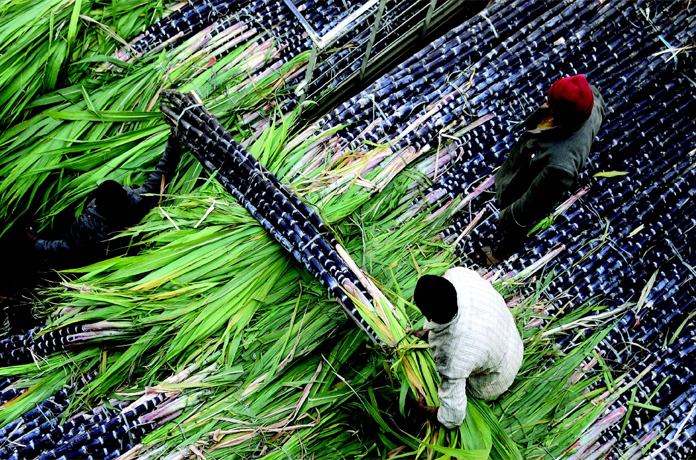
The sugarcane farmers are stuck between sugar mills, the state government and the government at the Centre. The irony is, it is the data released by the central government that puts it into the dock. The data suggests that in the last five years, the sugarcane farmers have been left on the mercy of sugar mill owners in order to get the fair price for their product. In these years, not once have the farmers been paid fully even after the coming of the end of crushing season. At the time of writing of this report, these mills owe a total of Rs 1,281 crore among themselves; the majority of which – Rs 1,092.35 crore – is owed by privately owned mills and the rest by cooperativeowned ones.
Farmers are not sure when shall they be paid their due. In fact, they have started to lose hope, and fast. On top of it, farmers are angry with the Minimum Support Price (MSP) set by the state government. They are now convinced that in spite of all the promises, Yogi Adityanath’s government has also ignored their concerns like the previous governments. As far as the MSP is concerned, the current government has increased it by merely Rs 10 for three categories of the crop. The high, medium and the low yields crop are now fetching Rs 325, Rs 315 and Rs 310 per quintal as compared to Rs 315, Rs 305 and Rs 300 per quintal respectively in the past.
The farmers are demanding to raise the MSP to at least Rs 350 per quintal. When similar demands were being raised during the reign of Akhilesh government, BJP leaders were seen supporting such a demand. The same leaders have now either vanished from the scene, or justify the move by their government. Farmers allege that a new dimension has been added to this entire exercise where the government is deliberately helping mill owners at the cost of farmers.
“The increased amount is a joke. BJP leaders were themselves demanding Rs 350 per quintal rate during the SP government. Now they are bending backwards to justify this pittance that is being given to us,” says Anil Dubey, an agrarian leader from Rashtriya Lok Dal.
On the other hand, VM Singh, convener of Rashtriya Kisan Majdoor Sangathan, maintains that it does not matter which political dispensation is in power; each one of them have systematically ignored the interests of the farmers. Left on the mercy of mill owners, farmers have not been paid fully for several years now. Consequently sugarcane farmers are now wary of remaining in this trade. Many have stopped sowing the crop at all. This is proved by the net fall in the total sown area of sugarcane in the government records.
Agrarian leader Naresh Tikait minces no word in criticising the BJP government and holds it responsible for the current crisis. However, he treats Adityanath with kid gloves. “Yogi ji is a saint. He is not aware of our situation. He is not being made aware of the real situation by the cane development minister. Had he been told of the prevailing situation, I am sure the entire problem would vanish just like that,” he adds in good measure.
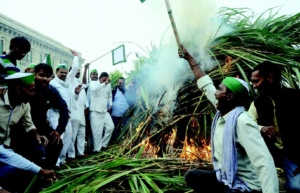
Pending which, sugarcane farmers have started to raise voices against the current dispensation. Yogi’s effigy was burnt at few places by irate farmers.
It is important to point out here that of all the states known for sugarcane farming in India, privately owned sugar mills are most dominant in Uttar Pradesh. There are as many as 99 private mills here. State cooperative is left with a total of 28 mills after selling several of their mills to the private players. Not one new mill has opened in the state in the last six years. The only exception was the reopening of a shut-down mill by Akhilesh government in ex-CM Mulayam Singh’s constituency. This does not even count.
The Akhilesh government was also accused of siding with the mill owners in their tussle with the farmers. He completely ignored the demand for raise in the MSP price. Agrarian leaders allege that Akhilesh did so in collusion with the mill owners. They now say that situation is the same under the Yogi government.
farmers are now convinced that in spite of all the promises, Yogi’s government has also ignored their concerns like others in the past
Anil Dubey maintains that while Akhilesh government in its initial days had set the MSP at Rs 280 per quintal, the government failed to pay that amount under the pressure of mill owners. After pressure from several quarters, Akhilesh allowed mill owners to withhold the amount equivalent to Rs 20 per quintal, which was to be paid at the end of the crushing season. There were many such concessions given by Akhilesh under pressure and lobbying from mill owners. However, when the time came to pay up, the mill owners did not keep their side of the bargain.
Cooperative mills in the state are technically obsolete, with the exception of a few. This, coupled with the fact that there is scarcity of trained technicians and labourers, has led to chronic losses in these mills. These mills look for government doles just to keep themselves running. To put it in perspective, while private mills operate on the efficiency factor of recovering over 9 per cent sugar from the cane, the cooperative mills hardly touch 8.5 per cent. This adds up to the losses. Says leader Rajpal Fandpuri, “If government focuses on reviving these mills it can work wonders, as in the absence of timely payments by privately owned mills, farmers have started looking towards cooperative mills.”
Mill owners on their part maintain that the fall in sugar prices has led to a cumulative loss of over Rs 3,000 crore for the industry. Under the circumstances payments to the farmers were delayed. They further add that under the Rangarajan formula, they are in the position to pay at the maximum of Rs 225 per quintal. Anything above that would send the mill owners towards suicide, they maintain.
When the tussle came to head during Akhilesh’s tenure, the Centre woke up from the slumber and decided to announce a package. UP’s strong sugar lobby reached the Prime Minister’s Office. Under the pressure from Centre, the state government decided to award the package to mill owners under the condition that they will pay up the pending amount to the farmers. After sustained pressure, the mills started paying up. The mills paid up only Rs 14,197.92 crore out of the total of Rs 18,002.62 crore pending. This was when the loose sugar was selling for Rs 40 per kilogram in the open market. This had a cascading effect on the farmers who decided to stand with BJP in the subsequent elections. Akhilesh’s goose was cooked in western Uttar Pradesh. It is another matter that the BJP leaders who were at the forefront of protest then, are nowhere to be seen now.
The Yogi government does not have a clear-cut policy for sugarcane farmers. However, Sanjay Bhoosreddy, Principal Secretary, Sugarcane Development and Sugar Industry, maintains that the government is extremely serious about the problems facing the sugarcane farmers and the industry and is doing everything that it can do to solve the issues. He insists that efforts are on to get the farmers paid.
Says Suresh Rana, the Uttar Pradesh minister of state for cane development, “CM Yogi ji is working on a road map to solve this chronic problem once and forever. We have expanded the sown area, and this means that crushing is slowly starting up in all 120 mills. Only 116 mills were active last year at this time. This government will keep the interest of both the parties in mind.”
Countering his claim, Naresh Tikait says that had the government taken punitive action against defaulting mill owners, things would have sorted out themselves. However, it was not to be, and consequently mill owners still owe over Rs 1,200 crore at the time of writing of this report. He further adds that while the retail price of sugar is increasing by the day the farmers are not getting even what is fair.
Another interesting fact is most of the defaulter mills, which includes cooperative mills as well, are from western Uttar Pradesh. This is precisely why decrease in the net sown area is higher in western Uttar Pradesh than in any other part of the state.
And if this is not enough, there’s the issue of interest on the pending payment. Law prescribes that the mill owners need to pay up interest on the pending payment. This interest period starts 15 days after the harvest is procured by the mills. Needless to say none of the mills pay interest to the farmers.
Singh further raises the question on the motive of the state government that did not announce the MSP in advance like governments in Punjab and Haryana did. Announcing MSP after the crushing season has started is ludicrous. The similar tactic was used by Akhilesh Yadav last year that forced the farmers to sell their harvest at pittance to local mechanical pressers. The same tactic is being repeated again.
VM Singh insists that the entire issue will be raised in any subsequent poll that comes. He adds that if the next crushing season starts without the payment of the pending sum of the last season, the situation would turn volatile.