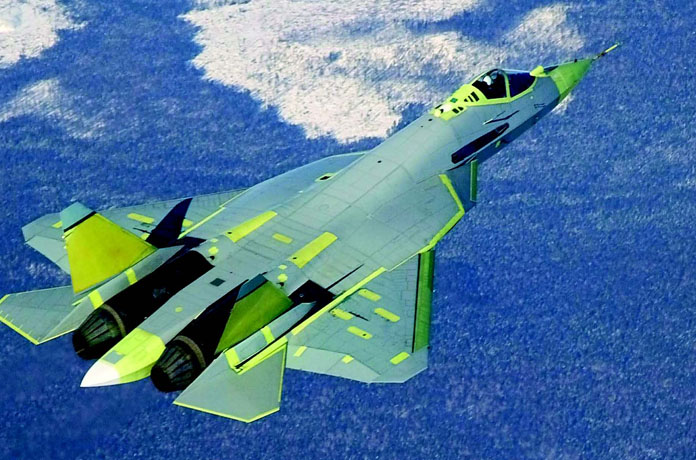
Despite the reluctance shown by the Indian Air Force about the proposed Fifth Generation Fighter Aircraft (FGFA) project, the ministry of defence is keen to ink the deal with Russia to get at least 54 jets. The IAF prescription against FGFA project with Russia is also marred with controversy as some former IAF officers had recommended to go with the project. As always with the change of Chief of the IAF, now the Air HQ is presenting a different perspective about the entire programme and projection of future fighter jet needs of the IAF.
The latest IAF argument is since Russia will only buy a dozen fighter jets out of the whole project, why should IAF go for bulk purchase order without proper futuristic technologies integrated into it. Russia announced in late 2015 that it would only induct a squadron (18-24 aircraft) of PAK FA fighter aircraft, and procure additional Sukhoi Su-35 aircraft instead. The original deal involved Russia procuring 250 and India 144 aircraft at a cost of around $30 billion by 2022. The proposed FGFA programme does not meet desired stealth and cross-section features compared to a F-35 fighter, thus major structural changes are needed that cannot be met in the existing Russian prototypes.
FGFA also does not have modular engine concept, making maintenance and serviceability of the fleet expensive and troublesome. For months, the IAF has expressed its displeasure with the joint Indo-Russian fighter project, despite the recent recommendation by an expert panel instated by the ministry of defence to push ahead with the project.
The Air Force has its reservations on the programme mainly on three points. First, the project cost is too high and way beyond what it had expected. The learning curve is not there as the project is already at an advanced stage and the stealth technology of the planes is not as advanced as that of the other similar planes.
Few senior IAF officers are concerned that the new aircraft will not meet desired requirements including stealth and crosssection features. Major structural changes would be required that cannot be met in the existing Russian prototypes. Consequently, the IAF is not keen to continue with the programme.
Indian Air Force’s opposition is not the only issue holding up the agreement. The two countries have also clashed over the issue of sensitive technology transfers from Russia to India.
HAL chairman believes that its state-of-the art facility in, Nasik will not require any major investment.
India wants a guarantee that it will be able to upgrade the fighter jet in the future without Russian support, which would require Moscow sharing source codes – the key to an aircraft’s electronic brains.
In addition, the FGFA should directly support India’s advanced medium combat aircraft (AMCA) programme – a separate Indian fifth generation fighter project. Still, there are signs for continued support for the deal from both sides.
Even, in the support of the project, the Hindustan Aeronautics Ltd (HAL) argues that the multibillion-dollar co-development project with Russia will be an opportunity as no country has ever offered such critical technology to India. HAL chairman believes that its state-oftheart facility in Nasik will not require any major investment to reconfigure it to produce the Fifth Generation Fighter Aircraft.
He said there was much in common between the FGFA and the Sukhoi 30MKI jet as both had structural similarities and the plant was well equipped to produce the new generation stealth fighter. The FGFA project between Sukhoi and Hindustan Aeronautics Limited is a decade old. The FGFA programme dates back to 2007, when India and Russia signed an agreement to explore jointly developing a fifthgeneration aircraft. Three years later, the two countries reached an agreement to spend $295 million for a preliminary design of the jet. The project was stalled after that phase, however, until reports last spring suggested that the two sides could reach an agreement to each invest $4 billion to complete the final phase of the plane’s development.
The project originally aimed to create a variant of Russia’s new stealth fighter with a number of alterations specified by India. These include potential enhancements to reach certain low observable (stealth) requirements, as well as particular avionics, communications systems, and weapons integration.
A two-seat version was also envisioned. The whole idea behind the concept being that the FGFA would leverage a fairly mature Russian next generation fighter design, and build upon it. The FGFA fighter is developed based on the Russian PAK FA (Prospective Airborne Complex of Frontline Aviation or T-50) jet in accordance with the Indian side’s technical requirements. In particular, the design and development of a two-seater version of the aircraft, the integration of an advanced engine with increased thrust are planned at the request of India, Russian officials state.
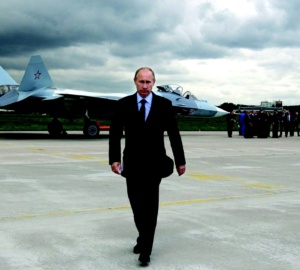 Moscow has recently designated the Russian-variant of the PAK FA/FGFA fighter jet Su-57. Like its Indo-Russian counterpart, the Su-57 will be a fifth-generation multirole, single seat, twin-engine air superiority/deep air support fighter. Simply put, India sees that it needs a stealth fighter to maintain some sort of parity with its potential foe, and for use as a force multiplier to enable its less capable fighter jets via creative tactics.
However, now the IAF believes that if the FGFA can only deliver limited low observability, with it only being considered “stealthy” in very narrow frequency bands and only from certain aspects, the goals of the expensive initiative won’t be met. Further, considering Make in India in defence, which is a non-starter today, India should utilise FGFA to get 50 per cent work share and urge some Russian companies to shift production line to India.
A high-level committee set up by the government to examine various aspects of the project has recently submitted its report and the defence ministry is likely to take a call on it soon. Finally, the political decision may favour Russia in this project in view of the changing geostrategic scenario.
As it is unlikely that the fighter jet programme be completely scrapped, India should strengthen its bargaining position with Russia in the final round of negotiations.