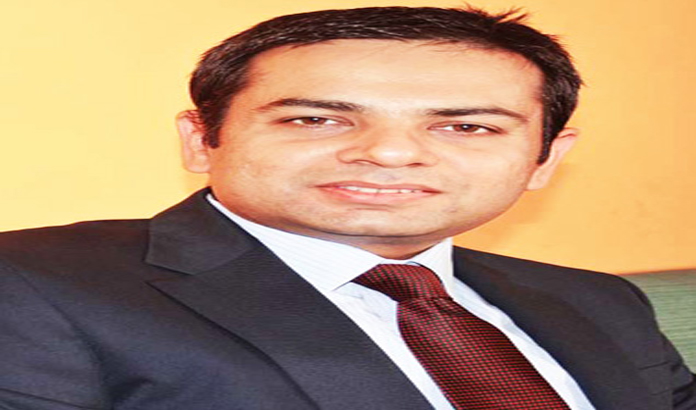
John F. Kennedy once said, “Change is the law of life and hose who look only to the past or present are certain to miss the future”. A 1998 pass out from IIPM, Mr. Saurabh Puri has gone from strength to strength in his career in which the pursuit to excel has been primary. He has worked across various industries. And on the axis of Kennedy’s words, Mr. Puri has a gifted prowess in ‘change management’. This makes him somebody who an organization can always trust in planning or strategizing for the future. He is an expert in leading profit centers and setting up new business ventures. Mr. Puri is a proven specialist in Sales Management, People Leadership, Channel Management, and Business Development. His career started in the sales vertical of PC Pro and then Hero Honda, and over the years he has seen successful roles in GE SBI, GE Money, and for the past 4.5 years, Mr. Puri has been a part of Kotak Mahindra where he is Vice President in the Cards & Loans division.
Q. Please take us through your career over the last 14 years.
A. After passing out from IIPM in 1998, I joined “PC Pro” in Kolkata. I worked there for a brief period of 6 months; perhaps not the best of the starts one would expect. However in these 6 months, while generating business for my organization, I developed a strong network of clients in IT sector. This in fact got me my next break in a fortune 500 company; “Ingram Micro”. Ingram Micro is a global market leader in IT hardware distribution. I worked there for 1 year and then joined a more known company in India; “Hero Honda”. I joined Hero Honda as Sales Officer and later got promoted to Sr Officer; managing entire dealer network of West Bengal.
Hero Honda in the real sense was the induction ground for me to the corporate culture. There was a sense of achievement and tremendous job satisfaction. I spent 4.5 years with the organization. The skills I acquired here was of channel management, event management and marketing communication.
In 2003 I got into GE SBI ( JV between SBI and GE Money); thus started my learning phase of working in a global work environment. My stint in GE SBI and GE money perhaps is the most enriching and professionally satisfying. I climbed up the corporate ladder from managing things at front end to managing large teams at a regional level. In between I also gained experience in project management and spearheaded a project of designing a distribution company for all SBI JVs.
In 2007, when Kotak Mahindra Bank launched its “credit cards”; I was part of the initial team for setting up the new venture. I joined in the capacity of the National Sales Manager – Alternate channel.
Q. What is your current domain expertise at Kotak Mahindra?
A. In 2007 when I joined Kotak Mahindra Bank, the key deliverable was to set up a complete sales process for the division. The task also included forming a 100 member sales team spread across various locations to cross-sell “credit cards” to existing customers of the Kotak group. In 2011, in addition to managing the overall “Sales” for credit cards; a new vertical under my leadership has been formed to sell personal loan to salaried segment. With this new addition, my profile has changed from managing a “function” to managing “P&L”.
Q. With the world moving to ‘cashless’ purchases, in what ways will banking through cards change?
A. Emerging markets like India offer great opportunities to credit card issuers. Issuers till date predominantly base their profitability model on interest income; however the need is to build profitability of transaction. E-money and alternative payment systems also have extraordinary growth potential.
The technology in this space is fast changing with the drive for contact-less payments and mobile money gaining traction. A Combination of factors including technological innovation is fueling the growth of e-money sector globally.
In next 5 years, the mobile phone is going to have the biggest impact on the payment landscape and will surely change the way we pay.
Banks should also focus on the unbanked and the under-banked to a greater extent. Innovative product and services encourages financial inclusion. Prepaid products are one such innovation that offers the unbanked and under-banked a first step to financial inclusion.
Q. What has been your success mantra in life as you have worked across different industries with different businesses?
A. Working in different industries not only helped me in gaining perspective through varied experience but it also helped me learn adapting to situations. I can manage “change” with utmost ease; which is an important attribute working in a dynamic industry like retail assets where the go to market strategy needs to be spot on. The critical success factors in the past may not necessarily work in the future; thus there is a continuous need to adapt to innovative solutions.
Q. In what ways can the finance ministry & IMF go hand in hand to develop the economy in association with BFSI industry?
A. As per the National Accounts Statistics, the Indian government contributes around 23% to the Net Domestic Product (NDP). Corporate sector contributes another 17% to the NDP. The remaining 60% of our national income comes from the non-corporate sector. Out of this 60% contribution by the non-corporate sector, agriculture accounts for nearly 19%, manufacturing 4.5% and services sector 36%. The non-corporate sector has a huge share in service activities, ranging from 60% in construction to 80% in trade.
Therefore the potential of noncorporate sector or self employed and young entrepreneurs in India is humongous. Indian finance ministry & IMF in association with the BFSI industry can actually fuel the growth of this segment by encouraging investments in SEZs and IT Park. Also BFSI with the help of Government Institutions can partner with Private players on a profit sharing business model –the way Venture Capitalists function today.
“ATTITUDE, SKILLS & KNOWLEDGE (ASK) IS THE KEY TO GROW IN THE CORPORATE WORLD”
Q. What is your take on Corporate Governance? Is it still just a jargon in India?
A. It will be unfair to state that Corporate Governance is still a jargon in India. With the introduction of clause 49 of the listing agreement with stock exchanges for listed Indian companies, the regulatory landscape in India has surely changed for the better. However there is a significant scope of improvement. As compared to developed countries the penal and criminal consequences for poor corporate governance in India is inadequate.
Governance standards with moderate regulation backed with stringent review mechanism is required. Weak oversight and monitoring are perhaps the biggest threat for corporate failures. Inadequate independence and lack of respect for shareholders also contribute to the risk. In India since many of the companies are family owned. This sometimes refrains the board from asking difficult questions to promoters; especially when the company is doing well. The selection of independent directors known to the promoters adds up the problem.
Q. What is your personal leadership style? Any business leaders that you admire?
A. When it comes to people management, the various style of leadership (telling, selling, participating and delegating) what we learnt in our management schools truly holds. Therefore I try and manage people as per their skills and maturity. In a lighter sense: “its horses for courses”.
When it comes to decision making, I prefer to be a better listener; instead being the one calling the shots. Participative style always results in Inclusive decision making. Most leaders in my experience make the cardinal mistake of either being autocratic or are a victim of their inherent bias towards their pre conceived notions. At this level these leaders only like one voice which is that of their own. I draw my inspiration from the first generation entrepreneurs like Narayan Murthy & Sanjeev Bikhchandani. One thing that is common in these entrepreneurs is the passion for their dream and amazing risk appetite.
Q. What is your advice to young aspirants looking to grow in the corporate world? What are the skill sets you think that are imperative for the same?
A. Attitude, Skills & Knowledge; more popularly known as “ASK” is the key to grow in the corporate world. In my experience everything revolves around this. Right attitude is not only important to succeed in the corporate world; this is something one requires to thrive in life. Acquiring skills is like a process of evolution. The best way to enhance or acquire new skills is by taking up different assignments. Knowledge is another important cog in the wheel.
In addition one needs to also pay attention to the communication skills. All the skills and knowledge goes in vain if you are not able to communicate well.
Q. From your days at IIPM, what are the memories that you will always hold dear?
A. IIPM is not only the place where I completed my last leg of academics; this is incidentally also the place where I found the love of my life (Monica Sarkar now Monica Puri).She is now working with HDFC Bank. Hence the memories of our courtship lies in the time we spent together in IIPM.
Q. How do you maintain a work-life balance and spend time with your family?
A. Maintaining work-life balance is not as difficult as it looks. The key lies in the way one fixes his or her priorities. I believe in leading a routine life; be it going to the gym in the morning , maintaining reasonably disciplined office timing, or, spending time with the kids in the evening. After all what’s the point in becoming “an egocentric perfectionist with a million bucks in the bank and nothing else to look forward to in life”.
Cult wishes him a sparkling career rise in the years ahead!