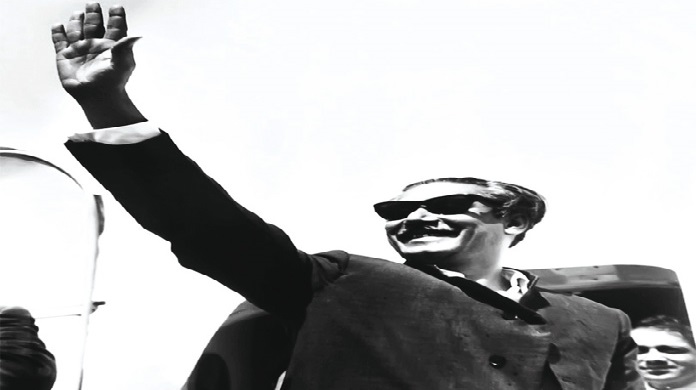
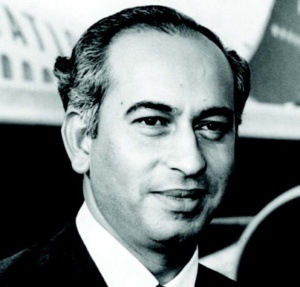
 The Liberation of Bangladesh of 1971 more often offers a test case of writing and rewriting history books– often a collection of memoirs and often opening up new facets in the debate that is already in public discourse. One interacted with a surviving 1971 war veteran Brigadier Onkar S Goraya lately – whose articulate words would lead to yet another new feature – Did Zulfikar Ali Bhutto finally repent his antagonism to Mujibur Rahman? Was it a simple power struggle?
“Compelled by the urgency to focus on rebuilding the broken pieces of Pakistan (after the war debacle from Pakistani point of view) and also mounting international pressure, Bhutto took the pragmatic decision and released Mujib….I strongly feel Bhutto also must have felt guilty having wronged Mujib after the elections and denying power to Bangabandhu,” says Brig (Retd) Goraya.
Brig (Retd) Goraya of 57 Artillery, who had moved to the forward areas in Agartala during the war as part of his unit’s Operation Nut Cracker, said the Independence of Bangladesh was inevitable as– “There was no cultural and historical affinity between West Pakistan and East Pakistan”.
Besides the battle front, another exciting part of his involvement during the Liberation War of Bangladesh, Brig Goraya said was the “uncertainty” for sometime on whereabouts of Bangabandhu Mujibur Rahman.
“After the great victory, the newborn country was caught in the mad euphoria of rejoicing and celebrating. But there was a subtle deficiency – the absence of Sheikh Mujibur Rahman, the father of the newborn baby,” he says. People of Bangladesh knew that Mujibur Rahman was arrested by West Pakistani forces on March 25, 1971 and taken to West Pakistan.
“There were doubts, whether he would return at all,” said Goraya, who has also penned a book on the 1971 war.
“There were certainly apprehensions that as 90,000 Prisoners of War were held by India, whether Mujib too will be held as hostage. But slowly public opinion in Pakistan turned against Yahya Khan,” he says –adding the onus then fell on Bhutto to act.
However, Brig Goraya said, ultimately “better sense” prevailed on Zulfikar Ali Bhutto and Mujib was released.
While there would not be any documentary evidence to suggest that Bhutto was in a repentant mood, there have been references in the past about the ‘power struggle’ between Bhutto and General Yahya Khan.
In fact, none other than Lt Gen (Retd) Ameer Abdullah Khan Niazi, who led Pakistan army in the 1971 war, had told Friday Times in an interview in 2000:
“Had the power been transferred to Mujib, Pakistan would have remained United”.
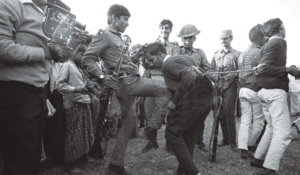 To re-track some obvious pages of history, the general elections of 1970 are considered one of the fairest and cleanest elections in the history of Pakistan, with about 24 political parties taking part. In the elections –Mujib’s Awami League could poll an overwhelming percentage of votes winning 160 seats while Bhutto’s Pakistan People’s Party with only 18.6 percent vote share could score only 81 seats in the 300-member National Assembly.
In the provincial election for East Pakistan, the mandate was more explicit –
Awami League could win 288 seats while Pakistan People’s Party could pick up only 2.
But, Bhutto declined to give up power. Rather in post-politics, he had made a fiery speech –“Idhar Tum-Udhar Hum”– in reference to East and West Pakistan as two different entities.
In these contexts, Brig Goraya has another facet to add.
“The West Pakistanis were bullies. They tried to impose Urdu language. The Bengali culture was assaulted and rightly so the Bengalis revolted. Even if 1971 was avoided – East Pakistan would have one day come out of the West Pakistan sooner than later,” he told The Sunday Indian.
“It was finally proved to the world that Muhammad Ali Jinnah’s two-nation theory based on religious divide was only a fallacy. Religion cannot unite people. People ultimately long for cultural affinity, they adore the affinity of language,” said Brig Goraya, who was in New Delhi recently to meet the visiting Bangladesh Prime Minister Sheikh Hasina.
Tracing some parts of the history – Brig Goraya says, in fact Bangabandhu’s return to Bangladesh after its independence has a unique story of its own.
“Bhutto knew keeping Mujib in West Pakistan jail for long would be difficult. But there was a section in West Pakistan baying for Bhutto’s blood,” he says.
Finally, Mujib was sent to London on January 8, 1972 – “where he was given a warm welcome by Prime Minister Edward Heath”. Then Mujib was flown to India by a Royal Air Force aircraft. Mujib was received “with much fanfare” by the then President V V Giri and Prime Minister Indira Gandhi. According to Goraya, Mujib finally reached Dacca on January 10, 1972.
“Many Bengalis had kept fast for the wellbeing of Mujib. And rightly so, the country burst into tumultuous joy and jubilation on receipt of the report of Bangabandhu’s safe arrival,” he says.
Recalling his role in the war, Brig Goraya said, “I was a Major those days and as part of our unit’s deployment I was in Agartala as Staff Officer to Brigade Commandant Janggi Singh Baba. We all got involved in Operation Nut Cracker. It was a fierce battle as from December 1 to 4, the enemy gave us a good fight; but then we took over and they were on the run.”
He still has clear memories of helicopter movements braving the darkness of night and often inclement weather over River Meghna and Indian Army subsequently entering strategic locations like Brahmanbari and Bhairavbazar.
“It was like living through a different era. Maybe unthinkable in present times. Everyone wanted to contribute to the war. People of Bangladesh were very cooperative amid multiple challenges. They knew we were there to help them. They felt proud of Indian Army and BSF’s role,” he said.
A proud Indian soldier, Brig Goraya still retains an original copy of the newspaper of December 18, 1971 – that carried the banner headline – ‘Yahya accepts Ceasefire’. In fact, the first lead story of The Hindustan Times carried a UNI (United News of India) filed copy – with the first sentence reading: “Pakistan President Yahya Khan today ordered his troops to ceasefire along the western front……”.
Intresting Tidbits
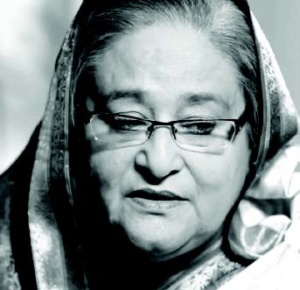 • Brig Goraya, now based in Chandigarh, said he was in the national capital also to handover a copy of his book,’ Leap Across Meghna–Blitzkrieg of IV Corps1971′ to Sheikh Hasina. Certainly, Bangladesh Prime Minister was delighted to get hold of a copy of the book.
• Brig Goraya said Indira Gandhi’s ‘diplomatic offensive’ had longterm impact as after the 1971 war, “the global image of India of a laidback and dithering nation changed overnight”.
“It is unfortunate that the nation reverted back to this image after a decade or so. But we are changing now and these are good trends,” he said making it clear, however, that his comments should not be interpreted in political context.
• It may be mentioned here that Gen Niazi in his interview in 2000 had flayed the Hamoodur Rahman Commission of Pakistan government on the ‘war debacle’. “The Commission did not unravel the whole truth about the tragedy, all the personalities and factors that fuelled the separatist movement in East Pakistan and caused the final break-up of this country”.
• “In my personal opinion, the 1971 imbroglio was the outcome of an unabated struggle for power between Yahya, Mujib and Bhutto. Yahya wanted to retain power while Bhutto wanted to attain it. This was despite the fact that Sheikh Mujib’s Awami League had emerged victorious and he should have been handed over the government.”