The NDA dispensation has demonstrated its earnest intent for improving the country’s rickety road infrastructure time and again. In its first avatar under the charismatic leadership of Atal Bihari Vajpayee at the turn of this century it came out with the Golden Quadrilateral of building up the sinews and muscles of the country’s national highways with tremendous success. The subsequent span of a decade by the Congress-led UPA cooled the earlier enthusiasm as the pace and progress of the prestigious road projects remained patchy and perfunctory. However, under Prime Minister Narendra Modi’s charge, the pace of road construction has gained distinct celerity at least from 2016-17 at 22.5 km per day, up from 16.6 km in 2015-16. In 2016-17, 16,271 km road projects were awarded as against 10,000 km awarded in 2015-16. The ministry of road transport has targeted constructing 15,000 km of national highways in the current fiscal (2017-18), the penultimate year of the Modi sarkar as it will seek fresh mandate in May 2019. This in effect means road construction of 41 km daily must perforce have to be executed to keep pace with the set target.
In parallel to paving the way for ensuring that the national highways get swanky and serviceable to a host of users, the government has also succeeded in passing the Motor Vehicles (Amendment) Bill in the Lok Sabha in the post-budget session in April 2017. It needs to be noted that for quite close to two decades, the Motor Vehicles Act, 1988 remained the major Act for regulating all the activities pertaining to motor vehicles in the country. It has been amended four times in 1994, 2000, 2001 and 2015 to tailor it to the technological upgradation emerging in road transport, passenger and freight movement and in motor vehicle management. Most provisions of the extant Act either had lost their lustre in the contemporary context or warranted adding more sinews and strengths to it particularly vis-à-vis provisions pertaining to enhancing penalty to enforce road safety as also provisions for incorporating modern technology and traffic engineering. The ministry of road transport also set up a Group of Ministers (GoM) under the chairmanship of the Rajasthan government minister for PWD and transport, Yoonus Khan, which made its recommendations for the due preparation of the Motor Vehicles (Amendment) Bill after due deliberations. It may be noted that there is some unease that the move to amend the MV Act obviously stresses the concurrent jurisdiction of the Centre at the cost of state powers. But the proposed changes incorporated into the amendment Bill follow after a long consultation bid especially by the GoM of state transport ministers so that the issues dearer to the states do not get ignored and short-changed in the final Act.
After five-hour discussions spread over two days, the government Bill was passed in the Lower House on April 10 which is basically designed to bring about a modicum of order in the country’s chaotic road traffic and to secure a legal safeguard from egregiously unruly drivers. The wellmotivated amendments moved by a few responsible opposition members were set aside as they lamentably lacked the legitimacy of numbers; still, the Bill, with the due sanctity of law after assent from the Upper House and the subsequent Presidential imprimatur, is poised to alter the country’s road transport scenario by making all the stakeholders a shade more serious than what their past abysmal behaviour showed up starkly.
The well-motivated amendments moved by a few responsible opposition members were set aside as they lacked legitimacy
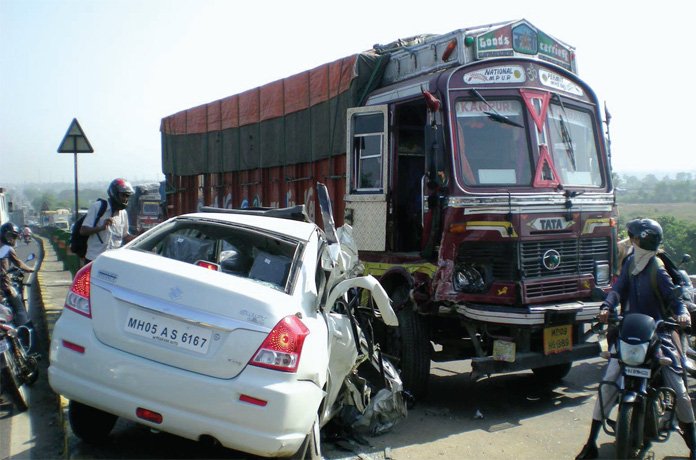
In the course of consideration and passing of the Bill, BJP MP Meenakshi Lekhi frankly admitted that “this Bill had to be brought because India is signatory of the Brasilia Declaration with the pledge that it will make all-out endeavour to halve the number of road accident deaths and fatalities by the year 2022”. Even as this suggests that we act only under duress sans our enlightened vision, the fact needs to be appreciated that at long last a significant thrust to usher radical reforms on the road transport is given for the benefit and the weal of all. This is particularly noteworthy because as the minister of road transport and highways and shipping, Nitin Gadkari said while moving the Bill that more than five lakh road accidents occur in our country every year and about one and a half lakh people lose their precious lives in these major mishaps.
The crux of the Bill include, among others, amending the Motor Vehicles Act, 1988 to address issues such as third party insurance, regulation of taxi aggregators such as those being operated by Ola and Uber and road safety and the extant categories of driver licensing, recall of vehicles in case of manufacturing defects, protection of Good Samaritans from civil or criminal action and enhancement of penalties for several offences under the well-nigh three decades-old 1988 Act. The last is significant in that novel practices such as road rage claiming lives because of the altercations in the jittery junctures of the intersections of roads was seldom known in a painfully pronounced manner as they do so now. In fact, the departmentalrelated Standing Committee on transport, tourism and culture headed by Rajya Sabha MP and Trinamool Congress leader Mukul Roy in its report laid in the Upper House early this year pulled no punches when it sought restricting licences for carrying firearms in such a way that it should not be carried while travelling in personal motor vehicles in metropolises and urban areas where traffic jam is the order of the day. It recommended this after events in road rages where guns are used to kill persons came to its notice.
It would be relevant to elaborate the provisions of major amendments in the Bill. Third party insurance is the liability purchased from an insurer (insurance company) by a person (insured party or vehicle owner) to protect one against claims from affected persons (the victim or third party) in the event of death, injury or damage to property. Under the 1988 Act, third party insurance is mandatory for all motor vehicles and the liability of the third party insurer is unlimited which is understandable as the party is the victim of the accident. This means the insurer must cover the entire amount of the liability incurred (compensation) as resolved by the tribunals/courts if the victim or his/her heir drags the issue to the courts. Incidentally, compensation amounts are calculated by courts on the basis of several parameters such as age and the earning capability of the victim!
By capping the maximum liability for third party insurance in case of a motor accident at Rs. 10 lakh in case of death and at Rs. 5 lakh in case of grievous injury, the Bill extends instant relief to the victim’s family. Most of the victims from poor families for instance do not get any compensation because the owner of the vehicle, if conscience-struck, satisfies himself with a pittance for the heinous crime and to shirk the onerous responsibility to escape from protracted legal proceedings. In a few cases, the local police also abet such blatant misuse of provisions of compensation by compelling the victim’s heirs to get satisfied with the scant amount. Now this abhorrent practice would come to an end as the victim’s heirs would get instant compensation of Rs. 10 lakh which would at least address some of the existential concerns of the bereaved family if it loses its sole bread-winner. Once the maximum instant compensation is ascertained, the insurance companies would also breathe easy as they would not have to contend with unlimited and unquantifiable amount by way of compensation which might dent their hard-earned premium pots. In his reply to the passage of the Bill, the minister confirmed that on third party insurance the upper limit of the compensation amount claims made to the tribunal by the victim’s heirs has not been fixed and the entire amount will have to be paid by the insurance companies. He said the victim’s heirs may accept the amount set in the amendment Bill as otherwise they would also be free to approach the claims tribunal.
The ineluctable corollary is that where the victim’s heirs do not have the time, energy and cost to take the issue to the tribunals/courts, they would get satisfied with the compensation set out in the law. No doubt, whether the compensation of Rs. 10 lakh is the ultimate price for a human being’s life is a philosophical issue. But the stark reality remains that instant and urgent relief and succour is given to the family of the victim without making them run from pillar to post in the interminable search for sustenance help for those left behind.
Other changes proposed in the Bill include mandatory disclosure of Aadhaar number to apply for driving licence
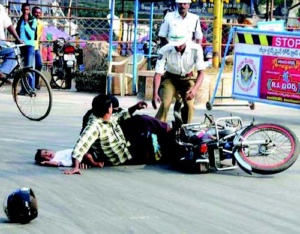 Though the Standing Committee scrutinising the 2016 Bill favoured deleting the provisions pertaining to capping liability, the government has done a yeoman’s service in helping out hapless families who are the victims of road rage and contretemps to enable them to face the future with a ray of hope through the swift release of monetary assistance.
Other changes proposed in the Bill, inter alia, include mandatory disclosure of Aadhaar number to apply for driving licence, process of getting driving licence online, making contractor responsible for bad roads liable to be penalised, prescribing standards for electronically monitoring highways and urban roads for enforcement, proposal of stricter penalties for high-risk offences such as drunken driving, perilous driving and non-adherence to safety norms by drivers such as not putting on seat belts and helmets. The Bill also provides for an accident victim fund which would be used in case of hit-and-run incidents and for providing treatment to the injured during the precious golden hour.
With the proposal of the new fund, the extant Solatium Fund would be merged into this new fund. The Bill also seeks to pave the way for farreaching changes in rural-urban transportation and last-mile connectivity. With the country’s passenger vehicle sales having crossed three million mark in 2016- 17 and the NDA government demonstrating its dynamism in road construction, both national highways and rural roads, the amendment Bill has not come a day too soon. Though the law has flaws as it is difficult to satisfy every interest group, it will definitely go a long way in bringing transparency to the existing system of road transport administration, which itself is a salutary exercise in salvaging it from slipping into disarray. Eventually, the onus is on the state governments too to prepare a quick rollout of administrative reforms set forth in the amended law such as issuing learner’s licences online, logging address changes through an online application and digital service delivery with set deadlines. Together both the Centre and the states can make our roads safe for all to draw comfort with the amended Act becoming the catalyst for the genuine development of this vital infrastructure sector.