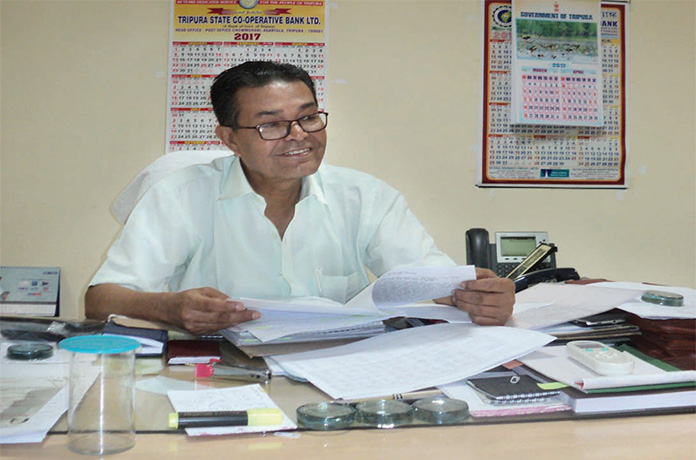
In the words of a former Mexican ambassador to India, Octavio Paz, India as a nation is made of ‘diversity’ created by extreme contrasts: modernity and antiquity, sensuality and asceticism, carelessness and efficiency. These phrases – suggesting the contrasts too often fit the bill well when it comes to the state of Tripura and the governance here under a Marxists’ regime.
The brown haze dusty roads in rural areas including townships like busy commercial hub Dharmanagar and Kamalpur reflect that the Marxists’ regime has kept the state with a minimum dose of development yet there is a control thought process that has ensured that there is a strong Left leaning of the voters.
The CPM is in power in the state since 1990s and the incumbent Chief Minister Manik Sarkar is ruling the roost since 1998. By March 2018, he would be facing a keenly watched assembly polls – already being billed as an exciting battle.
The common voters – often on the condition of anonymity – say for the first time in two decades time, the CPM will face a real electoral contest.
Gautam Biswas, a former ConGressmanturned-trinamool leader, is one suCh new turnCoat who joined BjP reCently with muCh fanfare
According to a tea stall owner R. Biswas, “Elections in last two decades for CPM used to be got-up match with the Congress. The CPM leadership always struck a deal with the Congress high command and hence Manik Sarkar had an easy sail. This time, he is facing a rough sea.”
Biswas’s contentions have many takers. “We have been dedicated anti-CPM voters for ages but every assembly election, especially 2008 and 2013, we were just surprised to see the final outcome. The Congress virtually gave away some seats as gift,” says fish trader Arindam Nath near Shanti Bazar market – on way between busy town Ambasa and Kamalpur.
There is certainly an increase in political activities in the state after long time. While the BJP has directed its tirade against the Marxist regime – often trying to play the antiincumbency mood – what is worrisome for the ruling CPMis that a large number of leaders and workers from the Congress camp and also from Trinamool Congress are embracing the saffron outfit.
Gautam Biswas, a former Congressmanturned-Trinamool leader, is one such new turncoat leader who joined BJP recently. But he has explanations well articulated: “I fought CPM all along, but was always let down by the Congress high command. I then joined Trinamool Congress presuming Mamata Banerjee is sincere about fighting the Leftists; but after demonetisation, she spoke to Sitaram Yechury and was willing to join hands with the Left; that was a nightmare for me. I had no alternative but to join a party which is sincere about fighting the Marxists.”
On the face value going seems to be fairly good for the BJP. This confidence only got a bolster during two-day visit of BJP president Amit Shah on May 6 and 7. According to BJP insiders in the state, Shah’s both the engagements with select intellectuals and media persons went off well. He also held a public meeting in Kumarghat, a known hub of Hindu migrants from Sylhet district in Bangladesh, and the response was much to the satisfaction of the organisers.
Thus, it is not without good reason that a confident Shah asserted in unambiguous term, “Our fight is with the communists who are finished globally and the Congress, which is finished nationally.”
Thus, the reading is, the CPM is likely to see a serious contest in the ensuing assembly elections.
“The real election is on the cards and the contender is the BJP. The saffron party is definitely weak organisationally, but people are slowly moving towards it, that’s important,” says a journalist B. Bhattacharjee.
In fact, BJP sources say, the number of BJP members, which was stated to be around 2,000 only sometime back, has gone up to more than 2 lakh over the last three years in Tripura.
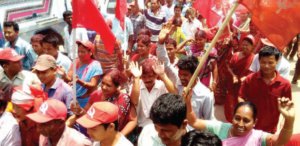
In a show of strength, the party workers are putting BJP flags across the state including in rural hubs and remote market places like Salema and Halali. Enthusiastic workers also held a motorbike rally in Agartala in May.
However, there is a catch or a sort of strategic challenge for the saffron party.
Both in West Bengal and also in Tripura, where Marxist leader Manik Sarkar is in power for the last two decades – the BJP strategists realise that even the upper caste Hindus do not necessarily relate to the ‘Brahminical appeal of the RSS’.
In other words, the Hindutva card may not be saleable.
“Hence there was a change of strategy. In Naxalbari in West Bengal, Amit Shah sat for lunch hosted by a tribal couple. This was like befriending a poor family. Certainly this has left even Trinamool leadership huffing and puffing. In a small way, Amitji has been able to strike a chord and Mamata Banerjee realises this,” the source said.
The saffron party strategists realise that the BJP lacks the renowned Left slant – both economically and socially – and that this could be a hurdle to sway minds of Bengali voters including in Tripura.
Though a tribal state, Tripura accommodates overwhelming number of Bengali Hindus– most of them having migrated from Bangladesh in 1947 and some in 1971.
“We do not say we have started making difference ideologically. But the BJP vote share in West Bengal and Tripura has been increasing gradually,” says a key party leader working closely with BJP chief Amit Shah.
Admittedly for the BJP, unlike in states like Assam or even in Odisha, the fact that Bengali voters and even others in the states of West Bengal and Tripura have remained “procommunists” ideologically, culturally and intellectually have made things difficult for the organisational drive (in Tripura).
Therefore, the party leaders have drawn out a few specially worked out electoral strategies to capture the minds of voters in these two states.
A well structured campaign has been launched in Bengalidominated parts of Tripura where the pro-Hindutva slant would find “easier acceptance”.
The idea is to also capture the upper caste Bengali mind – for a start – especially among those whose forefathers had to leave Bangladesh during Partition in 1947.
The BJP is beginning to understand that there has been an inherent advantage for Trinamool Congress for ‘being pro-Left or more Left than the Left’ in West Bengal – it had helped Mamata Banerjee’s party make a decisive mark in the erstwhile Marxist-ruled West Bengal easily.
Also displaying yet another departure from BJP’s known politics of temple and Hindutva issues – as was done with all the machinations in Uttar Pradesh – for Bengal and Tripura, the saffron party leaders are more talking about mundane issues – jobs, women empowerment and industrialisation.
“The repeated assertions by Amit Shah and BJP leaders to reach out to intellectuals in rural Bengal and Tripura is essentially to break the umbilical cord between Bengali ‘Bhadrolok’ and pro-Marxist intellectualism,” the BJP source says.
New challenge: Another moot point that needs closer scrutiny is how is the BJP – wedded to its hardcore Hindutva philosophy – has been able to make deeper penetration in Tripura. It goes without saying that the saffron party is here in confrontation with the Marxists – who are ruling the state since 1990s – as also with Christian forces.
The saffron party is thus avoiding the hardcore Hindutva issues like temple here and is thus trying to sell Prime Minister Narendra Modi’s ‘developmental card’ especially among the tribal and Christian sections.
“The overdose of Marxist regime in Tripura has made religious affinity weak. This applies to both Hindus and also the Christians. Today, this is, ironically, helping BJP’s cause,” says a BJP leader in Dhalai district.
Among the Christian leaders in the region – Pastor T. Chakhesang from Nagaland says, “The institution of Church has always been weak in Tripura due to many factors including the overwhelming Leftist influence.
Today, the BJP is trying to make inroads exploiting that gap. In these areas, therefore, the BJP is pushing the ‘catalyst of change’ image of Narendra Modi.”
FighTiNg The Pro- commuNisT BeNgAli miNd
Among the voters in Tripura, especially among the Bengali sections, one can be the biggest political rival of the Marxists or Leftists, but essentially Bengali voters may still not entirely reject the ‘power of Marxism’ as an intellectual food for thought and as a ground of reasoning. This is making BJP work hard to break the inherent pro-Leftist leaning of the voters. It is true, Tripura has overwhelming presence of Bengali Hindus – who had to flee the then eastern Pakistan (read now Bangladesh) during Partition in 1947 and also in 1971 during the Bangladesh war of liberation.
The Bengali people form the ethno-linguistic majority in Tripura while the indigenous communities the native Tripuri tribals form more than 30 per cent of the state population.
In terms of supposed Left leaning of the voters, rural BJP workers like woman leader from Kamalpur township, Sapna Das,told this magazine: “There is a gradual change and many young voters, who are aspiring and are readily rejecting the Left ideology, are looking towards Narendra Modi for change and development.”
BJP-led NdA hArmiNg TriPurA, sAys sTATe miNisTer
Tripura finance minister Bhanulal Saha says that the BJP-led Narendra Modi regime is discriminating against Tripura. He alleges that the Centre has made use of the 14th Finance Commission report and brought in “unrealistic fund allotment” formula for Tripura and other northeastern states.
“The state requirement from the central pool under the 14th Finance Commission allotment formula was Rs 64,215 crore; but with its unrealistic decision, the Centre decided only to allot Rs 31,309 crore – that is 58 per cent of the demand. Is this justified?”, Saha told this correspondent in Agartala.
 There is certainly a design and a tendency on the part of NDA government to lead CPM-ruled Tripura to a “revenue deficit” trap and the Narendra Modi regime is in the process hampering many welfare schemes and developmental projects in the state. “On the pretext of recommendation of the 14th Finance Commission, the Centre and newly created NITI Aayog discontinued the `Special Category State’ status to all northeastern states. The impact was felt the worst in Tripura. There is a widespread resentment and protest all over the northeastern region. The central government assured that 90:10 funding pattern would be restored, but nothing happened,” says Saha.
In this context, he further says, “Instead of helping a far-flung border state, there has been a design in the central government’s and BJP leadership approach. They tightened fund allocations on one side and on the other side, the BJP president Amit Shah visited Tripurain the first week of May and made utter false allegations that our government is not making use of the central allocations.”
Saha dismisses BJP’s aggressive drive in the state as day-dream and asserts that there is no alternative to Manik Sarkar in the state.
It is worth mentioning, CPM general secretary Sitaram Yechury has also said that the assembly elections in 2018 will be the Battle of Waterloo for the BJP.