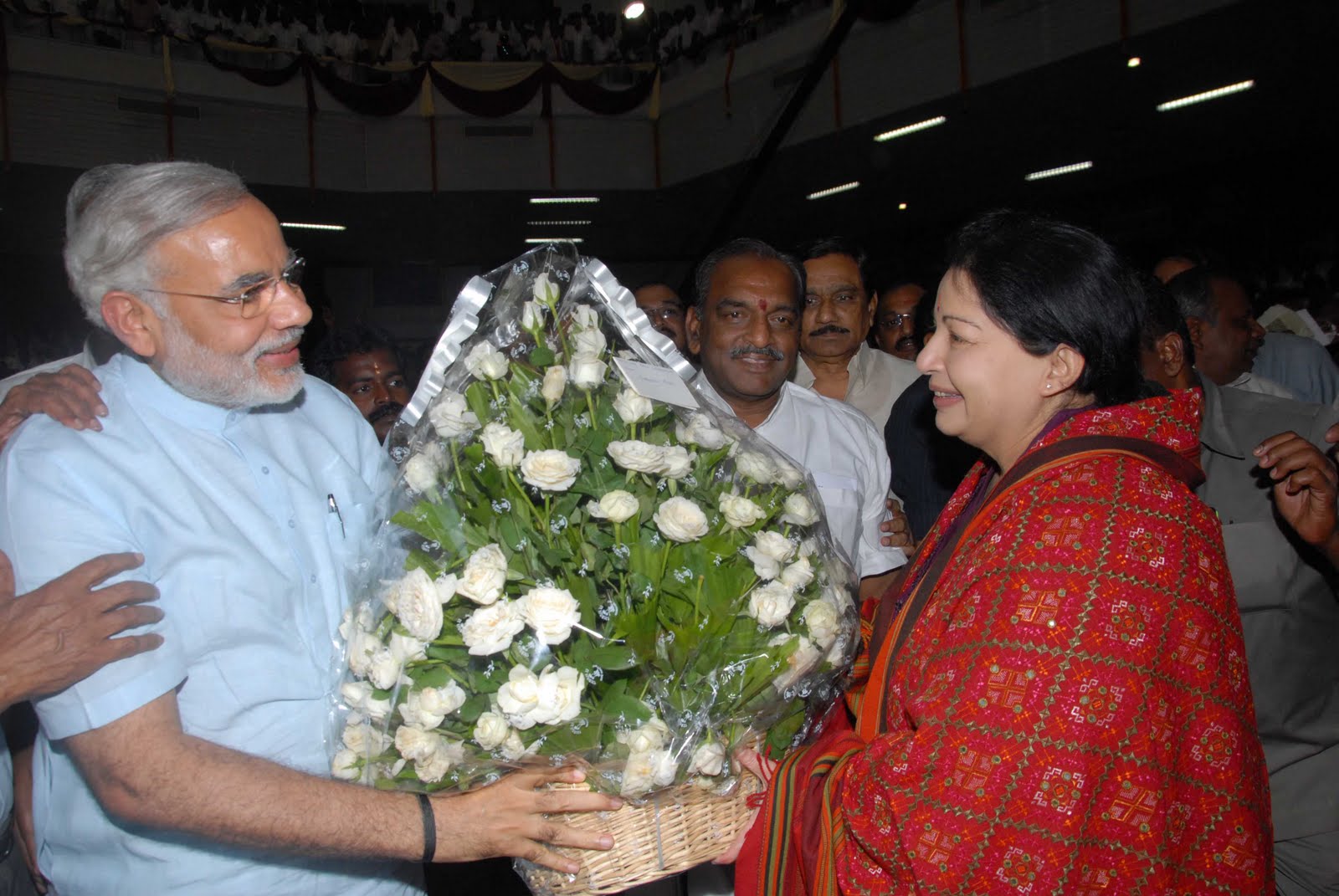
There are clear indications that Jayalitha Jairaman, feisty chief minister of Tamil Nadu and AIADMK supremo, is ready to form a third front-like alliance, read federal front alliance, with the help of old friends and hopefully, new allies.
The latest indication of her appreciation of coalition politics came in AIADMK support for CPI candidate D Raja in the Rajya Sabha elections. After much dithering, she finally agreed to the CPI request.
With moves like these, she hopes to influence powerful regional parties like Samajwadi Party (SP), the Bahujan Samaj Party (BSP), Biju Janata Dal (BJD), Telugu Desam, TRS, JDS, Janhit Congress, Haryana, and others and put into a place a non-BJP, non-Congress alliance.
In the state, analysts say, Jayalalitha is keen to go it alone. Says veteran play right and political analyst Cho Ramasamy, ‘‘Even after two years, the DMK is struggling to overcome the setbacks they faced in the assembly elections. Even DMK cadres are demoralised. The other influential parties in the state are in disarray. The Congress is not a major player in Tamil Nadu. In the given situation, it will not surprise me if she decides to go it alone.”
Jayalalitha loyalists point out that ‘‘Amma (Jayalalitha) has learnt a lot from her previous regime where she took very strong actions, like sacking 1.75 lakh government employees a year before the polls. Because of these mistakes, she had to face the consequences in the parliamentary and 2006 assembly elections rout.”
With elections to be held in 2014, the Tamil Nadu chief minister has announced a slew of sops and welfare schemes for the poor. A few months ago, Amma announced the opening of thousands of government-run low cost eateries all over the state: Re one for an idli and a lunch worth Rs three.
Sociologists see this scheme as ‘socially revolutionary’ and politically, a surefire winner. Then again, despite spiraling inflation, Jayalalitha has announced that the needy can purchase goods for Rs 20 per kilo – goods normally available for Rs 50 per kilo in the open market. This is in addition to 20 kg of free rice for BPL card holders. As part of this welfare programme, she recently inaugurated farm fresh vegetable shops in Chennai to control the sky high price of vegetables and fruits. Says Tamarai Selvi, a home maker from Thiruvanmiyur: ‘‘All these measures will help in controlling prices of essential food grains.’’ It is this sentiment that the chief minister is banking on for 2014.
Jayalalitha is also seen to have moved against corruption. Recently, she sacked her Labour Minister Chella Pandian from the cabinet and party posts on graft charges against him raised by the media. She has also taken action against those accused of corruption and irregularities. Political viewers see the much improved power scenario in the state as her singular achievement. Points out senior journalist Sigamani: ‘‘The comparison is with the last DMK regime where big power cuts had become the norm. If this improvement continues till the elections, it will definitely convert into votes.’’ And there is no reason why it should not.
Her support for CPI’s Raja is calculated to first get the Left on her side as Jayalalitha knows a third or alternative front at the national level will not be possible without them. She also has fine personal equations with Narendra Modi and she makes no bones about it, keeping her options open.
According to her calculations, as these smaller regional parties have the potential to win about 35 to 40 seats across India, she can accord an alternative ideological colour to this amorphous front.
AIADMK insiders say that Jayalalitha is well prepared for an early election. At a general body meeting of her party held in 2012 at the famous Srivari Kalyanamandapam auditorium on the outskirts of Chennai, she appealed to her party rank and file to get ready for Lok Sabha elections any time between December 31, 2012 and May 2014 and urged them to work hard and win all 40 parliamentary constituencies, if possible. She hinted obliquely that anyone with 40 seats (including Pondicherry constituency) will decide who will rule India. Her MPs certainly exude that confidence.
At any rate, there are enough indications that she would want to be the king maker – or even the queen herself. ‘‘If she sweeps all the 40 seats, she will get national importance. In that situation, she may even try to form a government under her leadership; otherwise she would be happy to play the king maker in deciding the next Prime Minister,’’ says one AIADMK MP.
There is another calculation as well. If she can win all seats in Tamil Nadu and other regional parties do not do as well as they are expected to do in their own areas, she will not hesitate to begin the process of putting into place a new political alignment and persuade the BJP to give her outside support. The sentiment that she belongs to the Brahmin community, Jayalalitha hopes, will see upper caste lobbying in her favour.
Another view from BJP well wishers like Cho Ramasamy is that small parties will assume an increasingly important role after the elections. He foresees the BJP emerging as the single largest party with the help of Modi. At that time, he says, it is important that Jayalalitha has sizable number of MPs to consolidate her friendship with Modi. For this purpose alone, it is important that she wants to win as many seats as possible in Tamil Nadu. And so far, she appears to be doing well.
The DMK, her main rival, is on tenterhooks. It is not just the political defeat that continues to pull down Karunanidhi and family; it is also the cases currently lodged against his family in the 2G cases, which can recoil on him anytime without warning.