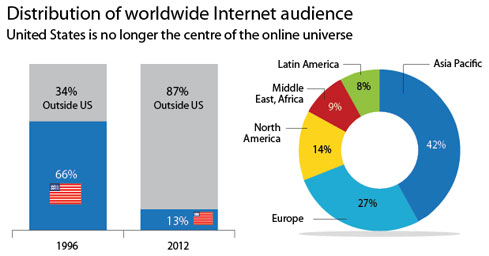
A few weeks ago Cupertino based Apple Inc. announced that it has cumulatively sold more than 170 million iPads since the product first debuted in 2010. Ever thought: What if iPad users constituted a country? Well, it would be roughly tied at No.7 with Nigeria, and if we also consider the pace at which the product is selling, the country would probably eclipse Pakistan next quarter and Brazil the quarter after that. And if you thought that this was something, there’s more. If Facebook users constituted a country, it would be the world’s third largest, behind China and India. Add to this some more interesting statistics: Of Facebook’s nearly 1 billion strong users, approximately 200 million are mobile only. In other words, nearly 20% of Facebook’s user-base doesn’t own a PC. YouTube reaches more adults in United States than any cable network. In fact, the number of people who watch television has fallen behind the number of people who watch YouTube on a regular basis. Further, research has revealed that more than 95% of Facebook users log into their account every day. The same number for Twitter is 60% and for LinkedIn is 30%. What’s more? Social Media has already overtaken porn as the #1 activity on the Web.
Marketers certainly know what social media is. They even claim to know what makes social media so potent – its ability to amplify effects. Yet the vast majority of marketers have no idea how to harness its power. In fact, according to a recent survey – Digital Distress: What Keeps Marketers Up at Night? – by Adobe, “Just 1 in 3 marketers thinks his company is highly proficient in digital marketing.” No doubt, companies are missing a potentially huge prize. In fact, the McKinsey Global Institute last year estimated that $900 billion to $1.3 trillion in annual value could be unlocked in just four sectors by products and services that enable social interactions in the digital realm.
Since the Internet rose to prominence in the 1990s, it’s grown rapidly as a communications platform and has created several industries, while assisting more in their expansion. At present there are over 2.4 billion Internet users in the world, of which 1.5 billion access the Internet through their mobile devices either as a primary or a supplementary device. The Web also has proven to be an incredibly effective marketing and advertising platform, which has allowed many companies to reach their target demographics and increase their overall visibility. While online advertising and paid efforts such as banner ads and pay-per-click have been effective for many businesses, search engine optimisation and social media optimisation are considered by most the next logical step for many businesses which are already invested in Internet-centric campaigns. This is the reason why spending on social business software is growing at 61% per year, and will do so right into 2016 (Forrester Research). In that year, it is estimated that corporations around the world will be shelling out over $6 billion on such products and services. But is this investment really enough to harness social media to shape consumer decision making in predictable ways?
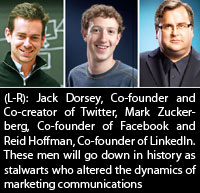 Till recently, business conversations were primarily one way messages – from marketers to customers. Then, the new age of social media enabled two way conversations. Marketers saw customers talking back and then talking to each other. Today, there is a post-modern shift toward complete democracy – everyone has a voice. Now even this is changing.
If not already, digital marketing is about to enter a more challenging territory. “As emerging technologies are poised to personalise the consumer experience radically – in real time and almost everywhere – marketing is headed toward being on demand, not just always “on,” but also always relevant, responsive to the consumer’s desire for marketing that cuts through the noise with pinpoint delivery,” states a recent report by Peter Dahlström (Director in McKinsey’s London office) and David Edelman (A principal in McKinsey’s Boston office). What’s fueling on-demand marketing is the continued evolution of technology and consumer expectations. Already, search technologies have made product information ubiquitous; social media encourages consumers to share, compare, and rate experiences; and mobile devices add a “wherever” dimension to the digital environment. But then that’s just the start. The developments pushing marketing experiences even further include the growth of mobile connectivity, better-designed online spaces created with the powerful new HTML5 Web language, the activation of the Internet in many devices through inexpensive communications tags and micro-transmitters, and advances in handling “Big Data.” What’s more? Consumers may soon be able to search by image, voice, and gesture; automatically participate with others by taking pictures or making transactions; and discover new opportunities with devices that augment reality in their field of vision (eg. Google glasses).
As these digital capabilities multiply, consumer demands are bound to rise. Consumers will not only demand on-the-go interactions with the brand, but would also like to try new things, things that create some value for them. Not to say, they expect this two-way communication process to be easy and customised as per their needs. Agrees Dawn Iacobucci, the E. Bronson Ingram Professor of Marketing at Owen Graduate School of Management as she tells 4Ps B&M, “It’s a great time to be alive! We have so many media choices, and the Internet alone is phenomenal. Computer technology continues to get smaller and less expensive and its pervasiveness fosters our inter-connectedness.”
In fact, over the next several years, we’re likely to see the consumer experience radically integrated across the physical and virtual environment. Most of the technologies needed to make this scenario happen are available now. One that’s gaining traction is near-field communication (NFC) – embedded chips in phones exchange data on contact with objects that have NFC tags.
 To understand it better let’s assume you have a phone with NFC capability. While shopping you come across an interesting pair of sunglasses which also has a NFC tag. Curious about it you tap it with your phone. As soon as you do that your phone prompts you to photograph your face and then displays how the sunglasses would look on you in various colours. You are then invited to send the photo to Facebook friends who are asked to vote among a choice of colours that best suit you. Meanwhile, you receive a text alert from another retailer offering a 20% discount if you buy the pair from them. Once you buy the product online and it’s delivered to you, a message asks if you would like to post a picture of yours wearing it, with a link for others to buy it as well. What’s more? When you meet your friends (who liked the product), your cell phone reminds you of the NFC chip in the sunglasses and offers you an additional discount of 10% (in your next purchase from that retailer) for each friend who taps and buys a pair of sunglasses.
The example clearly illustrates the new areas of consumer demands that are cropping up. Interestingly, the price of such tags is already as low as 15 cents, and new research could make them even cheaper, so more companies could build them into almost any device, generating a massive expansion of new interactive experiences.
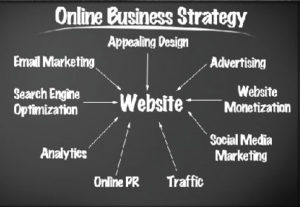
This changing dynamics of engaging consumers in the online space are the kind of things that haunt marketers. And, just adopting social media by creating touchpoints across platforms won’t reap favourable results. So what should be done?
 IT’S ALL ABOUT JOINING THE DOTS. HAVE YOU?
Today, many brands have successfully defined and addressed customer interactions across a few channels. What they need to be designing, however, is the entire story of how individuals encounter a brand and the steps they take to evaluate, purchase, and relate to it across the decision journey. Marketing or customer research can’t do this alone. “Managers from multiple functions need to go together into the field to do deep ethnographic research – watching how customers shop, going into their homes, and uncovering the triggers and motivations that drive behaviour” states the report from McKinsey. A case in point is the soft drinks giant PepsiCo. The cola major has successfully used social networks to gather customer insights via its DEWmocracy promotions, which have led to the creation of new varieties of its Mountain Dew brand. Since 2008, the company has sold more than 40 million cases of them.
Cross-functional teams should also come together and join hands with third parties such as industry bloggers and thought leaders from online-media companies, to map out new ways to influence the decision journeys of customers with different attitudes toward the brand or different kinds of spending behaviour. Marketers should then explore new ways in which social media could help customers show off the value they received.
 I KNOW…
WHAT YOU DID LAST WEEK!
To win over on-demand customers make data and discovery a nonstop cycle. You must know them, what they expect, and what works with them, and then have the ability to reach them with the right kind of interaction. Data lie at the heart of efforts to build that understanding – data to define trends, data to measure the effectiveness of activities and investments at key points in the consumer decision journey, and data to understand how and why individuals move along those journeys.
To realise that potential, marketers also need a clear view of the broad trends in its market and category. They need to track what people are looking for, what people are saying, and what people are doing to figure out warning signs of trouble or signals of latent opportunity. Although many companies have access to such data, yet few have much clarity on which things they need to look for and who needs to know what. But then there are some that have been successful in their endeavour. For instance, FMCG major Dabur got a jump on competitors when it saw a sudden rise in online conversations about the lack of natural ingredients in hair care products and then recognised a corresponding rise in search inquiries on the subject. All it did was that it quickly launched a new line of natural hair care products and gained a successful early mover advantage in a growing segment. Coffee chain Starbucks too uses MyStarbucksIdea.com to collect its customers’ views about improving the company’s products and services.
Hence, marketers need to push every customer-facing function to work together and form an integrated view of consumer decision journeys. It will not only help them reduce total costs per action, but also allow them to find the most effective decision-journey patterns, and thus spot opportunities.
 STICK TO THE BASICS
Last but not least: Just stick to the basics. When considering social media, what we really need to realise is that it is based on the very basic concept of communication. The way people talk to each other, share information and act upon recommendations is more or less the same throughout the world. And therefore, the basics of social media marketing also remain the same. For instance, whether it’s US or India, marketers need to ensure that they have accurate data on their target market. That helps in approaching relevant customers on platforms. Even the value proposition has to be consistent through out the media mix. “You can’t promise one thing on television and then come up with a different proposition on Facebook. That creates confusion and raises questions on credibility. The trick is to understand what is it that emotionally drives consumers and then tap into that base,” Crispin Reed, Partner at the London-based brand consultancy Fusion Learning tells 4Ps B&M.
 Further, brands need to embrace these platforms as against adopting them. The rise of social media has created something called social gravity. It’s a place where people virtually meet and interact with each other. It can be in the form of a Facebook or LinkedIn group, or for that matter even a blog. Now you, as a marketer, have two clear choices – either keep doing what you’re doing right now or since you know that a social gravity does exists, why not become the center of it. By doing so, you’ll be able to create orbits (engagement platforms) which will pull customers who will pull in more people along with them. The advantage of creating social gravity is that it generates value for the consumer which goes well beyond the standard product or service. A lot of people look at Apple’s App Store and Google Play as a brilliant strategy to make a lot of money. But a very few realise that these are orbits which the two technology giants have created within their ecosystems. It brings back Apple and Android users again and again to a platform where they have an opportunity to preview, download and give feedback. RIM on the other hand has been failing because the BlackBerry App World is not at all engaging. The company has not been able to entice the developer community to develop apps to as significant a level as Apple and Android have. When your product revolves around engagement, then you better strengthen your engagement platforms.
 Today employees, customers and external stakeholders are all embracing social technologies. While the true impact of building them into the culture, structure, and work flow of organisations remains to be seen, we know that brands adapting to a more open, sharing, and flexible world stand to create tremendous value. Thus, to deliver these new experiences, companies must rethink the role and structure of the marketing organisation and how it engages with other functions.
In fact, marketers need to challenge the delivery processes behind every touch point: Are the processes making the best use of data and interaction opportunities? Are they appropriately tailored to meet expectations of brand? The changes are likely to cut deep, transforming the way companies manage campaigns and communities, measure performance, provide customer support, and interact with outside agencies. But then, staying ahead of the design, data, and delivery requirements of on-demand customers is much more than a marketing issue. Isn’t it?!