The ‘Insider’ versus ‘Outsider’ question has for long been debated over. One school of thought claims that firms that train insiders gain because the Insider is simply not an Outsider and brings company-specific knowledge to the fore. The other recommends Outsider CEOs as he brings new energy and skill-set into the firm.
Studies in this respect are not hard to come by. Over the last few decades, researchers like Zajac (1990), Kesner and Dalton (1994), Wiersema (1995), Harris and Helfat (1997), Shen and Cannella (2002), Zhang (2008) and others have toyed with the idea of how the ‘Insider versus Outsider’ theory plays out when it comes to organisational outcomes. While a handful of Outsiders have made companies shine – like Ford’s Alan Mulally and Boeing’s James McNerney – that this superstar lot is a lot less immune to failure is a fact exposed. Classic failures – like Chrysler’s Robert Nardelli (brought in from Home Depot), GM’s Ed Whitacre (ex-AT&T), J. C. Penney’s Ron Johnson (ex-Apple), Supervalu’s Craig Herket (ex-Wal-Mart), HP’s Leo Apotheker (ex-SAP), Apple’s John Sculley (ex-PepsiCo), Xerox’s Richard Thoman (ex-IBM), Enron’s Jeff Skilling (ex-McKinsey), KMart’s Charles Conaway (ex-CVS), Yahoo’s Scott Thompson (ex-PayPal) – establish the validity of the argument that globally, it is the Insider who influences a spike in the value of a corporations.
Grow your own. In this ‘Outsider-Insider’ soap, the science of succession planning – the practice of training ‘Insiders’ – has already become conscience for many corporations. It isn’t shocking that companies today are focusing more on grooming talent indoors, getting high-potential employees laced-up to assume strategic decision-making responsibilities.
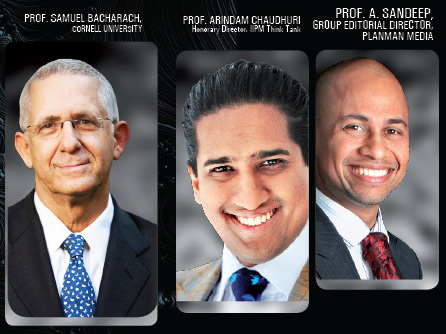
In this Cornell-IIPM Think Tank- B&E joint study, Prof. Samuel Bacharach, the McKelvey-Grant professor in the department of Organizational Behavior at Cornell University’s ILR School, brings to the table his three decade-long experience in leadership development programmes. He writes on why training ‘Insiders’ is important in a world where organisational commitment is a rare quality. Prof. Bacharach writes on how to identify high-potential employees and what should be the form and shape of good training programmes.
The second part is a joint write-up by two experts on management – Prof. Arindam Chaudhuri and Prof. A. Sandeep. They blow apart the myth of the superstar ‘Outsider’ proving how successful corporations across the world – like Apple, GE, IBM, P&G, 3M, PepsiCo, Coca-Cola, Southwest, GM, Verizon, Cardinal Health and many others – are putting Prof. Bacharach’s theory of ‘Identifying and training high-potential Insiders’ into practice.
 Leadership Training for high potentials
Prof. Samuel Bacharach, McKelvey-Grant Professor of Organisational Behaviour at Cornell University ILR School, writes an exclusive joint-study article on why creating a robust strategy to refill your company’s leadership pipeline to create change leaders out of high potential insiders regularly is a must for any organisation to move ahead
You may think that you’re the piece that holds everything together for your business. But this is far from the truth. In reality, the key to making your business a success – the key to ensuring growth – is to have a leadership pipeline. That is, you want to create a robust strategy to develop new leaders who are capable of seeing new horizons and methodically moving agendas to achieve those horizons.
Leadership is the key. However, let’s get leadership in perspective. The biggest mistake you can make is to assume that leadership belongs in the realm of the few or to think that leadership is a question of charisma and stage presence. If you hold on to an elitist notion of leadership – that leadership is only for the select few – you will never realise the potential of those around you.
You need to break apart the mythology around leadership and discover that leadership is about the skills of execution. Execution means mobilising teams around ideas and sustaining those ideas to fruition. Execution is about having the practical, learnable behavioural skills of negotiation, coaching, and team building. These are all skills that can be methodically taught and these are the type of skills that are essential to your organisation’s success. If you believe that leadership is key to the future success of your organisation, you must take control of leadership development and put in place a program that will give your high potentials the skills they need to move your organisation ahead. With these skills in hand, your high potentials can become true change leaders.
Your first challenge is to identify the high potentials you want to have in your pipeline.
Not everyone in your organisation is going to be a high-potential employee. Not because you work with a group of poor performers who embrace mediocrity – but simply because some people have different life goals and aspirations and are perfectly content with their current role.
There are also employees who feel that they have great potential and don’t mind talking about it. They spend time polishing their resumes without the requisite performance. When their work is closely examined, however, their claims fall short.
 At the Bacharach Leadership Group (BLG) we found that truly high-potential employees share a group of specific traits across all industries.
High-potential employees must first exhibit a deep knowledge of the business. The knowledge can be technical or simply a wealth of expertise that comes with many years on the job.
Moreover, high potentials must know how their expertise can help further the wider organisational agenda.
High potentials should also have an outstanding organisational reputation. They should have the ability to earn the professional respect of others and be able to train new employees with ease.
Of course knowledge and reputation aren’t the only traits a high-potential employee need exhibit. They should also have a keen sense of ambition and display a thirst for climbing the organisational ladder. High potentials should jump at the chance to take on new responsibilities, learn more, and achieve more recognition.
But high potentials shouldn’t be simply focused on racing to the top. They need to have the ability to partner with others for pragmatic, tactical reasons. They must have the ability to work with others to achieve goals and finish projects. Loners may be creative and hard-working, but they may not be ideal to tap for larger leadership responsibilities.
Lastly, high potentials need to be able to make tough decisions. They have to be comfortable with a degree of risk because in today’s uncertain climate information is limited. High potentials have to know that decisions are inevitable and will need the resolve to make them.
By selecting a group of high potentials you are setting the leadership theme for your organisation. You want them to be knowledgeable so they can remain competitive and current. You want them to have a firm reputation so they are respected for their work, not just their position. You want them to be ambitious and forward moving while a team player who doesn’t mind partnering with others to achieve goals. Lastly, you want someone who can stand firm and make a decision even in uncertain winds.
 How do you put a high-potential leadership program in place? How to you train your high potentials to ensure for results?
For years BLG has been tackling this challenge and have found a number of factors that need to be considered in putting in place a high-potential leadership program that assures that the program delivers the appropriate training. Let me share three that are of particular importance.
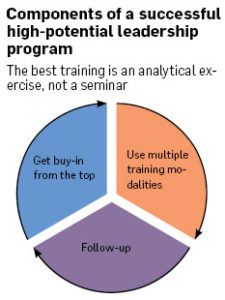
When putting in place a high-potential leadership program, be sure to:
1. Get buy-in from the top
Leadership training isn’t always welcomed with enthusiasm. People have work to do and view training as a distraction – especially if there isn’t wide organisational support for the training program.
That’s why is imperative that you ensure the program is legitimised from the top-down right away. Make sure the gatekeepers in your organisation state publically that the program is relevant and of consequence.
The gatekeepers in your organisation are those who have elevated, decision-making positions and control the direction of the business. Make sure you have their buy-in before implementing a training program and interview them about their needs. Tailor your leadership training to their specific wishes, goals, and agendas and give them a sense of partnership in the training program.
With a firm endorsement from your organisation’s gatekeepers your program will be legitimised internally and ensure participates are engaged early.
2. Use multiple training modalities
Some trainers view training as interaction and others rely too much on lecturing. Balancing the modality of delivery is essential. I’ve taught for thirty years and I know the key to successful learning revolves around student engagement. That’s why it’s important to use different learning modalities to keep things fresh, interesting, and active.
The best leadership training isn’t a dry seminar. It’s an analytical exercise that relies on illustrative stories, interactive cases, captivating games, anecdotes, online participation, and support.
Ideally, thoughtful, engaging lectures will actively support cases, games, and online discussions to create a broad, interactive learning experience.
Of course, face-to-face interaction is best and supports group cohesion that can benefit the organisation over time. But you should also develop programs utilising social media to encourage long-distance learning, communication, and collaboration.
 3. Follow-up
Ownership of the material will only take place if there is follow-up and continuous learning. Participants won’t remember everything you teach. That’s why they need something they can bring back to their desk and study routinely. Offer a list of principles and a guide for implementing change and overcoming leadership challenges. Providing take-away material for participants to reference later keeps the training program current, fresh, and memorable.
At BLG we create a lively alumni groups where we host chats, networking hours, and video-conferencing sessions to help keep everyone in touch. It’s a great way of keeping the material relevant and it drives people to routinely think about their leadership challenges, difficulties, and hurdles in a pragmatic, proactive light.
You can always recruit leaders from the outside. Is this what you really want? I think not. In this day, in an age where everyone seems to be worried about their career, organisational commitment is a rare commodity. A leadership development program in not simply a way of enhancing your leadership pipeline, but also a way of showing your key employees that you’re willing to invest in them, that you value them, and that you see that they are part of the organisation’s future. Even more than that, a leadership development program that brings together high potentials will enhance the interaction among the group, creating a network and sense of team that will only foster and enhance the collective culture that is so critical to your success.
The author of this piece is Samuel B Bacharach, who is the McKelvey-Grant Professor in the Department of Organizational Behavior at Cornell University and co-founder of the Bacharach Leadership Group (BLG), a boutique leadership development training company specializing in high-potential leadership programs. Among his books are ‘Get Them on Your Side’ (2004), ‘Keep Them on Your Side’, and the soon to be published ‘Pragmatic Leadership’. He also blogs at: www.bacharachblog.com.
 Succession Planning: A sureshot ‘Plan’ to ‘Success’?
Is succession planning a must for every organisation to thrive? Should all-work-play-hardly-ever type, competent Insiders be preferred over Outsiders with a proven track record to make this HR strategy work? Lessons from globally successful corporations and CEOs
Arindam Chaudhuri & A. Sandeep
It is a question many people have chewed over. But for a variety of reasons, the ghosts keep coming back. Regularly – despite examples of companies that have done exceedingly well over the past decade with well-planned succession scripts in their secret or not-so-secret lockers – we have new case studies that emerge and force us to revisit the question. Again and again we see instances of mega corporations that make headlines for hoping that some messiah will step into the corner office, make a few right choices for their company’s shareholders. And these are some of the most respected names in the world of capitalism. You would have heard of the ‘boss-got-fired-by the board’ hurricane that blew away rooftops at Airbus, Motorola, AT&T, Home Depot, Alcatel-Lucent, Ford, GM, Nokia, AMD, Merrill Lynch, Citigroup and Chrysler (between 2006 and 2011), or at Yahoo!, BlackBerry, J.C. Penny, HP, and others in the past twelve months. Each of these organisations felt the bleed when the poor performing CEO quit (or many CEOs walked out in quick succession – Airbus saw 5 CEOs between 2005 and 2008, Yahoo has seen five between 2008 and 2012 and HP has seen four in the past three!), but individual fade-out was never the issue that hurt these boards – it was the fear or inability of not being able to replace the ordinary leaders with those with irreplaceable qualities. In short, it was the lack of a proper succession plan that led to these company facing the heat of the times and ruining the very future of the organisation and its shareholders due to mismanagement at the most sensitive level – CEO succession planning!
 The typical high achievement-oriented CEO of today would choose to be surrounded by smarter juniors. Why? One thought – one of these juniors should be able to replace him/her in good time. It is necessary therefore that the CEO on his part should essentially have no interest in holding on to the corner office chair to create a record on someone’s calendar. You would have noted a common element in the succession planning fabric of publicly-listed organisations that would have been tagged “troubled” in recent past. That each of these companies would have little or no interest altogether to excel on the parameter of succession planning. And when tough times brought the realisation, they were caught off-guard, failing to highlight a potentially capable Insider’s name.
Despite organisations falling on their faces for having failed to execute this manpower planning strategy, there are still many who continue to question the battery of potential Insiders who could become CEOs in future. Why not go outside, spend less time and promise more in the name of bonuses? Why this ‘insanely ridiculous’ logic of signing your own death warrant? Why should top-performing CEOs want to get themselves out? Let’s talk examples and research.
Think of it – what makes companies like General Electric (GE), IBM, P&G, Apple, Southwest Airlines, Intel and others of their clan so respected and trusted as investments today? Read into their performances during the last downturn and you’d realise that all of them did lose value when markets around the world collapsed. So it isn’t a case of being hugely lucky all the time. Yet investors realise that these companies look through the ‘windshield’ (and not through the ‘rear view’) and their CEOs and Boards ensure that arrangements are made not to render the organisations “headless chickens” when it comes to deciding on leadership succession.
 It is known well that at any point, there are five potential candidates ready to fill the CEO’s shoes if required at GE. In a self-confession statement, Jack Welch admitted that he spent 50% of his time at work developing people. Ten years before he was to retire, in 1991, he had said, “From now on, choosing my successor is the most important decision I’ll make. It occupies a considerable amount of though almost every day.” In September 2001, when he was to retire after a 41-year-long association with GE, he had the likes of Jeff Immelt (then the CEO of GE Medical Systems and who was chosen as his successor), James McNerney (then CEO of GE Aircraft Engines, and currently CEO of Boeing), and Robert Nardelli (then CEO of GE Power and who later went on to become CEO of companies like Home Depot, Chrysler, and is today a Senior Advisor at Cerebrus Capital), waiting to step into his shoes. Immelt was chosen because he had leadership skills that were very different from Welch’s (required to lead a changed, Capital arm-dependent) GE in the new millennium.
GE’s story is known. There are some others whose succession tales are less talked about, but perhaps more successful.
IBM. Virginia Marie Rometty was made the CEO of IBM in January last year, replacing Sam Palmisano who retired at the age of 60 after leading the company for a decade and leaving it far better than he found it. He not only stayed a step ahead of others to ensure a smooth emergence of IBM as a service provider but also – thanks to his vision – made sure his absence would not be missed after his departure. It would not be wrong to say that Palmisano had his eyes set on the future CEO of IBM. In early 2011, an announcement was made that IBM would announce its next CEO in the next 12-18 months. In all likelihood, Palmisano and the Board had their eyes set on the successor – Rometty. The chatter is that IBM had several candidates – besides Rometty – who had been groomed over the years to fill the hot seat. IBM software veteran Steve Mills who lead the transition of IBM into the Windows NT software market in the mid-1990s before leading the transition into middleware, eBusiness and business intelligence software since the 2000s was one. The other two were Michael Daniels, IBM’s Global Services Chief (who lead the technology vision of the company that accounted for 57% of IBM’s topline in 2011) and Rodney Adkins, SVP of IBM’s Hardware business (who spearheaded the launch of the company’s mainframes and Unix servers and ensured business as usual after the previous head of IBM’s hardware business – Robert Moffat – was arrested in the Galleon Group Insider trading case). Who was ultimately chosen? Rometty who was a three decade-long veteran at the company and lead the 2002 integration of PwC’s consulting unit with IBM’s consulting arm that made IBM a strategic advisor from being a pure technology provider. She was an internal candidate – one of those work-hard, play-never kinds – who loved hosting internal workshops and meetings and had got the rap early on in her career for being excessively focused on her individual self. An ideal case of succession planning.
 To cut short long tales, let us catch glimpses of how successors were clinically chosen at “rather successful” companies.
Begin with Apple. Tim Cook who has now been the CEO for over a year-and-a-half was groomed under Steve Jobs for over 14 years. He joined Apple in 1998 and earned a reputation for living up to Jobs’ demanding, shout-at-will style. He was one individual Jobs was comfortable with. One rare individual he trusted. Cook was on the cards for filling Jobs’ shoes at least since 2008 – three years before the world officially saw Cook dance onstage to launch the first product sans Jobs!
In P&G’s (the world’s largest consumer products company) 180-year old history, the company has had only 12 CEOs – all of them Insiders. This is some sign as to how seriously the company takes Insider succession planning. To explain how P&G goes about planning for the big seat, every February there is a board meeting and three candidates are handpicked for each of the top 50 jobs across the company (including that of the CEO and Chariman)! In this way, at any given instance, there are 150 candidates who have either begun training or are almost ready to replace the CEO himself at P&G. And who oversees their training and development? The CEO, at a training centre less than 100 feet from his office! The current CEO Bob MacDonald was chosen (though not publicly) by former CEO Lafely two years after Lafely became CEO. This way, former COO McDonald was groomed for a decade before he was given the job! This is what Lafely had to say when asked about his company’s unbeatable leadership development programme, “If I get on a plane next week and it goes down, there will be somebody in this seat the next morning.” So strong is the culture of hiring Insiders at P&G that even today, less than 5% of the company’s senior managers are Outsiders (a concept called ‘Proctoid’ at P&G). [At present, McDonald spends 40% of his office time developing leaders!]
 3M’s CEO Geroge Buckley spends over 20% of his time on talent issues and teaches strategy and leadership to 3M executives (he is open about his love for being surrounded by Insiders who are more capable than himself). The senior managers at 3M are rotated once every 4 years from division to division to experience failure and learn the working of the entire organisation so that they are ready for the big day if required. Most critically, all 3M managers who are 2-4 levels below the CEO have to attend compulsory training sessions regularly.
When you want to talk success in the airline industry, one of the rare names that comes on top of the list is Southwest Airlines. The company has a University for People (U4P), its corporate training facility, that is dedicated to training and developing future leaders. The Manager-in-Training (MIT) Program is a developmental program that is meant to train high-potential Insiders who are believed to serve the long-term interests of the company. While the first level programme (MIT I) is about 20-plus training sessions on the culture and operations of the airline, MIT II is more focused on individuals and helps sharpen strategic thinking and leadership skills of managers in the company. For the record, Gary C. Kelly, Southwest’s CEO is a 30-year veteran at the company and had spent over two decades at the company before he was promoted to CEO and Vice-Chairman in 2004.
There are clear indications of how serious multinationals are when it comes to grooming the right talent in their organisations that facilitates the process of succession planning. These corporations believe in training and educational programmes for senior management and associates to shape and sharpen them for filling senior management posts (including that of the CEO) in future: PepsiCo’s Universities (PepsiCo University, Finance University, Consumer Management University and Global R&D University) and its leadership development programmes ‘360-Degree Feedback’ and the GM Development Centre, Cardinal Health’s EMERGE leadership development programme, Caterpillar’s Leadership and Technical Development Programme (LTDP), Dow Chemical’s Commercial Development, General Management, Public Affairs Development and Finance Leadership Development Programmes, and Verizon’s Learning Experiences programme for directors and senior leaders, are only a few of those. These are clear signals that the biggest of companies are today actively focusing on developing the leaders they need.
 What does research have to say about the importance companies are attaching to succession planning (and its effect on the company) and the idea of having an Insider don the leader’s hat instead of a fresh Outsider.
As per the 2012 Spencer Stuart Board Index (Governance Survey conducted on 486 S&P 500 companies in Q2, 2012), ‘CEO Succession Planning’ was amongst the top three concerns for companies’ boards, with 53% claiming it to be a top concern as compared to just 19% in 2008! There are some other findings that emerged. Interestingly, 71% of respondents claimed that their companies have succession plans both for the short term and emergency situations, but only 3% said they had a long-term succession plan. In fact, of the S&P 500 firms, about 25 firms (5%) reported having no succession planning procedure in place! In over a quarter of these companies (27%), the CEO spearheads the process of finding his replacement, while in 38% other cases, he serves as an advisor to the board/committee. In fact, in 61% of the cases, the CEO ‘evaluates internal candidates and reports to board’.
 Another comprehensive report on Succession Planning was the 2013 Booz & Company’s Chief Executive Study (titled, ‘ Time for New CEOs’), that analysed outcomes and events at 2,500 of the world’s largest public companies. The study noted that the CEO turnover in 2012 (15%) was the second-highest in the past 13 years (after 2005). That was the bad part. Good was – ‘Planned successions’ accounted for 72% of all CEO turnovers in 2012, making it the highest in the past 13 years. The message is clear – companies globally, are working more thoughtfully on processes to replace old leaders with new ones, in a manner that would best serve the company’s shareholders.
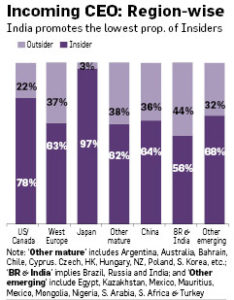
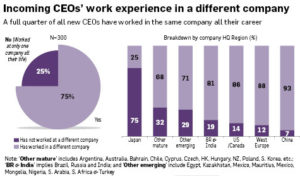
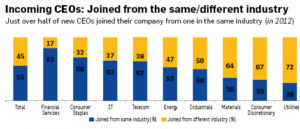
As far as the ‘Insider-Outsider’ equation is concerned, there is a heavy bias towards sincere Insiders, with boards trusting the company in the hands of committed and familiar faces in the company corridors. Of those who were made CEOs between 2009 and 2012, 71-80% were Insiders, with 25% having worked at the same company for their entire career!
While companies in US and Canada saw 78% of the new CEO being Insiders, those in India, Brazil and Russia saw only 56% Insiders being promoted to the CEO post. [This is a warning signal – succession planning as a process across companies in India needs to be worked upon. Strangely, CEO and leaders of India Inc. do realise the need for succession planning for a healthy future of the organisation.] Hiring Insiders also means greater stability for the CEO and company alike – Insiders remain CEOs for 7.4 years as compared to Outsiders who occupy the seat for a lower 5.9 years. The study also revealed that companies that recorded shareholder returns (during the previous CEOs’ tenures) in the Highest quartile of performance had a greater proportion of Insider CEOs (81%) as successors as compared to the Lower quartile (73% Insider succession). This proves that scouting for Outsiders could be taken by the investor community as a sign of a company being in trouble. No surprise the report states that companies that hired Outsiders as CEOs were tagged “Poorly performing” by perception (and “seeking new ideas to improve performance”).
 Answering the ‘Insider-Outsider’ debate, Wharton management professor Dr. Katherine Klein comments, “The ideal scenario is careful succession planning that grooms people internally.” The famed 2007 Hay Group Study confirms that almost 80% of Fortune’s Most Admired Companies preferred an internal candidate as a CEO successor! A study by David Clutterbuck (titled,‘Handing over the reins: Should the CEOs successor be an Insider or an Outsider? Corporate Governance: An international Review, 8-2, pp.78-86) reveals that a majority of firms preferred an appointment from within the firm making the succession as seamless as possible. While Booz Allen Hamilton’s study (‘Crest of the Wave’) shows how by 2005, the global CEO turnover rate had reached a rate that was 70% higher than what it was ten years back, the study also provides smashing insights into the fact that Outsider CEOs perform only during the short term; for the long term, only Insider CEOs provide value. The study concludes that while 30% of firms with negative performance hired Outsiders, only 6% of positively performing companies did that. It is not surprising therefore that “80% of the current Fortune 100 CEOs were selected from within the company’s ranks” (‘Picking the Right Insider for CEO Succession’; HBR, January 2009).
Remember, only an inside CEO who has spent years within the organisation can aspire to be the ‘perfect fit’. According to exhaustive research by HBS faculties, CEOs who were a ‘good fit’ with the organisation succeeded in providing abnormally high positive annual returns of almost 14% to shareholders over the first three years; and those with a ‘poor fit’ ended up massacring shareholders’ wealth with annual returns below a pathetic negative 30%!
 And it’s clearly the current CEO’s job to shortlist future replacements [article titled, ‘The Job No CEO Should Delegate’, Larry Bossidy, HBR]. In another HBR article (titled, ‘What effective general managers really do’), J. Kotter states that inside successions are viewed more favourably because Insiders may provide constancy and stability of the organisation while Outsiders may represent discontuinity and disruption. This is due to the knowledge of Insiders about the firm and established social networks.
Worrell and Davidson (‘Stockholder reactions to the departures and appointments of key executives attributable to firings’, Journal of Management, 13-3, pp.509-515) and Friedman and Singh (‘CEO Succession and stockholder reaction: The influence of organizational context and event content’, Academy of Management Journal, 32-4, pp.718-744) prove how there are positive market reactions to internal successions, when CEO change was initiated by normal retirements or disabilities or death of the predecessor CEO.
We leave you with one instance of a leader who championed the cause of succession planning and getting Insiders to do the magic that Outsiders could hardly be expected to. And despite leaders of world-class firms having had their succession plans excellently laid out over the past many years, there’s one man who, we suspect, started this brilliant trend of finding one’s replacements. We know him as Roberto Goizueta. Goizueta, an impoverished Cuban immigrant – who escaped to Miami with his wife and $40 to escape Castro’s political influence – became the best performing CEO globally in the history of mankind during his incredible 17 years at the top. Since he took over the CEO’s mantle in 1981, he created more shareholders’ wealth than any CEO in history – a mind numbing 7,100% share price increase! And ironically, his biggest contribution to the management fraternity has been formalising the art of ‘losing it all when at the top’. In other words, ensuring that he was thoroughly replaceable – what we today know as ‘succession planning’! Goizueta had four people ready to takeover his throne at any given moment, and ten more to fill in their posts! He died of lung cancer on October 18, 1997. For 17 years, this Cuban ‘revolutionary’ was the world’s best performing global Chairman & CEO of a Fortune 500 company we now know of as The Coca- Cola Company! And nobody’s ever ‘lost’ it like he did.
 What Goizueta did was not just ensure that the company had a battery of leaders ready to take charge, but created through those leaders a brand that is perhaps more recognised than any other, across all age-groups. The 1.8 billion units of Coca-Cola branded products consumed every day, the 64 million-plus fans on its Facebook page, the $77.84 billion valuation of its brand (as per the Interbrand ‘Best Global Brands 2012’ ranking) and the mammoth $187.50 billion valuation that the company enjoys (as on April 27, 2013) are all perhaps outcomes of this Cuban’s habit of ‘signing his own death warrant’. Today, as we speak, the CEO of Coca-Cola Muhtar Kent (who has been praised heartily on Wall St. for snatching market share from PepsiCo since becoming its CEO in 2008 and boosting bottomlines) has four executives ready to replace him – 47-year-old Steve Cahilane (currently in charge of the company’s Americas operations), 52-year-old Ahmet Bozer (currently in charge of Coca-Cola’s Eurasia & Africa operations), 55-year-old Irial Finan (who heads the company’s investments in company-owned bottlers overseas), and 60-year-old Gary Fayard (currently Coca-Cola’s CFO) – and possibly ten more to fill in their shoes. Truly, Goizueta has left a mark and a ‘succession planning’ principle that all at Coca-Cola know and believe is best followed.
‘Sign your own death warrant’, because the sureshot plan to success is to plan your successor. And every CEO better know that!
As we write this article, news is in that Intel Corp. has announced CEO Paul Otellini’s successor – COO Brian Krzanich. Kraznich [pronounced “Ker-san-itch”] will take charge on May 16, 2013. Otellini has been at Intel for 38 years (including 8 as its CEO). If Kraznich serves as CEO for as long as Otellini has, he will have completed 40 years at Intel by the time he hangs up his boots! Beat that for yet another ‘Superstar’ Insider.
Long live ‘Inside-O-Mania’!