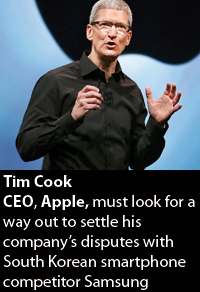
 Locked in legal wrangles over patents
The battle between Samsung and Apple over copyright and patents ownership reached a climax this year in August with a California jury ordering Samsung to pay $1.051 billion in damages to Apple. The Apple-Samsung trial came after each side filed a blizzard of legal motions and refused advisories by US district judge Lucy Koh to settle the dispute out of court. In April 2011, Apple had filed a patent infringement lawsuit to demand $2.5 billion from its smartphone competitor. In response Samsung, which has overtaken Apple as the world’s leading smartphone maker, had fired back with its own lawsuit seeking $399 million. After the trial, the jury found that several Samsung products illegally used such Apple creations as the “bounce-back” feature when a user scrolls to an end image, and the ability to zoom text with a finger tap. Samsung lawyers insisted that several other companies and inventors had previously developed much of the Apple technology at issue and argued that many of Apple’s claims of innovation were either obvious concepts or ideas stolen from Sony Corp and others. But even after the US court verdict, the battle between the two is far from over. Earlier this month, the two companies squared off once again in the same US court that gave the jury award in favour of Apple. In the hearings that have taken place so far, the iPhone maker has been going all out to convince judge Koh to ban sales of a number of the Korean company’s devices, besides defending its $1.05 billion jury award. Other than the US, Apple and Samsung have filed similar lawsuits in eight other countries, including South Korea, Germany, Japan, Italy, the Netherlands, Britain, France and Australia. In one such suit in South Korea, judges in Seoul ruled that Samsung didn’t copy the look and feel of the iPhone; instead it’s Apple that has infringed on Samsung’s wireless technology.
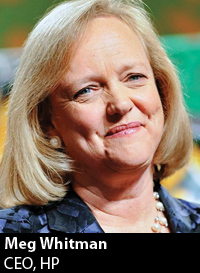 Can Whitman turn around HP’s fortunes?
For Hewlett Packard, the No.1 personal computer maker, things have been going pretty downhill for quite sometime. In the third quarter of this fiscal, HP suffered a $8.9 billion quarterly loss as personal computer sales shrank and it had to swallow a huge write-down linked to its $13.9 billion purchase of Electronic Data Systems Corp. It marked HP’s fourth consecutive year-over-year quarterly decrease in revenue, which sank 5% from last year to $29.7 billion. Worse was to follow as HP disclosed in November that it will take a $8.8 billion write off on the Autonomy deal for which it had paid $11 billion last year. This year alone HP has lost close to a quarter of its market value, and its shares are down about 15% from when Meg Whitman was appointed to the helm last year. Whitman has been shaking things up at HP by reorganizing divisions, ushering in new managers and slashing costs through the job cuts. To cope with the upheaval, HP has been expanding into technology consulting, computer software, data storage and high-end servers made for companies and government agencies. But HP hasn’t been evolving rapidly enough to avoid an alarming deterioration in its financial health.
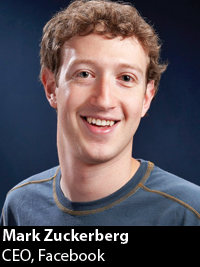 Facebook became the only US company to debut with a market value of more than $100 billion, but its stock price dropped more than 50% after the IPO in May this year. Though the IPO opened at a price of $38, the stock price fell below $19 on August 31, before bouncing back to $20.01 in the days after. But the disastrous IPO was obviously a wake up call for the world’s biggest social media networking company. Faced with the challenge to shift its ad sales to mobile platforms and fight off competition from Google and social networking upstarts such as Pinterest, Facebook’s founder Mark Zuckerberg has in recent months rolled out several new ad products and pushed the company to monetize its service more aggressively. He recently unveiled a new plan to grow Facebook’s user base – and mobile revenue – by expanding the reach of its mobile messenger app, whose features include free texting, group chat, and photo-sharing. All these initiatives are helping Facebook move forward on the revenue growth path. The company’s reported sales for Q3, whose results were announced in October, stood at $1.26 billion, up 32% from a year earlier.
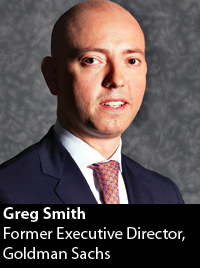 Smith’s unusual exit raised many questions…
In May this year Goldman Sachs executive director Greg Smith quit the company in a manner that was both unconventional and dramatic. In a very public and scathing resignation letter, which appeared as an Op-Ed in the New York Times under the title “Why I am Leaving Goldman Sachs”, Greg wrote: “Today is my last day at Goldman Sachs. The firm has veered so far from the place I joined right out of college that I can no longer in good conscience say that I identify with what it stands for.” Smith blamed the culture shift on Chief Executive Lloyd Blankfein and President Gary Cohn. “I truly believe that this decline in the firm’s moral fiber represents the single most serious threat to its long-run survival…. It makes me ill how callously people talk about ripping their clients off. Over the last 12 months I have seen five different managing directors refer to their own clients as ‘muppets,’ sometimes over internal e-mail,” wrote Smith, who went to Stanford University on a full scholarship, and was a finalist for a Rhodes Scholarship. Goldman Sachs later denied the allegations, saying, “We disagree with the views expressed, which we don’t think reflect the way we run our business. In our view, we will only be successful if our clients are successful. This fundamental truth lies at the heart of how we conduct ourselves.”
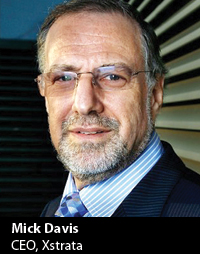 Biggest deal in mining history
Commodities firms Glencore International and Xstrata agreed in October to come together to create a group with a combined market value of $70 billion. Glencore is the world’s biggest commodities trader, with products including oil, coal, gold and foodstuffs. Anglo-Swiss firm Xstrata is the world’s fourth largest diversified miner, producer of copper, nickel and zinc, and exporter of thermal coal. The deal to merge the two companies was signed by Ivan Glasenberg, the South African billionaire who runs Glencore, and Xstrata chief executive Mick Davis and was sealed after five years of protracted negotiations to combine the two companies.
The $32-billion merger is now inching closer toward completion after the European Union’s competition authority conditionally approved the deal. Now, the deal only has two hurdles left to clear: final approval from competition authorities in South Africa and China. In South Africa, power utility Eskom has raised concerns that the deal could affect its coal supplies and has called upon the country’s competition authority to impose conditions on the tie-up. Clearance from antitrust regulators in China is expected to come by year-end. The combined company must obtain clearance from China because it hopes to increase market share there, where both firms already sell minerals. Some analysts believe it will be easier to get China’s approval since the new company won’t have operating assets such as mines and smelters in the country. The combined group would control about 30% of internationally traded thermal coal, supply over 30% of the seaborne market essential for fuelling the power stations of Japan, South Korea and China and would become the world’s largest producer of zinc, lead and ferrochrome, which is used in the production of stainless steel. The merger would create a business with $209 billion in sales and rank as the world’s fourth largest mining group by market capitalisation, behind BHP Billiton, Vale of Brazil and Rio Tinto.
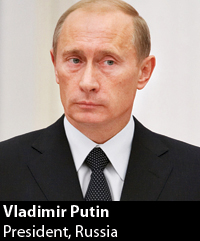 Country to earn trade benefits
After 18 years of negotiations, Russia became a full member of the World Trade Organisation in August this year. The WTO accession will help Russia to promote its exports and play its part in formulating the rules for global commerce. The change will encourage Russian businesses to operate transparently, as their activities will be monitored by the Russian authorities and also by foreign representatives. The membership will not only bring about the stabilisation of Russian trade policy, it will make Russia more appealing to foreign investors. One advantage has been that the country now enjoys lower customs duties, from which Russian exporters of metals and chemicals are sure to benefit. The fruits of WTO accession will also be enjoyed by Russia’s consumer services sector. The import duty for this sector is estimated to come down to an average of 10.3% from 13.3% earlier. Import restraints will be also get mitigated while other sectors, such as finance and telecoms, will get to reap in WTO accession benefits.
Country to earn trade benefits
After 18 years of negotiations, Russia became a full member of the World Trade Organisation in August this year. The WTO accession will help Russia to promote its exports and play its part in formulating the rules for global commerce. The change will encourage Russian businesses to operate transparently, as their activities will be monitored by the Russian authorities and also by foreign representatives. The membership will not only bring about the stabilisation of Russian trade policy, it will make Russia more appealing to foreign investors. One advantage has been that the country now enjoys lower customs duties, from which Russian exporters of metals and chemicals are sure to benefit. The fruits of WTO accession will also be enjoyed by Russia’s consumer services sector. The import duty for this sector is estimated to come down to an average of 10.3% from 13.3% earlier. Import restraints will be also get mitigated while other sectors, such as finance and telecoms, will get to reap in WTO accession benefits.
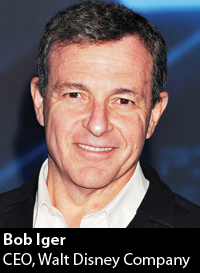 Flying high once again
For Walt Disney Studios, 2012 has been a year marked by highs and lows. The release of its sci-fi movie, ‘John Carter’, in March proved to be a monumental failure. With a production budget of $250 million, ‘John Carter’ needed to generate at least $400 million in box office receipts to cover the film’s costs. Instead, it made a $200 million hole in Disney’s pockets. To make amends for its huge losses, Disney mounted a superhero-style marketing campaign to ensure its next big-budget release in May, Marvel’s The Avengers, did not suffer the same fate. Thankfully, the film went on to gross about $1.5 billion and helped Disney tot up its highest ever quarterly earnings of $11.09 billion in the Q3, FY13. Its run of good fortune continued with Disney buying out Lucasfilm for $4 billion in October. The acquisition has helped Disney to add the legendary Star Wars franchise to its own stable of characters.
 Internet censorship on the rise in the country
The current year saw Indian authorities step up their efforts to tighten regulation of the Internet and social media sites. The conflict between Muslims and locals in the northeastern section of the country in August in which at least 78 people were killed came as a very convenient ruse for the government wanting to extend its control to cyberspace. Information and Communication Technology Minister Kapil Sibal said Internet companies needed to prefilter their content. The Indian government also called for introducing a system under which the authorities could ensure that Internet service providers removed content posted by local users within 36 hours. However, the move was widely questioned on the grounds that the government was using the incident as a pretext to implement an Internet censorship system and use it for its own benefit. A report published by Google says that content censorship in India has risen by 49%. The Google transparency report 2012, says India sought confidential web user details in as many as 2,319 cases from Google in the first six months of 2012. Besides, the number of items sought to be removed from Google’s various Internet platforms such as YouTube videos, search results, images and web pages, more than doubled to 596 in the six-month period to June 2012.
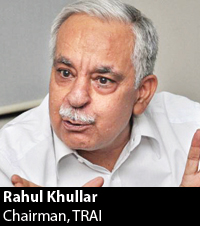 Headwinds for the sector
Capital investments in the telecom sector has slowed down over the past year in spite of the 3G / BWA opportunity and the fact that telecom teledensity in India, especially in rural areas, still has a long way to go. The urban teledensity in the country at 169% is far ahead of the rural tele-density of 41%. While this spells opportunity for the industry, significant investments will be required to increase the reach in rural areas. But FDI in the telecom sector plunged to $43 million in the April-September period of the current fiscal year, as compared to $1.9 billion in April-September, 2011.
The new telecom policy-2012 envisages 70% rural penetration by 2017 and 100% by 2020. To realise this goal, India needs to strengthen its domestic manufacturing capabilities in telecom and create the ecosystems that can help it become a major producer of hardware. But in the last couple of years, the telecom sector has been affected by policy paralysis and regulatory overhang. In February 2012, the Supreme Court cancelled 122 telecom licences issued in 2008 when spectrum was allotted bundled with a licence, allocated on a first-cum-first-serve basis. The court’s order paved the way for auction-determined pricing for spectrum going forward. As directed by the apex court, telecom regulator TRAI came out with a base price for the available spectrum which was more than 10 times expensive than the price paid earlier by the operators. Subsequently the empowered group of ministers lowered the reserve price by around 20%, which was still higher for the debt-ridden telecom operators. The 2G auctions held during November 12-14 witnessed a lukewarm response.
The outlook for the sector in the months ahead does not look bright either. Global ratings firm Fitch says that the high interest costs, and capex required to meet growing data traffic and voice coverage will keep 2013 free cash flow margins low at around 2-4%, which might be insufficient to pay for regulatory payments.
 New king of the spirits market
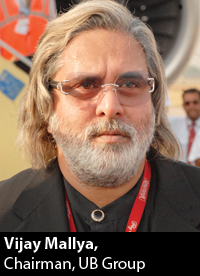
The world’s largest spirit maker Diageo has finally entered India, the world’s largest market for whisky, by buying out 53.4% stake in Vijay Mallya’s United Spirits for $2.1 billion. The deal, signed in November, will allow Diageo to take control over management though Mallya will continue to be the chairman of USL. Diageo, which makes some of the finest scotch whisky brands like Johnnie Walker and Smirnoff Vodka, will acquire a 27.4% stake in USL for Rs.57.25 billion at Rs.1,440 per share. Once the share purchase is completed, Diageo will make the mandatory open offer for acquiring another 26% of the equity, also at Rs.1,440 per share, taking its stake to 53.4%. After the deal, USL’s parent company United Breweries Holding will be left holding 14.9% in USL. The final amount of Rs.111.66 billion shows a a valuation of 20 times USL’s Ebitda for the fiscal 2011-12. The transaction is the biggest inbound deal in recent times after the $9-billion investment by BP in Reliance Industries and the $8-billion Vedanta Resources acquisition of Cairn India last year.
 Working to ramp up gas output
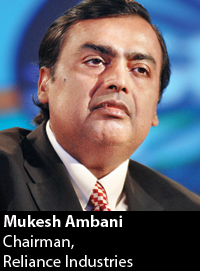
Partners Reliance Industries and British energy major BP recently surrendered nine oil and gas blocks out of the 21 blocks under their joint venture due to the poor prospects of these oil wells. UK’s energy giant BP had bought a 30% stake in 21 blocks operated by RIL in 2011 for $7.2 billion. The JV is currently focusing on reviving the falling gas production in KG-D6 fields in the Krishna-Godavari basin and bringing the Mahanadi basin block NEC-25 discoveries in the east coast to production. The JV aims to double its existing gas production of around 25 million metric standard cubic meter per day (mmscmd) to 60 mmscmd in the next 3-5 years in the Krishna Godavari basin. In order to achieve this production growth the JV has sought approval from the oil ministry for over five trillion cubic feet of discovered gas resources in the KG-D6 and NEC-25 blocks. The JV has also identified prospects, which if successful can add over 10tcf of yet-to-find gas reserves with the potential to unlock $100-$150 billion of value through import subsitution. With the objective of increasing output, RIL has sought clarity from the government on pricing of gas in India post March 2014. At present, gas from the KG-D6 field is priced at $4.2/unit and is due for revision from April 1, 2014. For the last seven months, RIL has been seeking approval from the government, but not for increasing current gas prices. Rather it has been seeking clarity on the basis of gas pricing that will be adopted post March 2014. This clarity is required because the contractor partners have to make significant investments to develop various new discoveries.
 On the wrong foot
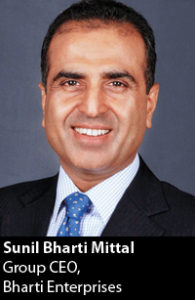
American retailer Walmart is under investigation for allegedly breaking foreign exchange rules when it invested $100 million in a unit of its Indian joint-venture partner. In September, the government announced a series of reforms and allowed foreign investors to hold up to 51% in multi-brand retail concerns. It is being alleged that Walmart bought a stake in its wholesale joint-venture partner Bharti Enterprises before FDI reform came into existence. The Enforcement Directorate is looking into the claim. In the recently concluded winter session of Parliament, there was an uproar following Walmart’s report submitted in the US Congress that it had spent around $25 million on lobbying so as to gain entry in emerging markets, including India. The government has ordered a judicial probe into reports of lobbying by Walmart, even as the US-based retailer has denied “improper conduct” in India to gain market access into the country.
 Banks face tough times
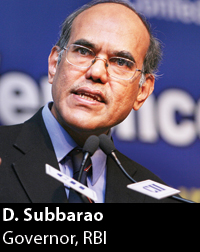
The current fiscal has proved to be stressful for the banking sector. Against the backdrop of a depressed domestic and global economic scenario, the Indian banking sector has been facing challenges on the asset quality front with a substantial jump in the restructured assets. The restructuring has occurred mainly in the power, aviation and textile sectors. With Basel III implementation schedule being announced by RBI, PSU banks additionally face the challenge of raising at least Rs.5,000 billion in extra capital to meet the new standards over the next six years. FY13 is thus expected to be a challenging year for the banking sector on many fronts, including sustaining credit and deposit growth as well as their ability to contain further deterioration in asset quality. The NPAs (non-performing assets) of banking sector has sharply climbed to 1.28% compared to last year’s 0.97% owing to high interest rates and the slowdown in the economy.
 No quick bounce back in car sales
Several challenges confronted Maruti Suzuki this year. In July, India’s largest car maker was hit by labour unrest and industrial violence at its Manesar plant, in which a general manager died and 96 supervisors and managers were injured. The incident led to a month-long lock out, which caused accumulated losses of around Rs.27 bilion due to non-production of its quota of 1,600-1,700 cars per day. Due to labour trouble and the subsequent slow ramp-up to normalcy, Maruti saw lower production of diesel-engined vehicles like the Swift hatchback and Dzire saloon, which impacted profitability. As a result, the carmaker has not been able to achieve volume growth even though the launch of new models like the Ertiga, which has averaged sales of around 6,000 units every month (the bulk of them diesel), and the new Alto 800 have helped salvage the situation for Maruti. But there is still uncertainty in the market due to which both petrol and diesel cars are hard to sell. Maruti expects growth this year to be around 6% and does not see the next year to be much better, with growth expected to remain in single digit. According to Maruti Suzuki India Managing Director and CEO Shinzo Nakanishi, “We are expecting to grow 3-5% this fiscal. High petrol prices are impacting our sales badly as most of our best selling models are in this mode.”
 Road ahead for the economy
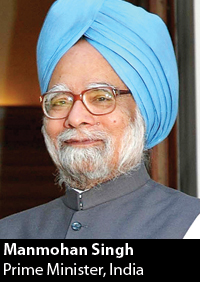
The current year can be described as a forgettable one for the Indian economy. Stagnating growth, policy paralysis and inflation woes remained the top concerns for the government as well as for the India Inc. India seems to have lost its allure amongst global investors during 2012. The initial warnings of India’s waning appeal as an investment destination came when global ratings agency S&P published a report in June, which was titled ‘Will India be the first fallen BRIC angel?’ Such concerns were further amplified in the mid-year economic analysis review conducted by the government. According to this analysis, the government expected GDP growth for 2012-13 to be between 5.7% and 5.9%, which is lower than the 7.6% that was estimated earlier. With the growth rate refusing to climb and inflation remaining outside the policymakers’ comfort zone, economists are stridently advocating that the government should take immediate steps to remove structural bottlenecks in the economy. To its credit, the government has stepped on the pedal and unleashed a spate of reforms in recent months, which its hopes will pump prime the economy again. The latest economic indicators, like the IIP numbers for November, have raised hopes that the worst may be over and the economy might have bottomed out. Though it’s still too early to celebrate, the new year may have something good in store.
 Cyrus Mistry steps into Tata’s shoes
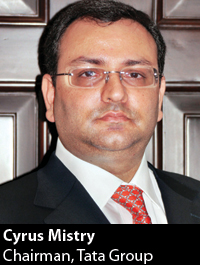
Ratan Tata has finally walked into the sunset. On December 28, his 75th birthday, he relinquished chairmanship of the $100-billion salt to software conglomerate, which he helped build and scale up over the past 21 years. The man who took over the mantle of chairman of Tata Group is 44-year-old Cyrus Pallonji Mistry, the younger son of Pallonji Mistry, whose construction firm Shapoorji Pallonji & Co. is the biggest shareholder of Tata Sons, with a stake of about 18%. Mistry, who has been on the group’s board since August 2006, is the sixth chairman of the group. While Tata is credited for largely transforming the conglomerate with his multibillion-dollar purchases of overseas businesses and turning it into a truly global multinational that gets over 50% of its revenue from overseas sales, the challenge for Mistry is to shift the group’s over-reliance on flagship firms such as Tata Motors and Tata Consulting Services. Tata watchers say that Mistry has a reputation for being sharp, focused on numbers, intent on change without being dramatic about it.
 Going straight for the jugular
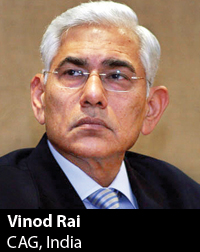
The current year saw the Comptroller & Auditor General’s office grab plenty of headlines and press. Under the current incumbent Vinod Rai, the office of CAG has issued a series of explosive investigative reports, the most devastating of which to come this year has been on the murkiness in land deals for Delhi’s new airport and on the dubious award of coal-mining blocks during the period 2004-2009. In August this year, the CAG accused the government of allocating coal blocks, power projects and land for Delhi’s flagship airport at a fraction of market prices, potentially costing the exchequer thousands of billions of rupees in lost revenues. It estimated private companies’ “windfall” gains from allocations of coal blocks to be $211 billion. In another report to Parliament, CAG said airport land in Delhi was allocated at a tenth of its market value, giving the developers an undue profit of $4.3 billion. The same auditor had uncovered corrupt practices two years ago in the sale of telecom licences, which may have cost the government up to $36 billion. Over the last two years, the office of the CAG has played a great role in bringing before the nation humongous losses amounting to billions of rupees to the central government’s treasury due to corruption and large-scale manipulations by government officials. Besides the 2G spectrum scam in the telecom sector, the CAG was also instrumental in unearthing shocking details of official malfeasance in the 2010 Commonwealth Games. As a result of these scandals coming to light, corruption has become a major headline-grabbing issue today.
 No clarity on taxes
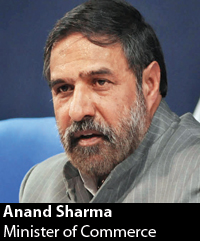
Despite the current economic slowdown, many foreign investors are still open to investing in India. But there remain quite a few irritants and barriers to foreign investment, which the country can happily do without. One such contentious matter is the issue of retrospective taxation. The issue has been starkly highlighted in the case of British telecom major Vodafone’s investment in India. Even though the Supreme Court struck down the income tax department’s claim of $2.2 billion as capital gains charge on Vodafone’s purchase of a two-thirds stake in Hutchison Essar for $11.2 billion in 2007, the government has now once again moved the Supreme Court seeking a review of its earlier judgment. Predictably, this has once again set alarm bells ringing among foreign investors. The government must realise that keeping investors guessing over tax and capital gains laws is bound to strike a blow for foreign direct investment to India.