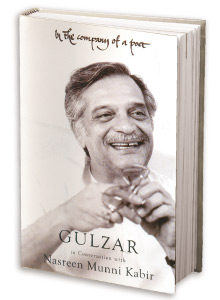
 One approaches this book with as much scepticism as expectation, wondering if there could be anything left to be said about a man whose work as a poet, writer, filmmaker, storyteller and lyricist has held sway over the minds of people across generations. But once you are drawn into In the Company of a Poet, it is a breeze. It is impossible to put the book down: it is eminently readable all the way through.
This despite the fact that much of the freewheeling conversation that documentary filmmaker and writer Nasreen Munni Kabir has had with Gulzar for this book – a large part of it on Skype – traverses known territory and touches upon facets of an eventful life that are already in the public domain. Yet, there is much in this book that reveals the man in ways that take the reader by surprise.
Kabir holds herself back completely and steps in only to ask the questions. It is Gulzar’s personality that imbues the book completely. There are few in the Mumbai movie industry who can match the celebrated poet and lyricist as a conversationalist, once he is drawn out of his shell.
In the Company of a Poet benefits from his striking insights, wry humour, great memory and ability to string his reminiscences together with a deep sense of the cinematic and literary history that he is an active part of.
Most importantly, an element of mystery always hovers around him. No matter how much he reveals of himself, there is always a little that remains concealed, irrespective of what it is that he is discussing.
Gulzar’s life and work are a bit like the poems that he writes – the words convey only one layer of meaning. When they come together and form deeper patterns of significance, their denotation is often left to the reader’s imagination and comprehension.
He tells Kabir: “A poem has an element of mystery. You have to unravel that mystery. Of course it depends on every poet – how much they reveal, and how much they choose not to.” Any conversation with Gulzar has precisely that quality, which makes reading a book like this a particularly rewarding experience. It is strewn with startling nuggets.
Unassuming to a fault, Gulzar is not given to making grand statements about himself and his place in the world that he inhabits. He chooses his words with care and precision, which is obviously not surprising for a man who makes a living off words.
He hasn’t made a film since the late 1990s but he does not miss being in a studio, setting up shots and directing actors. The break has allowed him to return almost full time to his first love – writing – and he is enjoying every moment of this phase of his life, coming out only once in a while to pen the lyrics of a film.
When Gulzar talks about the Mumbai movie industry, he has the unique advantage of being an ‘outsider’ who is in the vantage position of also being a complete insider. He can look in both from the outside and from within.
He is first and foremost a poet and short story writer. He can, therefore, afford to let his fame as a film director, screenwriter and lyricist – those are the hats that the general public in this country know him for – sit lightly on him.
In this book, he talks with equal felicity about the past and the present, about the associates he began his career with as well as the younger lot that he works with today.
Gulzar has constantly moved with the times and this book reflects exactly how he has managed to balance his poetic sensibility with the demands of a movie industry that is always in a hurry. He reveals that he does occasionally write a lyric to a deadline if the need arises, but he does request the filmmaker for some time when possible.
“I write a song in two days. You cannot always rely on mood and inspiration. At times you must rely on the skill and experience you have gained over the years. Craft comes to your rescue… but I am aware that the result is not the same, so if a film director can give me a bit more time, I ask for it. If it’s impossible, I meet the deadline,” he says.
A true-blue pro with the heart of a self-effacing poet who would much rather be left to his own devices – that is Gulzar, a unique man of the cinema. Here, he discusses in specific terms his craft as a writer and poet. “What a poem says on the surface is not all that it means. You have to unpick the lines and see the shadows of words,” he says. In the Company of a Poet is full of such “shadows”, all of them magnificent and multi-layered.
Gulzar in conversation with Nasreen Munni Kabir
Publication: Rainlight/Rupa
Edition: Hardcover
ISBN: 978-81-291-2083-0
Pages: 206
Price: Rs 495