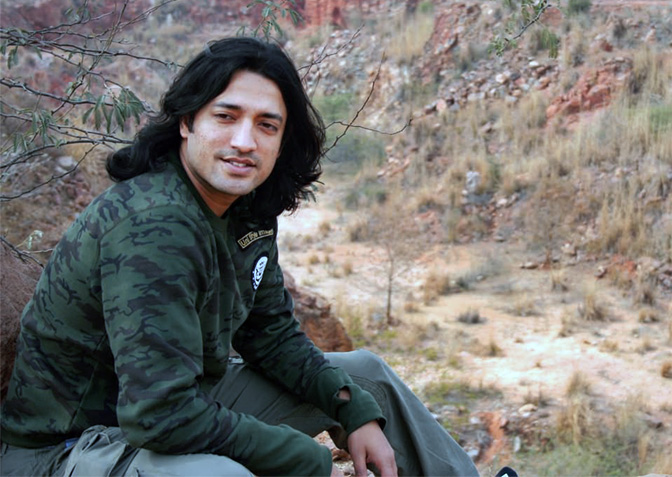
Professor Prashanto Banerji is a renowned & eminent personality at IIPM who has fought against all peculiarities and has achieved the pinnacle of triumph by his willpower and insistence. His style, diction, presence, persona creates an aura of excellence which makes it next to impossible to take one’s eyes and ears away fr om him. And, it holds true not only for the people who can read and write like us but also has great connectivity with animals. His love and passion for Wild life drives him to be a part of various adventures and social work. He has been a part of a documentary on Wildlife and Environment called “Cherub of Mist”: well-craft ed and scripted by Professsor Banerji. Th e fi lm bagged several international awards and we feel privileged to present his views on this documentary. He unfolds his admiration for Wildlife & film making exclusively through Cult.
Excerpts from the Interview:
Q. From the wide array of achievements, today we have picked up one of the most fascinating one : “Cherub of the Mist” Please take us through your journey and how did the name happen?
A. Ah let’s see… that was about nearly a decade ago but was a wonderful journey nevertheless. Like a lot of us city slickers I also harbour these romantic notions about a life in the woods, tracking a wild animal in the stillness of a forest, at one with the primordial laws of nature that haven’t changed since the last ice-age… a camera in my hand being the only reminder of the mood of the times. But that is a life lived by a privileged few. However, whenever I get the time, I try and slink away unnoticed into the bush ‘to reconnect’ if you will… Now during one of these trips, in a nice cozy teak-wood library in one of these wilderness resorts, I came across a coffee-table book by the Bedi Brothers titled ‘India’s Wild Wonders’… The pictures were intimate and alive… it was almost seductive. The Bedis, Naresh and Rajesh were legendary film-makers who I remembered from their Project Tiger films on Doordarshan. I was a fan. As soon as I reached Delhi I sent them an email and fi – nally we met up. I told them I would love to volunteer with one of their projects any which way I could. Fortunately, the project they were working on at the time was a fi lm on a rarely sighted, little understood creature from the cloud forests of the Eastern Himalayas – The Red Panda. Th e film was actually being made by Ajay and Vijay, Nareshji’s sons and while they were out braving the elements in the upper reaches of the Nepal-North Bengal border, I was welcomed into the project in Delhi. My role was to initially help with the script and other kinds of communication around the film… And yes, then the name happened. While watching raw footage that the younger Bedis had shot, we, Rajeshji, Nareshji and I, sat down and discussed possible options… Scenes of verdant green forests wrapped in shrouds of silver mist floated onto the screen and then I saw it… a fl ash of flaming red and then that perky face filled up the screen. It was a face that even Satan couldn’t refuse a cuddle and a hug, and there it was –the Cherub of the Mist. Th ere couldn’t have been another name for a film about this adorable little creature from the gates of heaven – not with my limited diction anyway. Luckily, it worked.
Q. Along with the prestigious Green Oscar the film has bagged 11 other international awards, how does it feel?
A. Feels great… I’m really happy for Ajay and Vijay. They are the real stars of the film. Singhalila (a national park in the Eastern Himalayas) is one of the most difficult environments to ‘film in’, if that’s the phrase… It is cold, bitterly cold and it pours out whole rivers from the sky… from leeches committed to bleeding you dry to moisture that
finds a way to creep in through the toughest of packaging to sabotage your equipment just when you need it… and then there is the small matter of tracking the secretive pandas, proverbial needles in that sprawling haystack in the mountains called Singalila National Park. This award and all the others that the film has won are a tribute to the commitment, tenacity and skill of the two brothers and the profound ecological and creative wisdom of their father and uncle. They are sure to win many more. And it would be an honour and a privilege if I could help with any of them.
It was an education… not just in the nuances of putting together an award winning documentary but also in humility and generosity.
Q. How was your experience while working with Bedi brothers?
A. It was an education… not just in the nuances of putting together an award winning documentary but also in humility and generosity. I was a nobody in the business and yet was welcomed with open arms and for whatever little my work was worth, I was treated with far greater respect and recognition than my work deserved.
Q. Aft er going through a lot of your work , one realizes that you are very passionate about wildlife, what inspires you?
A. Hmm… the passion stems primarily from my selfish desires to spend as much time as possible in the lap of bounteous nature and to that end preserve as much as is possible of it for myself and for those who’ll come aft er I’m gone. The indescribable ways in which the sight of a young bull elephant frolicking in the wild waters of an unnamed river in Kerala or the lonely silhouette of a snow-leopard standing on the edge of a precipice, contemplating its immediate future as much as the future of its kind in the barren wastes of Ladakh touches the heart is a feeling that each generation must know to feel rooted and connected with the world that he is a part of and has been shaped by, whether he realizes it or not… And today my activism is born of these twin desires to celebrate and to share our ‘wild wonders’ for as long and as far into the future as possible…
Q. At present are you working on a similar concept? Can we expect something to be out soon?
A. We are trying to develop a project with our students wherein we’ll involve students from management programmes , across tiger range countries to work together on identifying methods which will help local forest populations to become trustees , stakeholders, as well as benefi – ciaries in the conservation of tigers and their habitats. It’ll be economic planning and cross cultural people management principles applied in real life….should be a lot of learning and lot of fun.