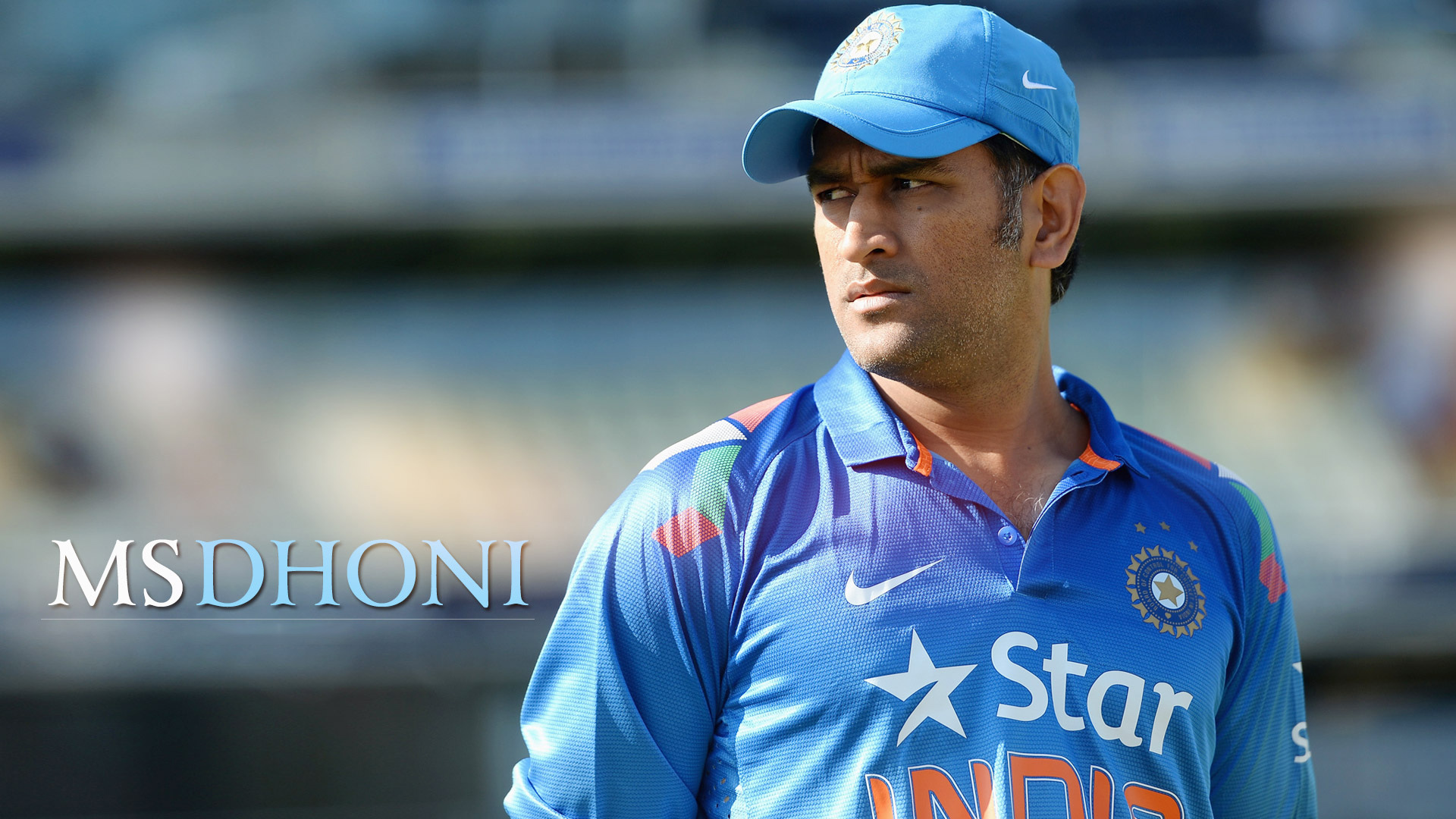
 On Tuesday, Mahendra Singh Dhoni’s boys registered a thumping victory over England in Kochi’s Nehru Stadium to draw level in the ongoing five-match ODI series. The beaming captain was quick to acknowledge that “this is the kind of pitch we were looking for”. Unwittingly, he was articulating a bitter truth. Things have come to such a sorry pass that it appears that the Indian cricket team can no longer win a match in any format of the game unless it is handed a 22-yard leeway by the curator.
After India lost the tall-scoring opening game of the current series in Rajkot, Dhoni trotted out an excuse that would have been dismissed as funny had it not been so spectacularly ludicrous. He suggested something to the effect that the outfield was lightning fast and the strokes played by the English batsmen got more value than they deserved. He however did not go on to claim that the outfield had slowed down when India came out to bat. Small mercy!
Well, Dhoni has been under tremendous pressure of late and some of his post-match utterances have only reflected the state of his mind. The World Cup triumph of 2011 is a distant memory. A nation that was once high on MSD has been brought down to earth by a string of humiliating Test defeats over the past year. Captain Cool has lost his much vaunted calm.
For great cricket teams (like Clive Lloyd’s West Indies, Steve Waugh’s Australia and now, South Africa), winning is a habit. For India, on current form, losing seems to be routine, especially in Test cricket. So questions are bound to arise. Is cricket in this country in terminal decline? Or is this a mere blip in the radar?
 “What goes up must come down,” says former India captain and legendary left-arm tweaker Bishen Singh Bedi. “With a little bit of effort, it will go up again.” The spin meister may be right, but is there anybody out there willing to put in that “little bit of effort” that can make the difference in the long run?
Given the present flow of things, the Indian cricket fan has little reason to be optimistic. And that is a far cry from the state of affairs that prevailed virtually all through the last decade, one of the most eventful in the history of Indian cricket.
From the time former New Zealand opener John Wright took over as the Indian team coach in November 2000 and struck up a successful duet with captain Sourav Ganguly, India has been a force to reckon with in strictly cricketing terms, and not merely as the nation that generates 70 per cent of the game’s revenues. The slump since the 2011 World Cup is easy to explain. Lack of planning for the future and widespread complacency brought on by the continuing commercial gains have been the bane.
The rise and rise of Team India, which was built on epic triumphs both at home and overseas, culminated under the Gary Kirsten-Mahendra Singh Dhoni combo. The team wrested the number one spot in the ICC Test rankings in 2009, albeit briefly, before winning the 2011 ODI World Cup. India was on a roll.
 But the glory is now firmly in the past. With the nucleus of the outfit that delivered the goods on a sustained basis – Anil Kumble, Rahul Dravid, VVS Laxman and Sourav Ganguly – dropping out of the frame, Sachin Tendulkar’s career drawing to a close and the likes of Virender Sehwag and Harbhajan Singh grappling with poor form, Team India, as we knew it, is in tatters.
The openers are failing to fire, the middle-order is as brittle as porcelain and the bowling attack lacks sting. Nowhere are these drawbacks as cruelly exposed as they are in the Test arena, where the skill, temperament and application of a player are pushed to the limits. Yuvraj Singh, the architect of many a major ODI victory, has yet to establish himself as a Test batsman and Suresh Raina, a regular in India’s one-day middle order, finds himself on slippery turf on bouncy tracks.
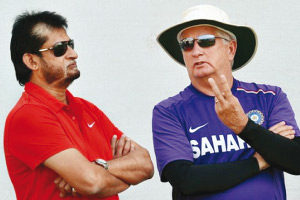 “When a bunch of top performers quit at the same time, it is difficult to find ready-made replacements for them,” says Bedi. “After the departure of the big stars, a huge void has been created. It will take many years to be filled,” agrees veteran cricket commentator Ravi Chaturvedi. “It will take time. You cannot rebuild a team overnight,” says ex-India stumper Kiran More.
There are stray rays of hope on the horizon. It is felt that Saurashtra’s Cheteshwar Pujara has the ability and technique to step into Dravid’s boots, that Rohit Sharma is a classy middle-order bat who can help fill the vacuum left behind by Laxman and that Ajinkya Rahane may be the answer to India’s opening woes. While Pujara has indeed provided glimpses of the possibilities that he brings to the mix, Sharma, despite being obviously talented, has been repeatedly found wanting in terms of temperament. It is early days yet for Rahane.
India is saddled with a generation of cricketers who have been weaned on the easy spoils of the Indian Premier League (IPL) and the steady largesse provided by flat pitches and generous bowlers in domestic cricket. These boys are at their wit’s end when they are up against some chin music or the swinging ball on a lively batting surface. In the post-Kumble era, India is struggling to find a match-winning spinner.
As the English spin duo of Monty Panesar and Graeme Swann showed us late last year, India is going to be playing catch-up unless it stops passing Ravichandran Ashwin off as a spinner. While Amit Mishra, who is probably India’s best leg spinner today, sits out, the easy-to-pulverise Piyush Chawla gets repeatedly selected ahead of the Delhi player. And the curious case of the in-form Manoj Tiwary (who is now back on the list of the hors de combat), who warms the benches even when he is in the squad, does not cease to baffle.
But what faces Indian cricket today is a malaise much worse than lack of on-field performance and inexplicable selection decisions. It pertains to the very way the game is run in this country. While the Indian cricket administration prides itself on being a dominant influence in the world, thanks to its overflowing coffers, it plain forgets that with power comes responsibility. It loses no opportunity to exercise the former – as it does in its cussed refusal to accept the decision review system (DRS) – it rarely, if ever, demonstrates an inclination to embrace the latter.
Domestic cricket, where batsman after gleeful batsman piles up mountains of runs at will on feather beds laid out around the country, is a mere formality that the Board of Control for Cricket in India (BCCI) conducts every year. The powerful administrators are too busy gloating over the profits of IPL to ever notice that the cupboard is bare in terms of genuine talent.
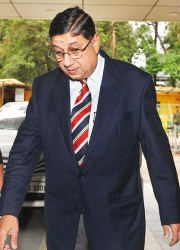 It is whispered, and not always in hushed tones, that Indian cricket is today a slave to the business interests of Chennai Super Kings (CSK), an IPL franchise that is owned by BCCI president N Srinivasan. Until recently, the chairman of selectors was Krishnamachari Srikkanth, who was also the brand ambassador of CSK.
Players who play for that particular franchise – the likes of Suresh Raina, Ravichandran Ashwin, Ravindra Jadeja, besides skipper Dhoni, and to a lesser extent Murali Vijay and Subramaniam Badrinath – have had a clear edge over others in the race to make it to the folds of Team India.
The current Indian ODI squad has as many as four CSK players and any suggestions regarding the need to strip Dhoni of captaincy in at least Test cricket – even when they are made by respected past cricketers – is met with stony silence, if not swift retribution, from the administrators. Without the Ranchi cricketer at the helm, CSK’s market valuation would dip substantially and that, in turn, will harm the BCCI chief’s long-term interests.
Cricket fans, owing to whose blind support the game thrives in this country, certainly have the right to ask why BCCI’s functioning is shrouded in such secrecy and why the selectors are under a gag order. The only stakeholders who have a say are the board officials who never tire of asserting that all the money that BCCI makes is ploughed back into the promotion of the game. Granted, but why then are the administrators so bent upon keeping their books under wraps?
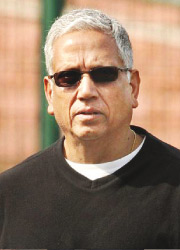 Remember how unceremoniously Mohinder Amarnath was jettisoned as a selector after only a year in the job and when he was in line to take over as the chairman of the panel from Kris Srikkanth. He had the temerity to demand that Dhoni be replaced as captain after eight straight Test match defeats in England and Australia.
What a blunder! He should have known better. In the past, Indian captains of the stature of Sunil Gavaskar and Kapil Dev have been summarily shown the door for presiding over disasters of a far lesser magnitude than the ones faced by Dhoni. But today, anybody demanding desperate measures vis-à-vis the captain, can do so only at his own peril.
Srinivasan’s detractors, including former BCCI chief AC Muthiah (who had filed a plea in the Supreme Court against the latter’s elevation to the post), see a conflict of interests. But who cares as long as the coffers of BCCI and its functionaries continue to overflow? The commercial success of IPL has led to overtly skewed priorities, both for the authorities and the players. For the latter, playing for a club is far more lucrative today than donning the India colours.
The motivation for youngsters to turn out for India in Test cricket is understandably on the wane. A couple of IPL seasons can completely change the fortunes and bank balance of a cricketer who starting out in the game. Why would he slog in the sun to make a mark in the demanding world of Test cricket, where selection is uncertain and sustained success ever more so? A Twenty20 tournament is infinitely better value for money.
 Says Bedi: “I am not at all a fan of IPL. It cannot be the yardstick to judge performance and pick players for the national team.” But isn’t that exactly what is happening since the now sidelined Lalit Modi unleashed the cash-rich Twenty20 league?
Anshuman Gaekwad, former India opener, is however unwilling to blame IPL alone for Indian cricket’s woes: “IPL began four years ago. The decline of Team India began only a year ago. Until the World Cup win, we were doing well quite consistently. So why blame IPL for everything.”
“I don’t blame IPL at all,” says More. “The tournament is played for just two months in a year. Domestic cricket is still as important as ever. But we do need to assess the hundreds that are scored there against the backdrop of the quality of the bowling at that level. We need to find bowlers who can take twenty wickets in a game at the highest level and quality batters who can survive the rigours of Test cricket.”
That is easier said than done. IPL is the perfect stage for bits and pieces players who can come out and clobber the ball with all their might and bowl four overs without conceding too many runs. Expecting them to play a match-saving innings in a Test or bowl a long spell and run through a batting line-up is like asking a mountaineer to go do some deep sea diving.
“Performances in Ranji Trophy and Duleep Trophy matches should be the only yardstick for selection,” says Gaekwad. “IPL games can never be a fair barometer to judge talent.”
Bedi raises questions about the motivation levels of some of the players who are in Indian squad today. “If you feel no pride in playing for the country, you don’t deserve to be in the team,” he says.
Gaekwad has a somewhat different take on the issue. “I don’t think it is a question of motivation. It is a matter of application. Every player wants to make a mark. Even if a player is regarded as selfish, he would perform simply to hold his place in the side.”
Is there way forward in the present scenario? The former greats are unanimous that the primacy of domestic cricket must be restored in order to ensure a steady flow of quality cricketers into the Indian team. They aren’t sure that split captaincy alone to spring a solution. “A new captain cannot be the solution,” says More. “The entire team has to pull its weight.”
At the moment, they seem to be pulling in different directions. The result is out there for all to see. The team that Wright and Kirsten built is dying a slow death under Duncan Fletcher. The Zimbabwean’s days as India coach may be numbered, but will his departure solve the problems that Indian cricket faces as a whole?
That would be wishful thinking. These are desperate times that call for desperate measures. A cricketing system that believes in resting on its haunches cannot be expected to deliver the fan from his misery. The ‘God of Cricket’ is on the way out. May be the God up in the heavens has an answer.