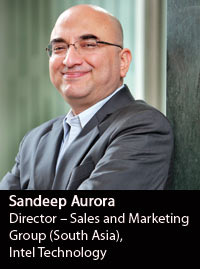
 With the advent of hybrid mobility devices, most have started believing that the PC is fast nearing its end. Intel believes otherwise. Sandeep Aurora, Director – Sales and Marketing Group (South Asia), Intel Technology, talks about why the PC continues to remain a solid first connectivity device and what his company is doing to spread the word
B&E: Could you explain Intel’s new campaign (‘A New era of computing’) that is aimed at achieving a higher PC penetration in the Indian market?
Sandeep Aurora (SA): In emerging markets, especially India, people are extremely cost-conscious. They think a lot before buying a PC. Though the potential of PCs is huge, there is a general lack of awareness about the usage of a PC. We are trying to address this challenge by making people a little more interested in what a PC can do for them. The second important trait is that people want to do a variety of things on their PC, but are hesitant to experiment. In this campaign, we are encouraging and helping them to take their first step towards experimenting various things on their PC. The whole idea is to educate youngsters and tell them that they can do so many wonderful things using a PC. This includes connecting with your kids, remotely making a small sketch, searching for job opportunities and much more. The thought behind the entire campaign is that the youth in India is very ambitious. They are restless, and want to go places to explore opportunities. But, at the same time, they are also a bit confused about how to differentiate the right from the wrong. We are trying to educate people in all spheres, even for choosing an appropriate career with the right help from technology. This is how we are trying to make PCs more relevant to them. B&E: Do you recommend any specific hardware or/and software configuration for buyers in India that may be willing to buy Intel’s proposition?
SA: We have a wide range of configurations available. The buyer takes the actual decision at the point of sale after duly considering various things like usage life, primary usage, secondary usage, single or multiple user device, any additional accessory, price et al. So everything put together defines the configuration. What we believe is that when you are buying a technology, it’s ideal to buy the latest available, because in general, technology becomes outdated very fast. If you are buying the latest, it will stay with you for two to three years. On the other hand, if you are buying a technology which is a year old, it will get outdated very soon, but then it will be available at a much cheaper rate. So everything has to come together in that sense. B&E: In the last three or four years, MacBooks and tablets have become a rage. Today, consumers are confused – the choice is between traditional PCs and the latest in the market like tablets, notebooks, MacBooks et al. What is your opinion on this?
SA: That confusion will increase further in the next few months as we will see convertibles, i.e. combination of laptops and tablets, be launched. In India, tablets are becoming companion devices. People have a PC, but they want a second device which can work as their PC on the move. Another differentiating factor is that a tablet is a great consumption device and consumes data, videos, content et al on it. However, it is not a creation device, as you can’t mix music, edit a video or write a story with the same ease on a PC. Multi-tasking is not possible on a tablet. So a lot of people are opting for both a PC and a tablet. Thus, tablets, smartphones and PCs are going to co-exist. What is important is – which of these devices will people buy first. Generally, people buy smartphones first, as it caters to the basic need of communication. After this they go for a PC or a tablet. Fundamentally, PCs and tablets are complimentary, but a first time buyer is often confused to make his first choice. A potential buyer should carefully mull over the need of the device. If 99% of your usage is Internet browsing, then to have a tab is fine, but if your usage has even 15-20% creation element added to it, then the tablet becomes a secondary device. But this problem will also get resolved when the convertibles come. B&E: This campaign is touted as the most expensive campaign from Intel in a decade. Do we expect product launches to follow this campaign?
SA: No, this is more of an awareness building exercise for PCs. We might extend the campaign when we launch new products, but how to go about it is still to be worked upon. Right now it’s a PC category campaign.
B&E: You would have done some surveys on barriers to penetration. What do you think are the barriers for the PC market? Are there regional disparities in India?
SA: It’s not regional at all. Five years ago, the barrier was affordability. To buy a PC, one would need about 80-90 weeks of income, which has now fallen to 18-20 weeks. First, technology has become cheaper, and secondly income levels have gone up. But the barrier now-a-days is usage and connectivity. The connectivity in India is still not good enough and it’s expensive too. Once 3G and 4G come into extensive use, there are high possibilities that people will start enjoying what is called broadband, and that will also increase PC penetration in the country. B&E: So at present, what demographics are you targeting?
SA: Let me refer to our campaign. We take this campaign forward in a variety of ways. First, it is being broadcasted in the most widely spoken languages across the country. Then, we are doing a lot of on-ground activations within this umbrella. We will be going to colleges, cafes, BPOs, et al and talk to potential buyers to generate awareness about the usage of a PC. On another hand, we have been training teachers, who further train more teachers and eventually students. From our perspective, all these areas are aligned with the digital literacy mission. We want to make sure that one person from every Indian household is digitally literate. The current approach is to focus more on youth, students and fresh professionals, which we can’t accomplish alone. We have joined hands with various partners like NIIT and various retail stores where professionals are trained to address consumers’ issues in a right manner.
B&E: Apart from households, are you targeting SMEs as well?
SA: SMEs are a little tough to crack as a sector because they are fragmented. But fundamentally, SMEs eventually end up behaving like consumers. They don’t have a CIO or a CTO, and most often, they visit retail stores and place small PC orders. For medium businesses, we are doing a bunch of programmes along with the OEMs. We have telecalling engines in place and also have seminars being organised through SME associations. The idea is the same – to educate people in order to address the concerned challenges. B&E: In retail stores, use of inventory management software or bar code reader caters to some obvious needs. In that sense, would working with software vendors also be an option for you?
SA: We already do that. We have a software success group who work with a variety of application and software developers. Long back, we did a programme for chemists. This is how it worked. An alert got generated for any stock that was about to end. So without wasting more than a couple of days, an order for fresh stock got placed. Initially, most people opposed the idea, but now big companies are manufacturing applications like that for kirana stores and medical shops as they see a huge business in it. The trouble with SMEs is that there is no unified application that can work. They all demand different applications. So the real task remains. However, things are expected to change fast on this front too.