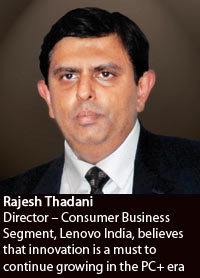
 Lenovo has become the #1 seller of PCs in India. But falling shipments of PCs and fiery growth of lesser-explored devices in the Indian market could throw up new challenges for it. Thinking heads at the company think otherwise.Rajesh Thadani, Director, Lenovo talks to steven philip warner, editor, B&E
Unlike across most developed geographies, tablets and notebooks may not yet have cannibalised the PC market in India. But given that PC sales did fall (for the first time) in Q3, 2012 (5.9%, y-o-y), that smaller devices are fast forcing a change in the PC world is no surprise. Most would assume that this development is no good for the no.1 PC seller in India – Lenovo (17.0% share in Q3, 2012). But going by the words of Rajesh Thadani, Director – Consumer Business Segment, Lenovo India, the Chinese manufacturer seems well on track to retain the leader’s hat in a growing Indian consumer market even in the ‘PC+ era’. Excerpts from an exclusive interview with Thadani who is in charge of Lenovo’s PC and mobility devices business in India. B&E: The tablets market in India is expected to cross the 7 million mark in volumes by 2015-16, as per a recent estimate by MAIT. What are Lenovo’s plans in this category as far as launches are concerned over the next year?
Rajesh Thadani (RT): In the vast world of ever-changing technology, the most mobile avatar of personal computing – the tablet – is the new buzz word today. With the growing accessibility and usage of the Internet in India across tier 1 and 2 cities, tablets are becoming more and more relevant because they are optimised for content consumption. Lenovo, believes that we have entered the PC+ era, characterised by the emergence of a variety of new devices and technology interfaces. With the growth in new viable operating systems, including Windows 8 and Android, we welcome the choice these ecosystems present to leverage and build hardware that delivers a great customer experience that can be shared across multiple platforms. We also believe that one size doesn’t fit all and have therefore forayed into the tablet market making available the new form factor to business users with ThinkPad Tablet and Lenovo A2107, IdeaPad A1 and K1 Tablets for the retail consumer. Lenovo has laid out aggressive plans to launch new tablets in the Indian market. Lenovo A2107 (7” ultraportable tablet) is the latest from our stable and is powered by Android 4.0 (ICS), ideal for content consumption and creation on-the-go with equal emphasis on style and performance. We are also in the process of launching a range of devices starting from 7” (screen sizes) on both Win 8 and Android OS.
B&E: Lenovo recently launched the IdeaPad Yoga, that has the capability to transform from an ultrabook into a media-friendly tablet. Do you see the market for such hybrid devices increasing in India in the near term?
RT: Lenovo ushered in a new phase of personal computing with the launch of its much-awaited IdeaPad Yoga in India. With the advent of new form factors, such as hybrids powered by new operating systems, we believe the PC market will continue to deliver strong growth in the long term. Due to the increasing need for mobility and changing needs of customers towards lifestyle and entertainment, PCs will increasingly become sleeker and more powerful. We believe that Ultrabooks as a category will grow tremendously over the next few years. We therefore have a strong strategy in this space. B&E: Is Windows 8 on a standalone basis a sufficient platform to satisfy changing demands given the shift in how consumers are using their personal computing devices today, or are you also experimenting with other OSs?
RT: The launch of Windows 8 is an exciting time for Lenovo as it creates new opportunities to continue to provide innovative convertible products that take advantage of Windows 8 and also help solidify the PC+ era we are currently in. Built around touch technology and tiled applications, Windows 8 takes the PC experience to a new level of customisation, consumption and creation. Windows 8 devices will definitely boost consumer demand for PCs and an increasingly wide range of products in the four screen suite. But we are not limiting ourselves to only Windows 8 OS. A balanced product portfolio across different form factors, operating systems and market niches will better serve the needs of different customers and strengthen our competitiveness over time.
B&E: What according to you would be the new phase in personal computing globally. Desktops to laptops to tablets to… What next?
RT: Lenovo sees a “PC+ Era”. Not a “Post PC Revolution”. PCs will still be an important part of consumers’ lives. In context, 364.5 million PCs were sold globally in 2011 and IDC predicts 529 million PCs will be sold in 2016. This is a 7.7% CAGR from 2011 to 2016 and signifies the importance of traditional PCs in the next phase of personal computing. B&E: Consumers in India have recently been bombarded with either launches or promises of low-priced tablets from makers like Zync, Sylvania, Datawind, Vox et al. Could these launches work against your interests?
RT: We have a long history of product innovation and as always are confident of our market position. B&E: From being #3 in India a year back to #1 today. Where next for Lenovo’s PC and tablet business in India?
RT: Lenovo is confident that it will continue to outperform and outgrow the market. We are strong where the market is strong and are investing where the market is growing. We are driving for balanced growth across all geographic regions, customer segments, and product categories. We are investing for growth both in the short-term and long-term, focusing on product innovation, branding and talent. We have a PC+ strategy in place that is bringing us into new areas such as smartphones, TVs and tablets that will allow us to capture those opportunities as well. Hybrids such as Lenovo IdeaPad Yoga are also expected to go a long way to contribute to the PC market growth. B&E: A lot is being said about how for microprocessors, the next battleground is the server and datacenter market. What’s Lenovo’s position in this respect?
RT: Lenovo recently entered into a JV with EMC Corporation that enhances Lenovo’s position in industry standard servers and networked storage solutions, while expanding EMC’s reach in China and other key, high-growth markets. The partnership with EMC is a first step in Lenovo’s aspiration to be a leading provider of servers with a suite of complementary storage products, both of which are the backend enterprise IT Infrastructure that powers the PC+ era. B&E: Final question – going forward, how will Indian consumers find hardware from your company both interesting and worth the price tags?
RT: Innovation is in our DNA. We are investing heavily in building a global brand that deeply resonates with our target youth audience and elevates our profile around the world. At the recently held Consumer Electronic Show, we showcased products like IdeaCentre Horizon, the first truly interpersonal PC and tremendously fun table PC, our ThinkPad Helix, a rip and flip convertible device for business and our incredible mobile touch screen monitor for Windows 8. We may look at launching similar products in the Indian market, and we are confident that consumers here will find them both interesting and value for money.