Infrastructure pulls the traffic
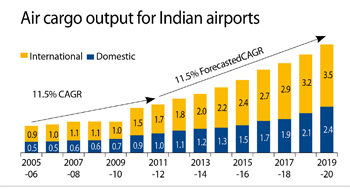
The air cargo throughput in India grew at 11.6% CAGR between 2006-12, thanks to government’s effort of developing world class infrastructure. Higher proportion of this growth comes from domestic front(12.3%) as compared to international (11.2%). Total air cargo traffic is expected to be double (5.9 MMT) over the next decade. About 50% of India’s domestic and international cargo is collectively handled by the Delhi and Mumbai airports.
 Funds flowing, thick and fast
In the 11th 5 year plan, Rs 361.4 billion were allocated for airport infrastructure development. This reflects a rise of 424% over the Tenth Plan (2002–07). Almost 95% of this money was put to use. Similarly, the 12th Five-Year Plan (2012–17) has allocated 86% more funds to the sector as compared to the 11th plan. Hence, we can stay assure that funds are not going to be a problem in the future.
 Traffiic continues to swell
Over the last decade, the Indian port sector has witnessed tremendous growth. From 368 MMT traffic that was handled on the Indian ports in the year 2000-01, the figure has grown at a CAGR of 8.5%, reaching 898 MMT by 2011-12. Post this, global slowdown has impacted the traffic. However, the sector is again showing the signs of rebounding, with estimates that the traffic would touch 1,304 MMT by 2016–17 at an accelerated CAGR of 8%.
 The new maritime agenda
Under the maritime agenda 2010-20, the Government of India intends to boost private investment to increase capacity at the Indian ports. The PPP model may play a very important role here. This will be helpful to generate the funds from the private players while government plays a key role to remove the obstacles on the policy front. By the end of 2020, this program is expected to handle 2500 MMT cargo per annum.