New brands shouted aloud, last year’s achievers fought hard to continue winning while legacy brands tried appealing consumers to top the charts. With new brands swarming the marketplace, it took long hours of brainstorming, data crunching and almost six-months’ of extensive research to get the 4Ps Business & Marketing annual ranking of India’s 100 Most Valuable Brands of 2013. Together with the Indian Council for Market Research (ICMR), our most trusted research partner over the years, we dissected brands’ journey and performance to fetch the best from a staggering list of 40,000 brands. So, here is how we did it…
FIRST PHASE
Phase I started with preparing a holistic list of local, national and international brands (40,000) present in India, which was then scaled down to a master list of 1,410 brands based on the growth, reach, demand and availability (in at least 4 metros and Bengaluru) further divided into 30 broad categories with over 100 sub categories. Both domestic and international brands having their presence in India were taken into consideration for the final phase of the research.
Next, ICMR prepared a structured questionnaire on parameters of Brand Awareness and Preference. Based on the questionnaire a primary research was conducted in Delhi, Mumbai, Kolkata, Bengaluru and Chennai with 5,000 respondents. Based on the frequency of brands under the parameters, as found in the primary research, ICMR shortlisted top 200 brands across all categories.
SECOND PHASE
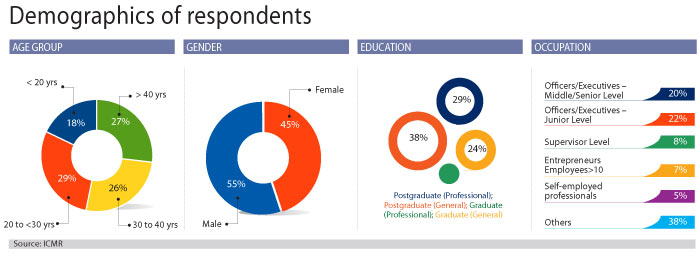
The second phase of the survey was initiated after tabulating the top 200 brands. A structured questionnaire was formed and one-on-one telephonic interviews were carried out with 4,500 respondents in eight cities (Delhi, Chandigarh, Mumbai, Kolkata, Bengaluru, Hyderabad, Pune and Chennai) across India. In order to avoid any bias, the order of the brands was changed for each of the cities. Each of the cities was divided into four zones namely North, South, East and West to ensure complete coverage of the city in terms of the target audience. Further, the respondents were selected based on socio-economic classification (SEC) i.e. education, occupation, gender and monthly income. In case of respondents such as housewives, students, et al, the monthly income of the Chief Wage Earner (CWE – Head of Household) has been taken into consideration.
 While conducting this year’s random, pan-India perception based survey, the focus was on Brand Equity (difference between perceived value of the brand and the core product, i.e., the total value of the brand minus that part of the value “owed” to the core product, which equals the value that accrues from the brand part of the product) of various brands. To achieve this measure, the questionnaire was framed taking into account the following five parameters, on which the respondents were asked to rate the brands:
Brand Image and Perception: Simply put, it is how customers perceive a brand – a unique bundle of associations about a brand within the minds of target customers. However, the brand image also conveys the emotional value attached to it. Please note that the listed scores reflect only the perceived image of a brand in consumers’ minds and not necessarily define the actual qualities of any brand’s products.
Brand Performance: This parameter aims at gaining an insight into overall health of a brand. The survey drilled down into details of the revenue, sales, profits, growth, performance, distribution, market share, goodwill, word of mouth publicity, competitor analysis and overall marketing initiatives.
Brand Loyalty: It is consumers’ inclination to continue buying the same brand. The parameter plays a paramount role to understand what are the drivers of brand loyalty – superior customer service, better quality, price, convenience, reward programs or legacy. (Please note: the loyalty parameter was rated by only consumers of the brand with a minimum of one year of association with the brand and the calculations have been made accordingly).
Brand Awareness: It refers to memorability – consumers’ ability to recall a brand and is considered to be a significant determinant of choice. The respondents were asked to recall the brands across categories they are aware of.
Brand Association: Association means images, symbols or anything that are deep seated in the consumers’ mind about a brand. Due to the brand’s strong communication strategy, a stage comes that the brand becomes synonymous with that product category.
The respondents rated each of the brands on a scale of 1-5 (5 being the highest). The survey results were then compiled to draw the final list of 4Ps B&M India’s 100 Most Valuable Brands 2013.