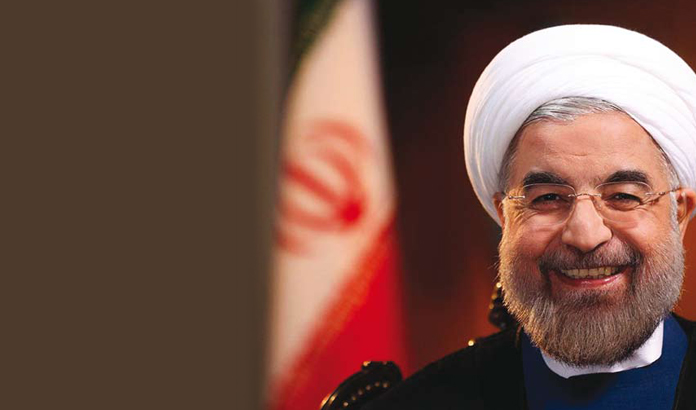
AN OPPORTUNISTIC ALLIANCE OF REFORMISTS, MODERATES AND SOME CONSERVATIVES HAVE MANAGED TO CREATE A WORKABLE SPACE INSIDE THE IRANIAN MAJLIS THAT HAD REMAINED A CONSERVATIVE BASTION FOR CLOSE TO A DECADE AND A HALF, SAYS SAURABH KUMAR SHAHI
In most of the nations with the Presidential form of government in place, parliamentary elections are normally lame-duck a_airs. Lukewarm events at the most. Not in Iran. e election for Iran’s 10th Majlis (or Parliament) as well as for the Assembly of Experts might not have gotten the kind of international attention it deserved, but it surely did not disappoint when it came to the excitement quotient. Under the Iranian system, while the President and his cabinet has the right to form policies and take decisions, those decisions needs to be passed by Majlis. Similar to what is practised by its arch-nemesis the United States of America. However, while the US President has a masterstroke in the form of an Executive Order, his Iranian counterpart does not enjoy any comparable power tool. Under the circumstances, it is absolutely essential for an Iranian President to keep a smooth functioning relationship with the Majlis. However, considering the makeup of Iranian internal politics, this has rarely been the case. When President Hassan Rouhani managed to strike the historic Nuclear Deal with P5+1, he was almost certain that he and other moderates and reformists would be able to show a relatively better performance this time around. But by how much, they did not know themselves. Post-election, the Majlis remains a divided house. However, that’s not necessarily bad for Rouhani. It is in fact good. While reformists, moderates and moderate- conservatives have fared remarkably well in the big cities, including Tehran, where they took all but one seat out of the 30 up for contest; the conservatives, called Principlists colloquially, have retained their stronghold of small-town and rural Iran. In spite of a landslide victory in big cities, the combined strength of reformists, moderates and moderate-conservatives is less than the desired halfway majority. e Principlists are expected to win around 170 seats out of 290 a_er run-o_s at some of the seats. However, this also means that the non- Principlists have enough numbers to make life hell for the Principlists, who, very clearly, will now have to share power and stop putting hurdles in the path of President Rouhani. But to be fair to the Principlists, although they blew hot and cold over the perceived or real concessions given by Foreign Minister Javad Zarif and his team during the nuclear negotiation, they were comparatively much more lenient with Rouhani’s administration than they were with President Ahmadinejad’s. While Rouhani lamented the lack of imagination on Majlis part, Ahmadinejad actually saw dozens of his minister nominees either rejected or impeached by the house. _e comparative number for Rouhani’s administration is remarkable low, considering that he is considered as a real opponent, as opposed to Ahmadinejad. _at is not to say that there were no rancourous outbursts. In the run-up to the nuclear deal in Vienna, both Rouhani and Javad Zarif had to overcome some serious hurdles posed by Principlist factions. Some went as far as to brand them traitors of the Iranian cause while others used unprintable sobriquets for the duo. “_e administration had a relatively smooth working relation with the Ninth Majlis and, in all likelihood, will also enjoy an extended honeymoon with the coming Tenth Majlis, which will scrutinize the annual budget and the next _veyear plan, among other things. In other words, the Majlis will assume an additional role above and beyond ‘checks and balance’ with respect to the executive branch, it will also complement it, e.g., by streamlining laws aimed at facilitating the government’s economic agenda,” says Seyyed Reza Salehi Amiri, a popular Moderate _gure. But for Iran, more than the results, it was the election itself that was 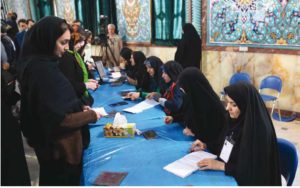 important. A_er some candidates were not approved by the Guardian Council to run for the election, Western media and analysts, alike, tried to present it as an example of how the “regime” did not want reformists and moderates to win. _is was a deliberate misinformation campaign, something Iran is now accustomed to. Now that the same faction has won almost 40 percent of the seats, there is no talk about where did these numbers come from if they were not allowed to contest. _e truth is, moderates and reformists try to overwhelm the Guardian Council by _elding dozens of candidates from every seat, which includes those who are not eligible to _ght elections due to various technical reasons. It is therefore very common that a majority of such “dummy candidates” are rejected in the _nal vetting process. To put it in perspective, there was not even one out of 290 contested seats where moderates and reformists did not have a candidate. _is small but crucial piece of information did not _nd any mention, not surprisingly, in most of the Western media outlets. _is concentrated e_ort to delegitimize the elections did not _nd many takers in Iran, though. As many as 33 million Iranians, a whopping 60 percent of the registered electorate, came out and voted on the day of elections. To put it in perspective, the comparative _gure for the US Congressional polls is in the low 40s mostly. _e election also saw the demise of the old way of campaigning where state tools were used by the ruling dispensation for campaigns. _e demographic reality of Iran has _nally started shaping all the aspects of elections. _e dependence on new medium and discarding of the old ones has meant that Principlists were le_ groping for proper media to reach out to the masses. _is worked mostly to the favour of moderates and reformists. “_e February elections can be considered as a turning point in changing the model of political participation in Iran. For the _rst time during campaigning in these elections, traditional publicity patterns were forsaken. As a result, there were no signs of either heated publicity in the urban environment and on the streets, nor was the state-run television mobilized to this e_ect. Participation and voting of Iranians in February 26 elections came about through the least use of traditional means of publicity. From this viewpoint, their participation in the recent elections is of high and great value. Election turnout on 26 February was – more than anything else – close to modern and civil models of political participation; a model in which the element of convincement replaced such elements as coercion and obligation; and before casting their ballots, participants paid attention to benets and losses of voting,” says Mohammad Nouri, an expert on the Iranian electioneering. As far as day to day politicking is concerned, there appears to be several political gures who have gone for opportunistic alliances. Ali Larijani, the Principlist speaker of the outgoing Majlis, sided with Rouhani during the entire deal and is expected to side with him again in the incoming Majlis. He also serves as the allimportant channel with the supreme leader, Ayatollah Ali Khamenei. Similarly, another important Principlist gure, Ali Motahari, has also sided with the moderates. Others, such as former Intelligence Ministers Ghorbanali Dorri-Najafabadi and Mohammad Reyshahri, as well as Ali Razini, the chief prosecutor of Iran’s Revolutionary Court, actually won on the moderate list. _is signies that the black and white portrayal of Iranian factions by the Western press and analysts is actually not very accurate when it comes to day to day politicking. _ose lawmakers, who will like their constituencies to benet from the li_- ing of sanctions, will vote for bills enabling investments, irrespective of their political standing. It is expected now that President Rouhani will go on and open Iran for further investment and trade. _is will mostly be benecial for Europe as there is no chance of any breaking of ice with the US in the foreseeable future. _ere’s no chance of a major change on the international and strategic front as well. Iran will continue to lend unconditional support to beleaguered Syrian President Bashar al-Assad and his government as well as that of Prime Minister Haider al-Abadi in Iraq. It is also expected that cooperation with Russia and Iran will be further deepened. Both these countries can expect to get a lion’s share of all the infrastructure and energy projects that will start in the months and years to come. _e electorate has given a respectable mandate to Rouhani and his team and have put their condence in his presidency. It will now depend on Rouhani how he delivers to this trust of the nation.