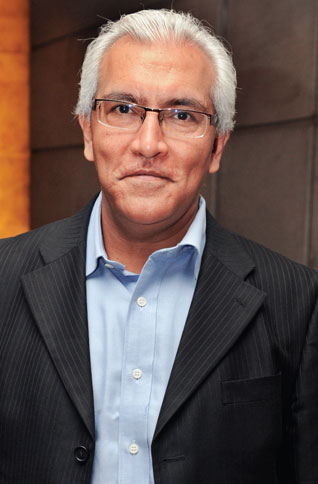
Mr. Khaneja, a Biology graduate decided to change his stream of education and pursued MBA from IIPM in 1982. This proved to be a stepping stone for his entry later into the IT field. He has always believed that professional journey should begin with an end goal in mind. But once an individual embarks on a journey the perspective should be ‘change’. True happiness and professional accomplishment emerge when one learns to enjoy the journey rather than being obsessed with the end goal. Giving 100 per cent to the occurences that constitute the journey should be the utmost priority. His professional journey, in short, has been replete with serendipity and the personal willingness to follow his heart and take calculated risks.
He was fortunate enough to start his career at a very young age of 19 with an organisation called “Initiatives of Change”. It is and will always remain a memorable moment as he got the opportunity of a lifetime to meet Mr. Rajmohan Gandhi, grandson of Mahatma Gandhi.
Talking about his first job, he explains, “The first job facilitates in setting a definitive path.” The choices made during this phase should be given due weightage. The industry chosen at the beginning of one’s career makes substantial difference in governing one’s long term career objectives. For instance, one should initially choose between a high growth and low growth industry and be in sync with the margins that effect the predefined pace and intense competition. The career prospects in mature industries drastically vary from the new forming industries. The thumb rule in this case would be to choose the industry and role in alignment with the career objectives, skills and temperament. A vital aspect of the career graph is the awareness of situational realities along with competence.
When asked about his first boss he laughs aloud and says, ”Your first boss is almost like your parents, you do not choose your parents, they choose you!” The two things that a boss really expects are sincerity of purpose and reliability in the responsibilities undertaken. There are no ideal bosses as they are mere human beings contending with their own challenges.
Mr. Khaneja, being extremely dynamic and adaptive, understands the perspective of young professionals. He grew up in a world of scarcities, they live in a world of relative abundance. It is a strange contrast of worlds. He recalls, ”In our world a telephone landline connection could take you a dozen years, a motor bike had a waiting period of around a year, the internet existed as a research project, a television set had 12 channels and Windows still meant something quite mundane!” The new recruits are mostly self-driven, willing to re-educate themselves on the job, pull responsibilities and align themselves to objectives rather than personalities.
Fast forward 20 years and the economics of scarcity is almost irrelevant. Knowledge is available on a tap, communication is ubiquitous for a pittance and apparently the world is fl at. This new world with its technological advancement demands for a fresh set of skills. Knowledge has become a key leveller. The application of knowledge with deep dive skills in a particular domain along with a good EQ stand out as an invincible combination.
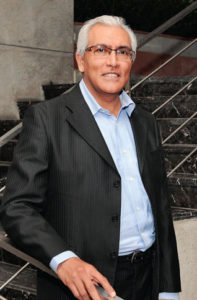 During a career span of 31 years, Mr. Khaneja has assuringly achieved and adapted himself to different work environments and has emerged as a leader in the process. Presently, he thrives on an American non-hierarchical and management by objective driven work culture. Therefore, the work culture is completely task and result oriented, and customer centric in existence.
As far as the threats are concerned he broadly categorises them under two headings. The first, essentially being the wide gap between those who accept, understand and assimilate technology, eventually use it for their advantage and those who are unaware of technological advancement. The second is, the impact of technology on personal relationships, proximity, intimacy and on social and cultural evolution. Facebook and social networking sites cannot be a substitute for face-to-face communication.
His toughest decision at workplace has been the termination process during the economic slow down. In order to reduce the headcount, he was directly involved in giving pink slips to some of his close team members and associates whom he had nurtured under his guidance.
“The leader has to be practical and a realist, yet must talk the language of the visionary and the idealist”, was quoted by Eric Hoffer. Mr. Khaneja believes in talking less and listening more, focussing on the task and optimum execution of decisions for better results. Amongst the gamut of leaders he admires Bill Clinton and Steve Jobs for their remarkable achievements. Gandhiji has always been an ideal and his advocacies and thoughts still fascinate him.
During his leisure time, he tends to be adventurous, and enjoys going on cruise trips to Bali, China and Egypt. However on weekends, he likes to spend time playing golf, reading and running. The endearing charm, enthusiasm and passion drives Mr. Khaneja towards good to better and ultimately to perfection, and we believe this perfectionist still has miles and miles to go…