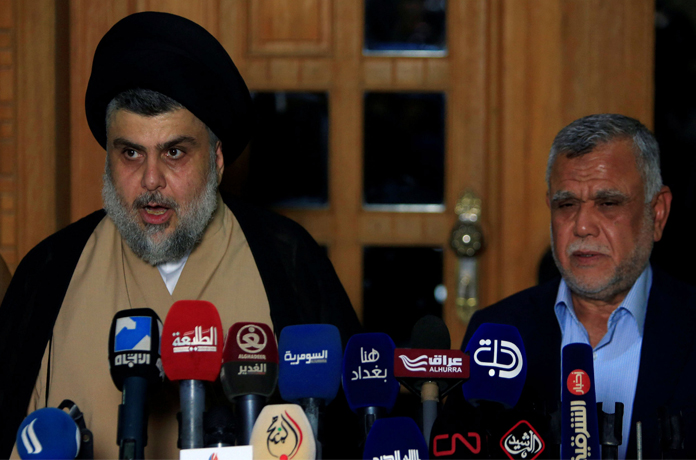
There was just a too much strategic investment in Moqtada al Sadr for the GCC states to not have lost their wits when Sadr finally decided to do a volte-face and form his post-poll coalition with Iranian backed and Hadi al Amiri led Fatah Alliance. Even by their own standards of failures in containing Iran, this would have hurt them a lot. And for a much longer time.
A year or so ago when Sadr started making some anti-Hezbollah, anti-Assad, and more importantly anti-Iranian noise, the mandarins in the GCC countries though that they now have the chink that will destroy the armour of Iran in Iraq. The happiness was visible. Sadr was flown to Riyadh to meet Saudi Crown Prince Mohammad bin Sultan and later to UAE to meet the Sheikh of Abi Dhabi. This was while UAE and Saudi wee bombing and starving Shias in Yemen. The visit provoked a massive online backlash from Iranians who saw it as a betrayal. However, IRGC’s commander QassemSolemani, who takes care of the Iraqi Affairs, was not the one to react. He was plotting his own counterblow. And it came in the form if Fatah Coalition made up of pro-Iran factions of Hashd al Shabi or PMU who had decided to field their own candidates after asking them to resign from the post of commander.
While Solemani wanted this coalition to support embattled Prime Minister Haider al Abadi’s al Nasr Alliance, in spite of the bad blood between Solemani and Abadi, the coalition failed to take off. Abadi was sure of his victory with or without Fatah’s help and that’s why he put stringent demands.
Following the elections that saw record low turnout, care based parties like Sadr’s Sairoon Coalition and Amiri’s Fata did exceptionally well. While Abadi’s middle-class voters didn’t come out to vote, the poor constituency of both Sadr and Amiri did and that propelled Sadr and Amiri to be the top two performers. Abadi was on third.
This was perplexing for GCC handlers. While they were joyous that they could now control Sadr and form an anti-Iran government in Baghdad, they were also wary of Fatah’s performance. For initial few weeks, they tried to stitch an alliance between Sadr, Iyad Alawi, Ammar al-Hakim and some other Sunni parties, but there were not enough seats to titch such an alliance.
In the while, because of the numerous complaints of rigging, some members demanded recounting or even re-election. However, on the eve of re-counting, the ballot boxes caught fire and everything was destroyed. Sources insist that it was the handiwork of Sadr’s men, who were wary that in any re-election, Abadi and Amiri will join hands and crush Sadr’s Coalition.
“Moqtada al-Sadr may refuse a new election, he who considers himself to be sitting on the top of the largest group with the biggest number of seats in parliament. Moreover, it seems almost impossible for any coalition to come together and collect more than 165 seats in parliament so as to be able to nominate a prime minister within the time limit. The larger groups are Shia and these are divided among themselves,” says Elijah J Magnier, noted expert on the Middle East.
But then, something remarkable happened that left the GCC capitals stunned. Solemani, who was working behind the scene, managed to mollify Sadr and made him saw reason. Sadr realised that there can be no government without Amiri and Abadi and decided to do a political somersault. The very next day, a post-poll coalition between Sadr and Amiri was announced.
While this block is still way less than the simple majority required, it is easy to bring in smaller parties around this coalition. It is also expected that after sustained pressure Sadr will see the logic in keeping Abadi as the Prime Minister once again. This would not only be a win-win situation for Abadi, it will also keep the Americans less wary as they had previously fought battles with Sadr’s fighters following the Iraq War.
As for Iran, this is another victory that will likely strengthen its presence in the region a bit more. Any future government will assure Iran’s two major interests. First, they will not let Iraq become a launch-pad for American and GCC designs against Iran, and second, there will be an uninterrupted land channel from Iran to Lebanon to arm Assad and Hezbollah. And it is going to get both the wishes.
“Iran also fears the Iraqi politicians who are very prone to jump into US arms, considering especially the presence of a strong current of animosity against Tehran among the Marjaiya, among many politicians and ordinary people. There is already a strong Hashd al-Shabi, capable of defending Iraq against any US hegemony. Thus, given all these elements, it appears logical to many that Iraq will remain very weak indeed. It seems headed towards a weak government or no election at all. It is already under the control of the militias in parliament and in most key positions, a very suitable scenario that fits most involved foreign players (US, Iran, Saudi Arabia), and is supported by the collaboration of many Iraqis,” adds Magnier.
The haggling might still take several weeks. A lot can change in between. However what is not going to change is another crushing defeat that Iranian diplomacy has put on Saudi-led GCC clique.