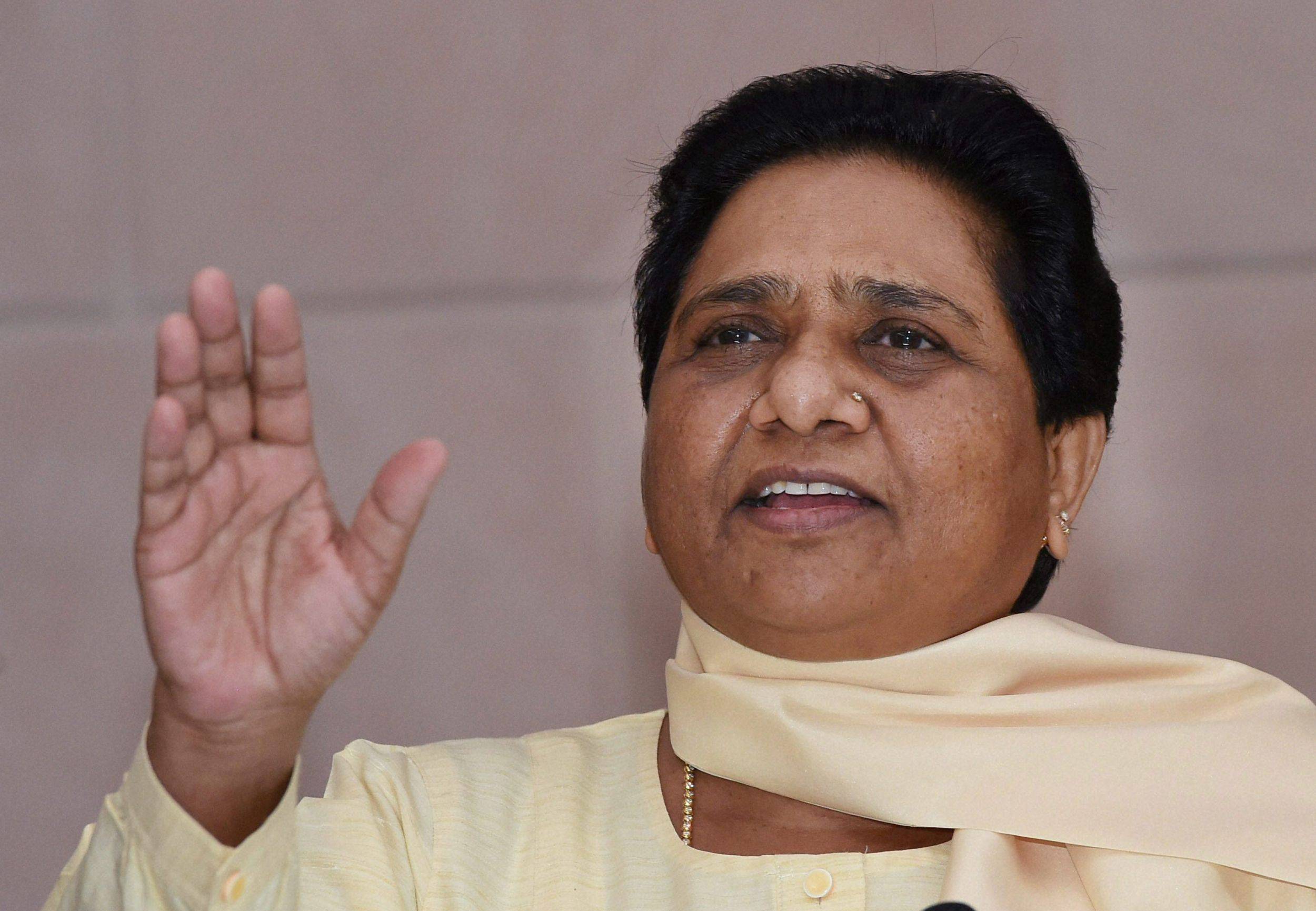
Bahujan Samaj Party (BSP) boss and former Chief Minister Uttar Pradesh Mayawati is pretty much her own woman. Undaunted, feisty and someone who keeps her cards close to her chest, India’s most influential Dalit leader is not known to harbour prime ministerial ambitions. At least, not yet.
She is reported to have said on previous occasions though that it is only a matter of time before India gets its first Dalit prime minister – the allusion to herself hardly a state secret.
Mayawati’s sights are firmly set on regaining India’s most influential political state which she lost to archrival Samajwadi Party in 2012. But there is little doubt that should she emerge with the largest number of seats in Lok Sabha 2014 from UP, Mayawati could well end up throwing her hat into the ring for the top job. And if the ambit of her Dalit influence goes beyond Uttar Pradesh, so much the better.
At any rate, given UP’s numbers, a leader with double digit MPs can rightfully expected to play an important role when it comes to government formation at the centre.
Despite making her political debut in the early 1990s and late 1980s, Mayawati did not establish her independent entity till 1993, working under the overarching influence of her boss and mentor Kanshi Ram, whose domination of Dalit politics in UP and elsewhere in north India back in the 1970s and 1980s, remains without a parallel in the annals of backward politics in post-Independence India.
In 1993, the politics of UP was under the grip of several waves, all pulling in divergent directions. BJP’s Ramjanma Bhoomi agitation at Ayodhya was at its peak and the shadow of the Shah Bano case had barely died down in the state where its impact was the most severe. In other words, communal polarization was complete.
But perhaps the most significant movement of mobilising the lowliest of the low was on the horizon. The post-Mandal ferment was in the process of unleashing forces that would ultimately become the most potent factor in north Indian politics.
That year, Mayawati began her political ascent. She teamed up with Mulayam Singh Yadav and two jointly fought the UP assembly elections. Though they did not get a majority, with outside Janata Dal support, Mulayam become a chief minister for a second term.
It was here that the young Dalit leader began to make an impact. Her constant interference in the working of the new government made tensions an everyday affair, and relations between the two coalition partners reached the nadir with a personal attack on Mayawati – or behenji as she is known – at Lucknow’s State Guest House. It then became a matter of time before the government collapsed and Presidents’ Rule imposed in the state.
The Presidents Rule period marks an important land mark in north India’s Dalit politics. The BJP stepped in now with its coalition dharma: it teamed up with the BSP to elect Mayawati as UP’s first Dalit chief minister. But given the imperatives of vote bank politics, that too proved short lived. Mayawati decided to get tough with Ramjanma Bhoomi activists, and it was only a question of time before the BJP – in order to protect its vote bank – decided to pull the carpet from under her feet.
The next state assembly elections proved to be a three-way street with no party gaining majority and the Congress utterly vanquished in its once stronghold. After much dithering and horse trading, the BJP and BSP came together for a second time. But strategic differences between the two were unbridgeable.
As part of the accord, Mayawati was to rule for the first two-and-half years to be followed by a BJP chief minister. It did not turn out that way. In a slew of allegations and counter allegations, she completed her term but when it came to BJP’s turn, the Dalit leader went back on her commitment leading to yet another incomplete term for the UP assembly.
With no political formation having the desired numbers, it came down to another round of horse trading – this time the beneficiary was Mulayam Singh.
But through the nineties, Mayawati revealed a canny political sense and an intense desire for self-preservation. Politically, she had emerged an entity in her own right. In doing so, she had discarded some of the set notions of her guru Kanshi Ram. His avowedly anti-upper cast rhetoric – tilak, tarazu aur talwar, inko maro joote chaar (loosely translated it meant bash up the Brahman, Baniya and Rajput, symbols of upper caste Hindus) gave way to her broader call for bahujan samaj (taking all castes on board).
The results of her social engineering proved deadly in the 2007 when the BSP swept the UP polls winning 206 out of 403 assembly seats and Mayawati became chief minister for yet another time. With her numbers, running a government for a full term was never a problem but what became problematic was her decision to etch her regime in stone – literally.
Her decision to erect statues of Dalit icons – including mentor Kanshi Ram – among others led to much heart burn, charges of graft and all other trappings which are natural accompaniments of power in a third world democracy. King sized statues sprung up between Lucknow and Noida, making it easily the most publicized regime to have come out of UP. She was accused of doing too much for lifeless statues and very little for people who inhabited the state.
The results were there to see and 2012 proved costly for her. She was routed at the hands of archrival Samajwadi Party in the UP assembly, failing to reach the three-figure mark. Since then she has maintained a low profile, her views on most burning subjects unknown. But there is little doubt that she is waiting for 2014 to revive her fortunes. Of all regional leaders, she is the one looking to expand her base.