India has currently one of the world’s largest pool of engineering graduates – in 2013 there will be 6.5 lakh of them while the number will almost double come 2014, creating an even greater surplus of talent than what international and domestic companies require with their businesses in the countryi. Since only a fraction of them would hail from reputable colleges, employers would be fiercely competing for these ‘top talent’.
One would expect all talent to want to work for the most prestigious companies. If this is so, Indian Oil and Reliance Industries – with the highest rankings among Indian companies on the Fortune 500 list – should be the most attractive employers to work for. Yet, according to Universum’s Top 100 Ideal Employers 2012, based on the world’s largest survey of its kind conducted annually among university students, the two firms are ranked 19th and 23rd respectively according to engineering students in India. The most ideal employer to them is Google, followed by Microsoft and Infosys.
To understand how talent consider an employer more attractive over another, we asked them the relative importance of attributes among the 4 Drivers of Employer Attractivenessii, namely Employer Reputation & Image, Job Characteristics, People & Culture and Remuneration & Advancement Opportunities. Engineering students pride innovation most, followed by having a friendly, creative and dynamic work environment.It is therefore easy to understand why Google is perceived to be more attractive than Infosys – even though both value innovation – simply by going into their career websites where their employer brands are brought to life.
Globalisation stiffens competition for talent
The past decade has witnessed tremendous growth of Indian companies overseas, particularly prior to the financial downturn when Tata bought over Corus and Jaguar Land Rover in 2008 and 2009. With increasing presence in foreign markets, it is inevitable for Indian employers to hire local talent or recruit Indian graduates in those markets. That brings the war for talent to another level – competing with homegrown companies as well as other leading multinationals in the market. In the USA, an Indian conglomerate was looking to recruit American graduates. While they were among the largest and most reputable employers in India, there was little awareness of them in the U.S. as a corporate brand or how they were as an employer. Thus, they could not attract the talent they wanted despite visiting the top universities during campus recruitment drive.
Today, companies need to build their corporate brand presence overseas, realising that the appeal of an employer to talent in different markets differs, even within the same region. Using engineering graduates in Singapore as an example, they consider having a friendly work environment to be the most important attribute of an attractive employer, followed by the availability of professional training and development. In contrast, Chinese engineering students value professional training and development and good reference for future career the most while evaluating an ideal employer.
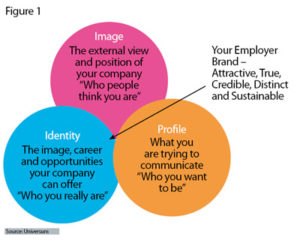
Qualities of a strong employer brand
The key to having a strong employer brand is to actively own it, basing it on EVP developed through in-depth research so that it is attractive, true, credible, distinct and sustainable to external and internal talent groups (see Fig 1).
For an MNC, having one overarching global EVP forms the foundation for the development of localised EVPs which correlate with varying talent preferences in different markets. The process of developing an EVP is not arduous, but the road to fostering a strong employer brand in the hearts of targeted talent pool requires a thought through, long-term and strategic process, aligned with the company’s business plan and talent strategy.
Benefits transcends attraction and retention
Benefits of owning a strong employer brand extend beyond talent attraction and retention. When we asked employers globally if they believed a reduction in investments in employer branding would result in higher recruitment costs per hire, six in 10 said ‘Yes’.iii
The business costs to not having a strong employer brand are apparent–over 4 of 10 suggested that they had lost business because they did not have the right people. Almost 80 per cent admitted that finding the right people is or will potentially be a problem, mostly because their targeted talent are unaware of them and their employer offerings, and that their employer reputation and image are not attractive enough.
If you have huge ambitions in India and beyond and you have not taken ownership of your employer brand, it is not too late to start now