Strong brands are the typical 800-pound gorillas. Their hulking presence is as eye-catching – but only as long as the element of entertainment is not forgotten by those seeking attention.
Often they get lazy.
Not always. But during one such rare a moment, a competitor brand spots them on the wrong foot, and dives-in for the kill. Chances are, once in many such-an-instance, a strong brand is caught unaware. It falls prey to a shrewd marketing strategy executed by a smaller, swifter brand. Think of a case of common cold turning into pneumonia. A lucky shot, but one worth the bullet for the smaller brand. However ‘cool’ the megabrand, being lazy costs it the crown. And once turbulence hits it at 20,000 feet, sea-level is a lesson only moments away.
Among the myths that circle around a widely recalled brand is that it is too big to fall. Actually, that is true. Precisely why, when it happens, the world takes note. Ask a globe-trotter of a baby boomer to pen down his partial list of powerful brands from the 1980s. Chances are, his list will include some or all of the following brands: Sony, Sears, Pan Am, Atari, Kodak, Microsoft, Polaroid, Coca-Cola, Disney, IBM, Oldsmobile, and TWA. Now ask yourself: why are some of these brands non-existent or only faintly recalled by buyers of today? They did not live up to the responsibility of remaining relevant as the years rolled by. They have become what we call ‘zombie’ brands – ones that exist on paper or are fondly remembered in an attack of nostalgia by buyers around the world, but come with no worthwhile products that can convince a demanding, young buyer in the 21st century to include them in his consideration set. Good news is – some of these brands still are worthwhile names for marketers around the world. Not solely for the lessons their failure tales have to offer, but for the value they hold in case their respective owners consider spending capital to get them walking and talking again. Then of course, fairy tale revivals are hard to come by.
PR disasters killed two legacy brands – what’s the cure?
How could an airline carrying over 17 million passengers a year, serving over 160 countries in six continents with its fleet of 230-plus aircraft during its peak in the 1970s fizzle out in a matter of just over a decade?
 Pan Am (Pan American World Airways) was one of the most respected airline brands in the Cold War era. It was for the Americans a sign of their supremacy in commercial aviation – the unofficial flag carrier of America. The famous image of The Beatles’ 1964 arrival at JFK airport on a Pan Am Boeing 707 flight is hard to forget for most Americans. So is the story of con artist Frank Abagnale who for four years (in the second half of the 1960s) fooled the world posing as a Pan Am pilot – as documented in his autobiography ‘Catch Me if You Can’. By the mid-1980s, the airline brand had won accolades for shaping the global airline industry due to the many innovations it introduced in air travel like the use of jet aircrafts, jumbo planes (most notably the Boeing 747s), and computerised reservation technologies that were considered beyond time. During the early 1970s, Pan Am’s aggressive advertising made the airline famous. Its trademark slogan, “World’s Most Experienced Airline,” won the hearts of all international fliers. From the advertising to the crew service – the airline was respected and won great recall through word of mouth. In fact, Jacqueline Kennedy Onassis (wife of JFK, and who later got married to Greek businessman Aristotle Onassis) always flew First Class on Pan Am while travelling between NY and Athens, despite being the co-owner of Olympic Airlines! So how did this Ritz-Carlton of the airline industry meet sudden death? Bad PR.
The energy crisis of 1973, downturn in air demand and negative political forces essentially weakened its financials. Its fame also won attention of the wrongdoers. Two terrorist attacks broke its reputation’s backbone – the 1986 hijacking of Pan Am Flight 73 in Pakistan (20 people were killed and 120 were injured), and the 1988 bombing of Pan Am Flight 103 in Scotland (that killed 270). The Gulf War reduced Pan Am’s flights to zero passenger flights and the company was declared bankrupt in December 1991. Since then, six attempts have been made to revive the Pan Am airline brand but all that survives today in the name of Pan Am is Pan Am Railways (owned by Guilford Transportation Industries that purchased the Pan Am brand in 1998).
Pan Am’s casual attitude towards spreading awareness about the levels of security it had introduced much before 1988 cost it its life. Such activity would not only have improved its perception in public eyes after the 1986 attacks but would have also discouraged terrorists who plotted the in-flight bombing of 1988. Not many know that the airline was actually one of the safest to fly in the whole world, being the only to have a customised security system installed called ‘Alert Management Systems’ way back in 1986. But not only did the airline forget to promote its new safety standards, it also decided to keep security at a minimum so as to not cause inconvenience to passengers and lose business. The airline did innovate by starting with the customers and working backwards, but it did not ensure enough branding for itself.
 After more than two decades of the death of the largest international US airline, one is still confident that unlike more recent brand shutdowns in the American aviation business (like Continental and Northwest Airlines), Pan Am’s brand is worthy of more attention. Why? It’s been 20 years since the company hasn’t serviced a single plane, but its blue globe logo is still flaunted on merchandise, and as recently as in 2012, it was the subject of a TV series on ABC! While speaking to 4Ps B&M from NYC, Mary van de Wiel, Brand Anthropologist (CEO of ZingYourBrand.com and Creator of NY Brand Lab) says, “Pan Am is a 20th century cultural icon. Pan Am still holds a sense of memory and a significance all its own. Long after the airlines closed its doors, the Pan Am brand still lives for glamour, adventure, and the thrill of the journey. A brand like Pan Am doesn’t just disappear from our consciousness. People hold Pan Am close to their hearts.”
Perhaps one of the big four airlines in US (Delta, Southwest, United and American) can strike a deal to acquire the Pan Am brand name and use it at a time when in US, airlines are back to making profits. The top 10 airlines in US made profits of $10.2 billion in 2011-12, with a historically high load factor of 82.8% [as reported by The US Bureau of Transportation Statistics; May 2013 data]. And with a brighter 2013 (expected net post-tax profits for FY2013 is $8.4 billion as per IATA’s December 2012 report), now seems to be the time to resurrect this Lazarus. Except, unlike two decades back, there has to be a tremendous PR and advertising exercise to precede and complement the effort this time around.
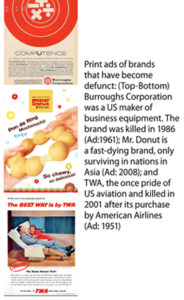
The story of Trans World Airlines (TWA) is similar. It was once the third-largest airline in the US domestic airline circuit. In fact, after Pan Am, it was the second unofficial carried of US and had a large European and Middle Eastern network. TWA brand met its end when the airline brand was merged with American Airlines in 2001. Because the airline was a flag carried for US with a huge European presence, and flew to Israel, TWA was frequently on the radar of Palestinian guerilla groups and was involved in five terrorist attacks between 1969 and 2001. The erosion of public trust in the TWA brand ensured that it would never see better days ahead. As such American Airlines decided to kill the brand altogether. So what went wrong for TWA? As per a study by Prof. H. Mueller of Ithaca College (titled, ‘Rewriting the Crisis Response’, pp.2), TWA lacked a “clear vision for handling a crisis and did not have an effective crisis response plan set in place for emergencies.” This “inefficient channel of communication caused the public to respond negatively towards the airline brand which hurt the overall success of the brand relationship between the airline and the public” (Duncan T., ‘Brands and Shareholder relationships’, c2008, pp.141).
 Today, the idea of reviving the TWA brand sounds a hard reality. Unless another investor like Carl Icahn (who initially bought over TWA in 1985) is found willing to invest in a cyclical industry such as the airlines by buying out American Airlines for a mighty $2 billion (if valued at $6 million over and above its current m-cap). But on AA’s part, there could be a partial revival to make the most of TWA’s legacy and increase its brand value. AA could rebrand its Admirals Clubs to (TWA’s erstwhile) Ambassador Clubs. Also, its Business Class could be rebranded to a TransWorld One and the AAdvantage could become TWAdvantage. AA could also launch TWA as a regional airline, starting with a fleet of MD80s or similarly sized aircraft possibly acquired from its parent with an initial route that could connect TWA with several cities in the Midwest, South and Northeast and some long distance routes to the West coast, with alliances forged with other carriers. In the long term, larger capacity planes like the A321s could be used and the successful (profitable) models on which jetBlue, Frontier and other LCCs operate could be replicated. AA has the cash to do that (its cash balance stood at $1.5 billion as on December 30, 2012). But AA would prefer considering pumping life into TWA only after it turns a profit (the airline recorded a loss of $3.9 billion between 2010 and 2012). With the airline expected to stop its bleed this year (expected EPS of $2.45 in FY2013 as per fundAnalyst estimate by Thomson Financial), such a move may not be unthinkable. Alternatively, AA could even consider selling the TWA brand in a multi-million dollar deal. Not choosing to do anything with the TWA brand will be wasting a name that took 75 years to build (until 2001).
In case of both Pan Am and TWA, the historical story telling model would work well to mark a revival. Both already have the global brand cache. Question is – are the owners interested?
How culture culled two technology brands – the unsettled master brands
The soul-touching philosophy of living and dying by a category has (almost) killed two brands that were once considered masters of photography. Most argue that it is the advent of digital photography that did the harm. Judging from a more true angle, the problem in reality was much deeper: It was the companies’ cultures.
More than ten years back (in 2001), after failing to improve falling sales, Polaroid filed for bankruptcy. Although the brand has found many interested buyers in the years following the bankruptcy filing (PLR IP Holdings owns it today), it has effectively killed itself over the years. Today, this pioneer of instamatic cameras is nothing more than a filter option on smartphones and tablets around the world. The brand waited until 2008 to switch to digital products and even the hiring of Lady Gaga as its creative director and launching of the Instagram-type app (called Polomatic) has helped it little. During the 1970s, the brand succeeded in impressing millions around the world for being the creator of a device that had the power to transform a blank, white paper into memories almost instantaneously. It became a fun brand. But with time, its association with artists started to turn counterproductive because of the changing profile of the very artists who were its biggest users. So while Polaroid continued to become popular, its credibility started to fall. It became growingly regarded as a frivolous and throwaway brand. A substitute to the normal film camera. The solution would have been to allow other camera manufacturers – like Canon, Kodak, Minolta et al – to embrace instant photography, perhaps charging them a royalty (like Qualcomm does in the CDMA business). But this is where Polaroid missed the plot. It took one candidate who was serious about instant photos (Kodak) to court and was unwilling to share its market with anyone. This killed the instant photography market. As such, when in the late 1980s, more conventional 35 mm cameras came to market, Polaroid started feeling the heat. The killer blow came from the advent of computers and digitised telecom devices that made photo sharing easy. In the end, Polaroid’s USP became its weakness. The brand association of Polaroid and instant imaging in the consumers’ minds turned out so strong that it was not accepted as a digital imaging product maker.
Polaroid can however still change perceptions, and offer itself as a logical and inevitable extension to instant photography. It should not focus on low-margin hardware. It should offer itself as a valued-service, time-tested license. More like a social-lubricant than a hardware manufacturer. Of the past for now, but with the right perception-altering strategies it can become the Qualcomm of photography. This brand deserves more than just a 1 cm-square space for its icon on your smartphone.
The problem with Kodak on the other hand was much simple. It became a common noun for conventional photography. In the early 1990s, it held a share of 90% in the world film market. Death of this brand was again a culture problem – a mindset of that of an ostrich with its head stuck in the ground, unwilling to see change coming. For over four decades, this brand was unmissable at the Grand Central Station in New York – the 16×18 foot Kodak Coloramas (photographs) personified what Kodak called ‘Kodak Moments’. But this popularity made its brand managers myopic. They forgot consumer orientation and assumed that buyers would see the products only the way Kodak wants them to. People who contest that Kodak missed the digital age of photography, can’t be farther from truth. Few know that Kodak was actually the inventor of the digital camera – and when? 1975! But it did not introduce the product in the market for fear of killing its cash cow – films. In the meanwhile, Canon, Sony and Nikon, rushed into the digital photography business in the mid-to-late 1990s, and shut the doors behind them on Kodak. This blind faith in marketing being superior to a product that suits the evolutionary needs of customers who are growing impatient by the hour killed Kodak.
 Where Kodak should start now is by asking itself the right question. It has already filed for bankruptcy and the only way is up. If Ford could wake up from a bad dream, so can Kodak. A worldwide launch of a handful of great digital imaging products, with the rightly positioned and geographically located imaging (marketing) show-studios and a tsunami of advertising will make life comfortable for Kodak. Here, Kodak can take some lesson from the books of Canon and Samsung. And the fact that it managed to sell its patents for over $525 million to new-age companies like Google, Apple, Facebook, Amazon, Microsoft, Samsung, Adobe and HTC this year only confirms that the brand has what it takes to wake up to the demands of a digitised world of imaging – value. Offering hope to Kodak, Peter Fisk, Founder CEO, GeniusWorks, while speaking to 4Ps B&M from London, says, “People still love great photos and Kodak as a brand is more associated with great photos than brands such as Fuji or HP, Sony or Samsung. So with the right business owner, the Kodak brand could be great again.”
How management compulsion killed the once-world number 2.
Once the world’s largest second-largest oil company (until 2001, when it recorded a topline of $51.13 billion), Texaco is today just one of many brands that pops out accidentally from Chevron’s pockets from time to time. The brand ran into legal trouble when it lost a three-year-long, $11 billion civil suit against Penzoil and filed for bankruptcy protection in 1987, after 86 years of operations. Since it was merged with Chevron in 2001, the Texaco brand has been killed in phases. First, it was exclusively licensed out to the Shell Oil Company for two years. When the contract ended in 2004, Chevron promised much in the name of revival of the Texaco brand. Today, very few people remember the red-coloured star T-name and logo. Strange it is to imagine that just a decade back, there were over 7000 gas stations in US that sported the Texaco logo. Starting 2005, Chevon started killing the Texaco name from its retail products. At present there are just about 20 gas stations in America that boast off this once revered brand. For Texaco, the brand died not because of any other reason but management compulsion. Post-2004, the merged company had to decide whether to invest in two brands or one. It chose the smaller, less-controversial Chevron. So why is it that the Texaco brand is still worth a revival? A 2009 study by the Oil Price Information Service (Lakewood, New Jersey-based), revealed that even after being literally dead for over seven years, the Texaco oil brand was able to fetch 2 cents more a gallon than competitors, and of the 45 branded retail oil brands, it was the no.1. More dollars at the pump is definitely because the Texaco brand still enjoys massive recall amongst today’s youth – both in US and overseas. Here is what Chevron could do. Get Texaco back on the shelves for a couple of years, invest bucks on promotion, and then instead of spinning if off into a separate brand, sell it to a willing suitor for a few billion bucks or give exclusive geographical (or global) rights to the oil brand to some other company. Either way, the Texaco brand will be reborn.
 unconventional. underutilized.
Napster which became a rage as a P2P music sharing platform when it started in 1999 was forced to shut down by the court in 2001 after the brand ran into legal tussles over copyright infringements (against the Recording Industry Association of America). Between 2001 and 2013, Napster’s ownership has changed hands twice. First Roxio acquired it in 2003 for $2.43 million. [Its brand and logos were acquired by Roxio, which rebranded its Pressplay music service as Napster 2.0.] In September 2008, US retailer Best Buy bought the Napster copyright from Roxio for a much higher $121 million. In December 2011, Napster merged with Rhapsody, and that hasn’t helped the brand much. For instance, logging onto the Napster website leads you to a page that is primarily Rhapsody’s! How the brand has been underleveraged can be understood from the fact that the main homepage has three mentions of an unknown ‘Rhapsody’, and just one mention of the brand name ‘Napster’! Napster has the potential of becoming a cult brand – it already has an image of everything not necessarily lawful and definitely unconventional. If a established record company like Sony BMG, EMI or Warner Music Group could pick up the Napster name and leverage the brand’s image amongst today’s ‘typically atypical’ youth, it could earn millions in the process. One buyout and quick advertising is all that Napster requires. Given its business, ATL advertising could come quiet inexpensive. Think social media!
a tough game to win
Atari is another brand that first hit global headlines 30 years ago when it launched the first videogame, ‘Pong’. Later, it introduced classics like ‘Space Invaders’, ‘Pac-Man’, ‘Missile Command’ and ‘Asteroids’. The brand grew weaker over the years because it failed to keep innovating in the fast changing landscape of the gaming world. In the 70s and 80s, the brand was the leading home console seller. Even a decade back, Atari was the highest selling brand of videogames in Europe, but since 2000, Sony, Nintendo and Microsoft have got the better of Atari.
At present, the brand is working double time to move from conventional retail games to digital games. It has also launched many titled for iOS and Android mobile platforms. But a total revival of the brand would perhaps require an outsider firm to put in some enormous efforts to introduce more titles and perhaps a slew of hardware devices. Of all the brands we have discussed so far, Atari’s revival is the most difficult as despite having a legacy and a brand recall, it has become oblivious to video gaming youth around the world. Atari was the player to pioneer elements like gaming cartridges and licensing in the world of video games. It shouldn’t forget that. Instead of going alone, Atari would do best to sell a stake in its brand to an established player and work towards the revival. [It should learn from its 1983 mistake when Nintendo had offered a partnership to get into the US market, that Atari refused.] Few marketers would contest the fact that the most valuable asset that Atari has today is the name and that three-striped logo. That the brand still has value is indicated by the fact that 18% of its revenues in 2012 came from selling merchandise ($11 million). What has not helped the brand is that in the past two decades, it has been juggled around like a hot potato, and none of its owners have actually invested in building the brand. The revival tale has to begin with a sign-up with a powerful publisher – like Activision. Might however be a difficult proposition given that Atari’s classic titles have today become bigger than the brand itself.
Strategy #1: Refocus on differentiation – Why did Oldsmobile become a defunct brand? Because by the 1980s, its customers did not see much difference between Oldsmobile and other brands that GM or Ford offered. If brands have to be revived, the first message that should follow the “I am back” voiceover is the line that explains why the new ‘Me’ is better and different than not just the old ‘Me’ but even the new ‘Them’.
Strategy #2: Refocus on competition – Why did Puma and Adidas got almost squeezed out of the European market in the late 1990s and early 2000s? Because they lost sight of what their competitors – Nike and Reebok – we doing. Revival of a brand does mean scanning what competitors are doing. Says William Frezza, a Forbes columnist to 4Ps B&M, “Such brands that sell sneakers, are all about branding. Why anyone would pay more than $40 for a pair of sneakers is totally beyond me.” This is what Steve Jobs did when he revived Apple in the mid-2000s. None of his best-selling products were his own innovation. He only packaged them better and branded them as the premium-priced, inedible Apples!
Strategy #3: Refocus on the right quality – Product quality improvement will not prove the magic wand that makes your brand relevant again! GM dedicated billions of dollars to infuse better product at Cadillac. This proved only part of the solution. Cadillac needed new marketing, design, and a bold departure from its historical image of a luxury car for the older generation. It was not a quick recovery for Cadillac but by looking beyond product quality. GM has successfully revived Cadillac to become a model for Lincoln Motor Company to follow.
Strategy #4: Refocus on change – Don’t change radically for the sake of it. Just because it’s a revival act doesn’t imply you need to change. The trick is for your brand to be relevant and distinctive. IBM is a very different type of business now then it was 100 years ago (it doesn’t sell computers for one thing) but the underlying brand promise of applied intelligence is still relevant to a business consultancy. Coke, on the other hand, is the same product but has been able to freshen-up and evolve its image and personality worldwide continuously.
Strategy #5: Refocus on media vehicles – Don’t forget social media. Often marketers dedicate the lion’s share of their ad budget to traditional forms of media like TV and radio and when it comes to social media, they assume that their Twitter handles and that lonely Facebook fanpage will do the trick. Wrong. If social media could help re-elect Barack Obama, it can revive a brand too. Social media helped revive Ford too. The small car sales in particular were aided by the social media dominance of youth. The Ford Focus, Fiesta, and other small economical cars used social media to leverage multi-media marketing. “Traditional TV and print advertisement were not as effective for the TG of those youth-oriented products,” confirms Art Wheaton, Director – WNY Labor and Environmental Programs, Cornell University ILR School, to 4Ps B&M. Social networks are the essential metaphor of our age, what assembly lines were 150 years ago.
Strategy #6: Refocus on the fact that ‘Consumers are fools’ – It is perception change that is required to get a dead brand walking again. Old Spice was starting to fade, but they did a great job of bringing it back to life by launching a great marketing campaign around 2 years ago. They also got rid of the image that it was “Your Dad’s or Grandfather’s cologne”, and targeted the new demographic of Gen Y (20 something’s) males with that new funny marketing campaign. Macy’s almost “went away” but seems to have done a good job at repairing their image. Skoda is another great example of a brand revived through change in consumer perception. Volkswagen having acquired the production facilities of the old communist brand, recognised that it still had many fans who had dreamed of a Skoda car in difficult times, and perceived it as strong and reliable (even if it wasn’t!). They reinvented and change the perception of the brand in the eyes of consumers for a new Europe, combining nostalgia with high performance and good prices. Today, the Skoda brand is the most profitable in the VW group. In case of revivals, “The buyer has to believe the ‘new’ product will be marketable – like Skoda cars,” says Zurich-based Dr. Frank-Jurgen Richter, Chairman, Horasis, to 4Ps B&M.
Final lesson
Run though the history of brands and you realise that in most cases when some 800-pound gorillas fell victims to the times, it was because they got lazy and imagined themselves on the top spot forever. No brand is immune from decline and failure. All airlines and computer firms have had to reinvent themselves via merger or by accepting a take-over – perhaps from a surprising buyer. IBM, once dominant as a vendor of massive corporate computers also entered the personal computer market and that branch was bought by a Chinese firm, Lenovo, which benefited from acquiring the IBM brand ‘ThinkPad’. DEC, a competitor of IBM, was bought by Compaq which later merged with HP and that joint operation has had a chequered history.
The market is full of brief flares. But those like Coke survive, often reinvigorating sales in countries that had banned them due to anti-American sentiment and subsequently being invited as a revival tool to stimulate local competitors.
Four elements are necessary for reviving ‘dormant’ brands. One, there must be a ‘truth’ about the brand which can be made appealing and relevant and sufficiently differentiated from what is on offer today. Two, there must be clarity about what type of consumer will find that truth most appealing. Three, don’t forget the modern media of promotion and advertising, as Andy Milligan, Founder, The Caffeine Partnership, tells 4Ps B&M, “a clever and consistent campaign to reach the consumers – this does not mean TV advertising, but a proper marketing strategy including social web.” And finally, a management team that ‘believes’ in the brand. Then, you just have to ‘get your break’.
As much as it is important for a zombie brand to focus on a revival, it is critical that it learns the art of remaining relevant. That can’t be taught, yet has to be mastered. One revival is altogether a difficult task. A second time, it would be better dead than walking.