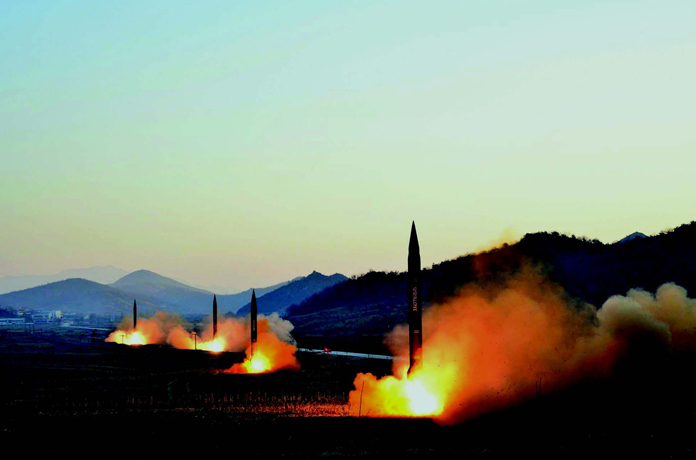
The missile tests frequently conducted by North Korea are part of a bigger game which China is playing to avoid international detection of its own series of new missiles developed by the Second Artillery of the PLA which need to be tested for validation.
China needs to test various range of new missiles it has developed over the last three years. President Xi Jinping after coming to power and consolidating his position in Chinese polity has found a new way to conduct tests.
China is using North Korea as a testing ground to avoid detection of its own activities and at the same time it is boiling up the strategic environment which it can use as a bargain chip against the US and Japan.
The Second Artillery has been renamed as the People’s Liberation Army Rocket Force (PLARF) in January 2016 and ever since China is trying to test a new type of short and medium-range missiles.
The PLARF is using sometimes Pakistan and North Korea, two closest allies, to count on validation of its missile systems. China is having long-range missiles but only two types of short to medium range in its arsenal.
Thus, China is using North Korea to test some of its own missiles along with North Korean programmes. China is also looking for miniaturisation of nuclear warhead tests in which both warhead and missiles should be in conformity.
China is worried that if Beijing does such tests openly and validates weapon parameters then many will oppose Beijing’s move and it can harm its national expansion plans such as OBOR.
North Korea which is testing series of missiles for the last two years is being supplied by China all the material including rocket engines, fuels, navigational equipment, and in exchange, Kim Jong-un’s regime is being paid a handsome amount of money.
But all is done to keep China’s strategic interests while deceiving the world. North Korea is paid by China but later it sends that money to Chinese companies who are the suppliers to North Korean programmes.
Last year when North Korea wanted to buy some electronic components from a European vendor China rebuffed such effort.
Subsequently, China was very unhappy with Kim’s step brother Kim Jong Nam who was living in Macao for some years as he came to know about Chinese payment for Kim Jong-un in relation to defence technology and some military testing facilities which were being hired by China.
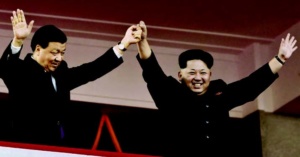
In fact, Kim Jong Nam, the half brother of Kim Jong-un, was killed in Malaysia last year after he came to know about the details of Chinese ministry of state security officials and Kim Jong-un’s relationship.
Indeed, among other missile programmes of North Korea, Hwasong 12 and Hwasong 14 both of which are under development, have strong bearing of Chinese technology suppliers.
Almost 15 Chinese companies have supplied spare parts and logistical support at a very hi-tech technological end to North Korea. Although North Korea does not have telemetry tracking system of its tests, Chinese companies based in Macao have provided that service after Kim Jong-un paid them a huge amount of money.
But bulk of the money was paid from the Kim Jong-un’s Macao account so there was no international tracking of such transfers. At the end it is Chinese money. The Macaobased companies who cooperate with North Korea have ties with Chinese companies in mainland China.
Even the PLA Rocket Force while restructuring its capabilities since 2016, has given certain access to private contractors of Chinese origin companies to sell spare and technology to its allies from outside China. Most of them are based in Hong Kong and Macao.
These entities are behind rapid success of North Korean missile tests. In fact, while China is using North Korea for its own end to test and validate some of its missiles, at the same time North Korea is using this opportunity to develop its own capacity against South Korea and Japan.
This suits China’s strategic containment programme of South Korea, Japan and the US. In December 2016, Taiwanese intelligence agencies had spotted that 11 trucks carrying high yield missile components and various technology and transportable missile silos had entered into North Korean border at night.
That day there was a blackout day for North Korean highways as no private or official vehicles were allowed to ply during the night time for a week at the border highways between China and North Korea.
This was to avoid detection and Chinese cooperation with North Korean missile capabilities. North Korea has also sourced almost 76 per cent hi-tech material import from China for the ICBM and other missile tests in recent time.
The NorTh KoreaN eNgiNe TesT iN March was reporTedly coNducTed aT The Tried aNd TesTed siTe of yuN soNg
The North Korean engine test in March was reportedly conducted in the city of Yun Song, where previous engine tests have taken place. Indeed, it has been observed that dozens of Chinese engineers and private contractors have been visiting near the North Korean site since February this year.
In fact, the city of Dandong, in China’s northeastern Liaoning province, North Korea runs a well networked transport facility and where most of the actions are taking place. While more than 5,000 Chinese companies do business with North Korea each year, North Korea allows some of them to ply trucks only during the night.
China has been behind Macau-based bank, Banco Delta Asia, which is a linchpin in the laundering of North Korean funds. Even the Dandong Hongxiang Industrial Development Company, and its subsidiary, the Liaoning Hongxiang Group are involved in North Korean missile programme.
Besides, Shenyang Machine Tools Company in northeastern China sent banned products to North Korea last September. Later under pressure China arrested 11 corporate executives of Hongxiang Industrial Development Company, including founder Ma Xiaohong, for exporting dual-use products that can be used in the production of chemical weapons.
However, China responded with denial just to save face. Similarly, China’s Limac Corporation and North Korea’s Ryonbong General Corporation established a joint venture in 2008 to mine tantalum, niobium and zirconium – materials that can be used in nuclear reactors and missile technology. The joint venture reportedly set up an office in Dandong. The business went on till 2015.
China is doing these tests through North Korea to achieve many strategic and operational objectives. It wants to keep North Korea as a strategic bargain chip against the US, Japan and South Korea.